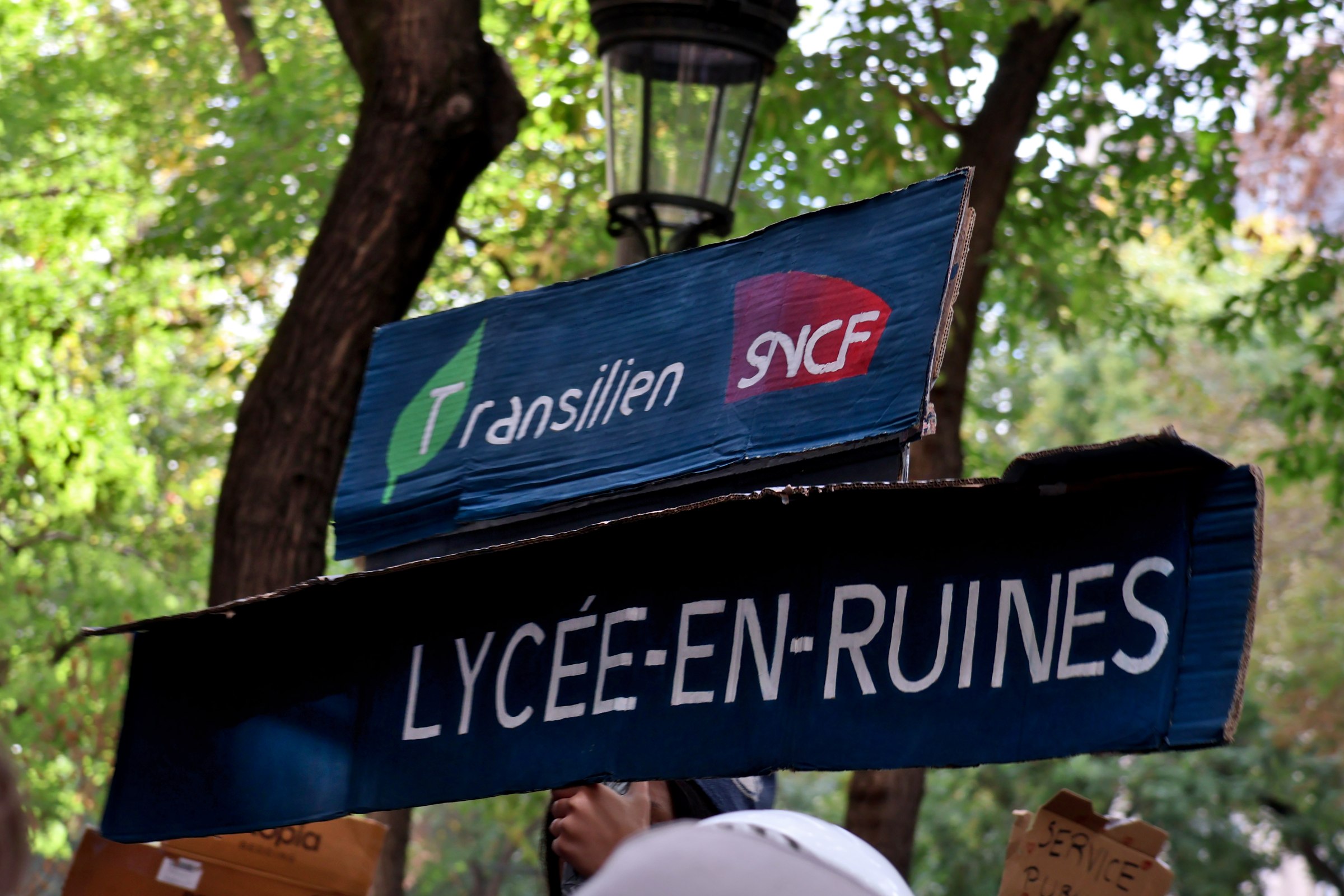
French teachers said on Tuesday, October 27, that the government’s education concessions would not meet protesters’ demands. The response came two days after Marine Le Pen opened her presidential campaign on promises to restore security. Further demonstrations are planned for October 31 and November 5.
Story in brief
- Le Pen launched her bid at the National Rally congress in Orléans, pledging restored border controls, automatic expulsion of foreign criminals, and a crackdown on gangs and drug traffickers. Jordan Bardella was re-elected party president and presented as her choice for prime minister.
- An appeals court in July upheld her embezzlement conviction but reduced the effective office ban to time already served. Her prison sentence includes a year under electronic monitoring; a further appeal can suspend its enforcement while examined.
- The government’s Monday package caps some high school classes at 28, lends four billion euros for school renovation, puts one billion into university campuses, and replaces the admissions system by 2028. The budget minister put the cost at five billion euros, to be offset by cuts elsewhere.
- Student leaders called the package a first step and vowed to continue. The next demonstrations are set for Saturday and a nationwide strike for November 5.
Launch in Orléans
Le Pen promised a hard line on immigration: restore border controls, automatically expel foreign criminals, and crack down on gangs and drug traffickers. Restoring security, she told the congress, is the state’s first duty. “We say: ‘Things were good before, they will be better tomorrow’,” she said, before leading the crowd in the national anthem. “The future belongs to us.”
On the economy she pledged spending restraint, lower business taxes, reduced bureaucracy, and support for industry, innovation, and artificial intelligence, and she rejected further increases in the retirement age. On Europe she stopped short of advocating a French exit from the European Union: she would roll back Brussels’ influence, restore national control over borders and laws, and keep France out of foreign wars.
The congress was built to show a settled ticket. Bardella was re-elected president of the National Rally and presented as Le Pen’s choice for prime minister. His speech was interrupted by activists from a Jewish student union, drawing attention to accusations that he made antisemitic comments in his youth, which he denies. Le Pen has spent more than a decade reshaping the party she inherited from her father, Jean-Marie Le Pen, in 2011, softening its image and broadening its appeal beyond its anti-immigration base.
Le Pen’s campaign also faces an unresolved legal process. A Paris court convicted her in March 2025 of embezzling European Parliament funds, imposing four years in prison, two suspended, a 100,000-euro fine and an immediate five-year ban on public office. On July 7, 2026, the Paris Court of Appeal upheld the conviction but reduced the ban to 45 months, with 30 suspended. She had already served the remaining 15 months. Her prison sentence became three years, two suspended and one under electronic monitoring.
She announced a further appeal to the Cour de Cassation. Le Monde’s account of the ruling says the appeal would suspend enforcement of the electronic-monitoring sentence while it was examined. Eligibility to stand and enforcement of a prison sentence are separate questions; the eventual campaign restrictions depend on the outcome of that process.
Concessions and their price
The protests began in September, when high school students blockaded schools over inadequate staffing and crumbling buildings. Trade unions and yellow-vest activists later joined the movement over public services and living costs. The government deployed 70,000 police and gendarmes for the October 24 demonstrations. Interior Minister Laurent Nuñez said there would also be a heavy security presence at the next protests.
On Monday, after student leaders met officials in Paris, the government announced its package: a commitment to cap the size of some high school classes at 28, four billion euros of loans for renovating schools, one billion euros of investment in university campuses, student grants increased with inflation, and 15,000 further higher education places. The university admissions system students call socially unfair will be replaced by 2028, with institutions required from 2027 to publish fuller selection criteria and explain rejections on request. “It’s clear we have to ease the pressure being felt in the education system,” Education Minister Edouard Geffray told a press conference. Budget Minister David Amiel said on TF1 that the measures were expected to cost five billion euros and would be offset with spending cuts elsewhere.
The government is also under pressure from bond markets to reduce debt, limiting its room to finance concessions. Reuters reported that the unrest had strengthened Le Pen’s position before the presidential election. A polling lead, however, is not an election result, and the timetable for the education changes extends beyond the coming campaign.
Movement that will not settle
The concessions were received as an opening, not a settlement. “Not all our demands were met. We’ll go on for as long as it takes,” Louis Letoublon, one of the high school student representatives, said after Monday’s meeting. Student leaders called the package a good first step and held to the protest calendar.
On Tuesday Sophie Venetitay, secretary general of the SNES-FSU teachers’ union, said more classes should be covered by the cap and more staff hired. “Today, what the ministry has said is only the beginning of a response,” she told reporters. “It will not be enough to extinguish the anger.”
Business is counting its own cost. Alain Di Crescenzo, head of the CCI France network of chambers of commerce, said many retailers had stayed closed as a precaution after the violence of October 17, with sharp falls in sales: “We have shopkeepers who are tired and demoralised, and we are killing local commerce.” President Emmanuel Macron, touring damage in Marseille, acknowledged there would likely be more unrest this weekend ahead of the bigger nationwide day set for November 5, and said he would keep security measures in place and work to move protests outside city centres.
Nuñez told RTL there would be a heavy security presence on Saturday, two weeks after nationwide protests gave way to violence and looting that brought curfews and bans on large gatherings in parts of France. Demonstrations are called for Saturday, October 31, and a nationwide strike and protests for November 5.
What happens next
The next demonstrations are planned for October 31, followed by nationwide action on November 5. The government must specify the spending cuts it says will offset the education package while negotiating next year’s budget. The promised admissions replacement is due in 2028, after the presidential election; its delivery will depend on the government then in office.
বাংলায় মূল প্রতিবেদন পড়ুন · Read the original Bengali report