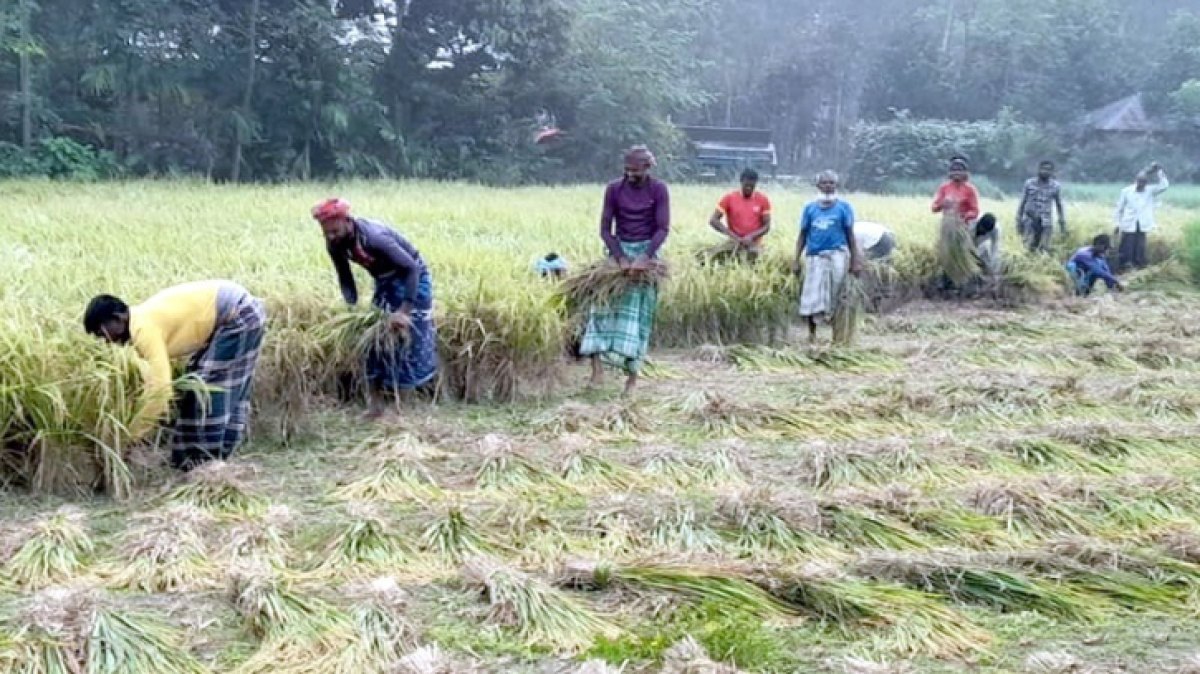
The harvest of early varieties of Aman rice has begun in Ghoraghat, Dinajpur district. After cutting the early Aman, farmers are preparing their land for early winter crops. They say production costs have gone up with higher prices of fertiliser, diesel and pesticides and higher labour costs, while yields have stayed the same as before.
Cutting of the early varieties began from the end of September and the first part of October, and will go on until the middle of October. The harvest of the main-season Aman will begin at the start of November.
With no major flooding or serious crop disease this year, the yield of early Aman has been good and as expected, to the farmers’ delight. But some farmers said their profit had shrunk somewhat because production costs had risen.
Nazir Hossain, a farmer in the Rameshwarpur village area of the upazila, said he had grown the early variety Bina-7 on ordinary high land where water never stands. He grew it on two bighas.
He said the early Aman yields two to three maunds less per bigha, giving 16 to 18 maunds a bigha. This year it cost Tk 14,000 a bigha to grow, against Tk 12,000 last year. “After cutting the early Aman I am getting ready to grow early winter vegetables on the land,” he said, adding that he would also grow maize.
Moju, a farmer in Kashigari village of the upazila, said that although early Aman yields a little less, after the harvest early winter greens and maize can be grown on the land, which brings farmers a profit. “The yield has been good this time, but we are frustrated because production costs have gone up,” he said.
Upazila agriculture officer Rafiquzzaman said the target for Aman cultivation in the upazila’s four unions and one municipality is 17,350 hectares in all, of which 500 hectares were set for early varieties. Despite some drought and lack of rain at the start of the season, the fields are in good condition and local farmers and the agriculture department expect a bumper harvest.
He said the early Aman crop had met expectations this year because floods had less effect. After cutting it, farmers grow maize, potatoes, early vegetables and a range of other winter crops, he added.
বাংলায় মূল প্রতিবেদন পড়ুন · Read the original Bengali report