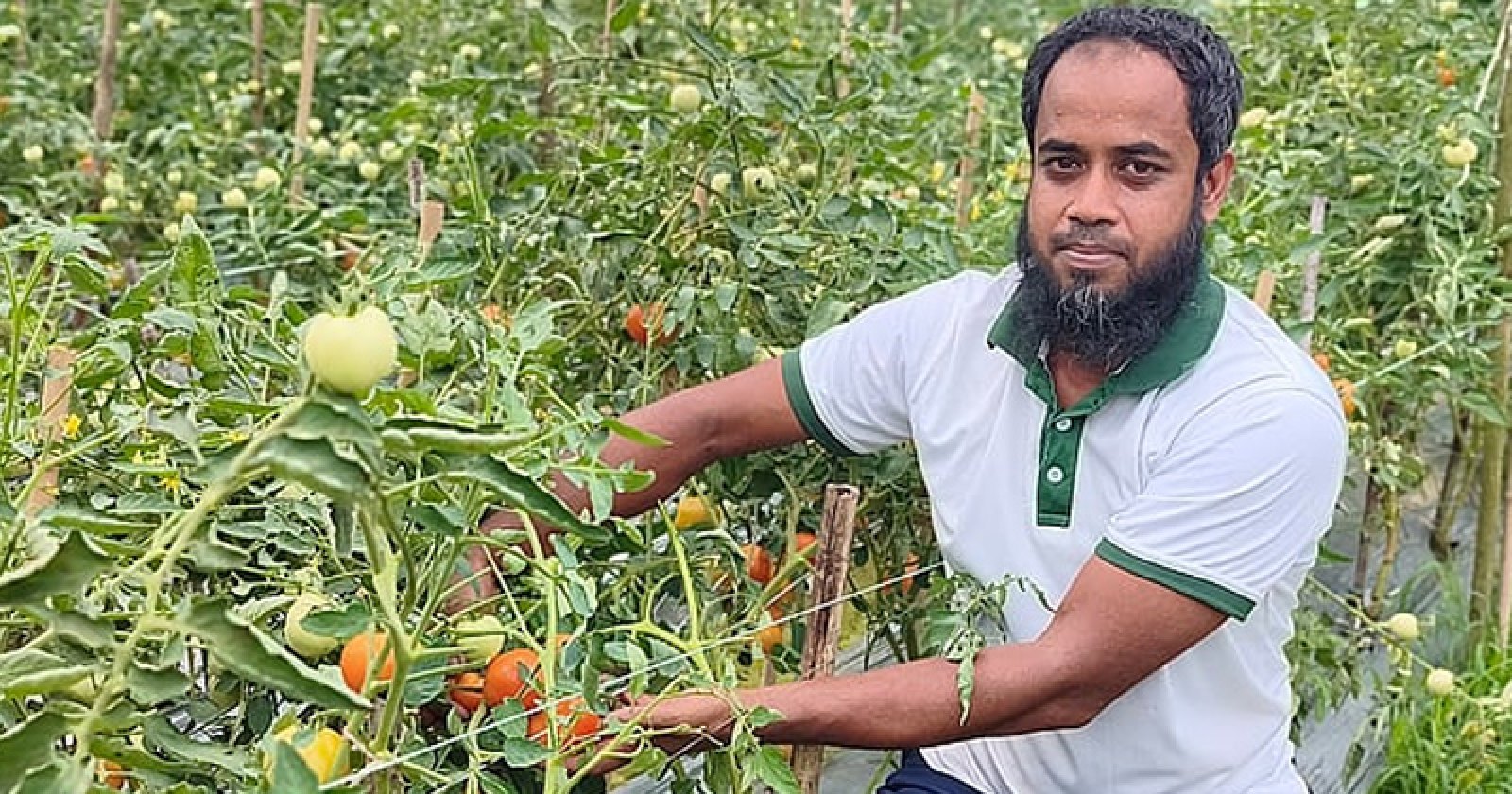
A few years ago 80 decimals of land lay idle, covered in scrub and weeds. Thanks to one businessman’s determination it is now bearing fruit. Abdul Matin, 35, a local shopkeeper, has surprised his neighbours by turning fallow land into a productive field. Alongside his main business, this chemical-free vegetable garden has become a reliable extra income that has changed his life.
In 2022 Matin decided to make use of 20 decimals of his family’s uncultivated land beside his house. Seeing another 60 decimals belonging to a neighbour lying idle, he widened the plan, leased it for Tk 25,000 a year and, on the advice of the agriculture department, began preparing the ground.
The first time, he grew tomatoes, green chillies, aubergines and coriander with a local farmer, Tajul Islam, on Tk 40,000 of capital. The first season brought in Tk 1,60,000. That unexpected success raised his confidence many times over, and from 2023 he went into farming on a larger scale on his own. Running the shop and the farm together is hard, but he has not lost focus. He goes to the field straight after the dawn prayer, works there until 9:30am, then goes home to bathe and eat before opening the shop. He has also hired a permanent worker on Tk 15,000 a month for the daily care of the crops.
The garden has given a local man a job. To avoid losses from rain and weather, Matin has turned to modern farming methods. The first time he planted straight into the soil, but rain washed the soil away and caused various problems, so the second time he changed his method. He now uses mulching paper to protect the soil’s nutrients, shade net to control the temperature, and grafting to grow tomatoes in summer. The vegetables are grown mainly with organic fertiliser, without chemical pesticides, so his produce is in greater demand at the market than that of any other field.
His field now has tomatoes on 30 decimals, bottle gourds on 20, cucumbers on 15 and yellow watermelons on 15. Matin says the modern methods have raised his costs, to about Tk 1,50,000 a season. In summer he grows grafted tomatoes along with watermelons, cucumbers, bottle gourds and bitter gourds; in winter, bottle gourds, tomatoes and potatoes. On prices and income, he said his tomatoes sell at Tk 110 a kilo, cucumbers at Tk 35 and bottle gourds at Tk 100 to 120 each. Having sold Tk 1 lakh of vegetables this year up to August, he expects to sell another Tk 2.5 to 3 lakh before winter.
“The land was lying useless, so I put it to work,” said the farmer-entrepreneur Abdul Matin. “The vegetables meet our own household’s needs, and I give some to my two brothers’ families too.”
He said some local wholesalers buy vegetables from him, and he also keeps some in front of his shop, where many people buy a kilo or two. The vegetables are sold before they reach the market. Alongside the business, it has become a source of extra income.
Matin has planted fruit as well as vegetables: mango, black plum, jackfruit, lychee and guava of various kinds on two bighas of his family’s land near the house. He has expanded his farming step by step by putting fallow land to use.
Matin said he uses mostly organic fertiliser and hardly needs pesticides. Tomatoes, bottle gourds and cucumbers are usually winter vegetables, he said, but in summer both demand and prices for them are higher, which is why he grows them in the summer season. His success has caught the attention of ordinary people and of the agriculture department.
Inspired by it, the upazila office of the Department of Agricultural Extension held a day-long workshop in Matin’s garden on 24 August to train local farmers.
Md Mahmudul Alam Khan, the Juri upazila agriculture officer, said: “Matin is a shining example of how, with will, the right work and modern care, even fallow land can bring great profit. He is now an inspiration for the whole area. The small dream he sowed on uncultivated land has become an example of a ‘green revolution’ for the whole upazila.”
বাংলায় মূল প্রতিবেদন পড়ুন · Read the original Bengali report