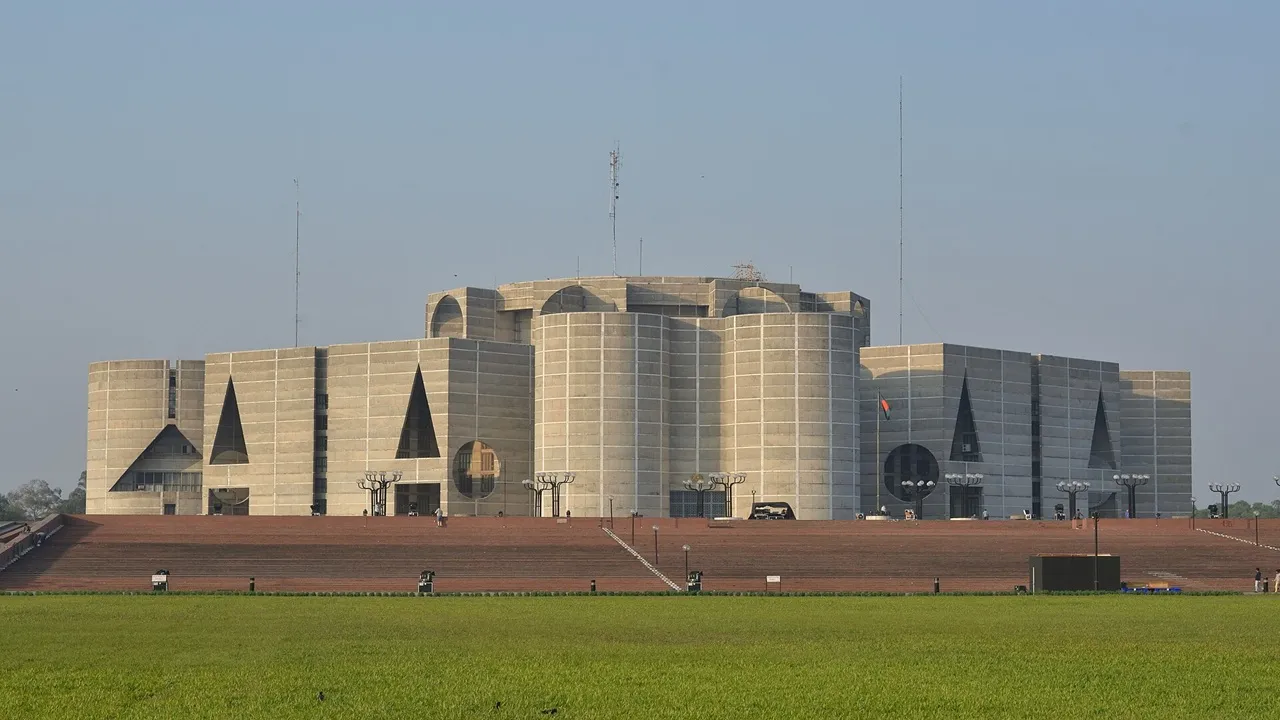
The special committee on amending the constitution has received a new “idea” on how an election-time caretaker government could be formed. It came up on Saturday when the committee met constitutional experts, law professors and Supreme Court lawyers. The meeting discussed whether, if parliament has two houses, the caretaker government could be formed from the upper house. The outline of the caretaker government system has not yet been finalised.
Home minister Salahuddin Ahmed, who chairs the special committee, told journalists this after the meeting. The meeting began at 11am in the cabinet room of the parliament building and, with an hour’s break at midday, ended at about 5:30pm. In all, 44 people took part.
According to sources, proposals at the meeting included: a separate secretariat for the judiciary; a balance of power between the prime minister and the president; making the Anti-Corruption Commission and the Human Rights Commission constitutional bodies; widening fundamental rights; a 4-year term for the lower house and a 6-year term for the upper house; an upper house drawn from the 64 districts and from members of different ethnic communities; direct elections to the reserved seats for women; a neutral search committee for appointments to constitutional bodies including the Election Commission; and handing administrative control and discipline of lower-court judges to the judiciary.
Some, however, questioned whether a country like Bangladesh needs an upper house at all, and proposed an advisory council instead. Some also proposed that, besides committees such as public accounts and public undertakings, the parliamentary committees on the foreign and home ministries be chaired by the opposition, and that a law be made under Article 76 of the constitution to strengthen parliamentary committees. Sources said the meeting also discussed whether a ruling of the higher courts amends the constitution directly. Most said that in such cases parliament must write the ruling into the constitution as an amendment.
The caretaker system
After the meeting, Salahuddin Ahmed told journalists there had been a detailed discussion of how a caretaker government would be formed and what it would do, and that a new “idea” had come up. He described it.
The idea is this: if an upper house of parliament is formed, its term would not end with that of the lower house. The meeting discussed whether the caretaker government could be formed from the upper house. If the post of vice-president is created, it was proposed that the vice-president serve as speaker of the upper house. An alternative put forward was that the upper house’s speaker be elected with the agreement of the ruling party and the opposition. There could be a provision for that speaker to head the caretaker government, with the other advisers also appointed from the upper house with the agreement of the ruling party and the opposition.
Salahuddin Ahmed said such views had been expressed and could be considered. If more proposals come, the committee will set them out in its report. Everyone has been asked to give their views in writing.
He said everyone agreed the caretaker government should be formed by consensus, keeping the judiciary and the president out of it. The discussion of this was “theoretical”. The committee said written views on how to form the caretaker government would help, and it would look at each of them. The committee wants the caretaker system settled through agreement.
Notes of dissent
Asked whether, after the talks with stakeholders, there would be concessions where the BNP has a “note of dissent”, Salahuddin Ahmed said no such decision had been taken yet. He said they were calling on the opposition: if the opposition wants the BNP’s note of dissent relaxed on some points, it must come to the committee and say so. The committee could then consider it.
He said the meeting also discussed constitutional and statutory bodies. The committee wanted to give a new definition, a “statutory constitutional board”. It discussed how statutory bodies are formed, what they do, and whether there is a way for them to work independently. The experts also gave their views on the basic structure doctrine of the constitution, the judiciary’s power to review executive and legislative action, and the judiciary’s jurisdiction over constitutional amendments.
On a separate secretariat for the Supreme Court, Salahuddin Ahmed said the government is committed to it. But the ordinance issued by the previous government had several flaws, so it was not made into law. A separate secretariat is under discussion in the committee.
“Reaching the goal is what matters”
Earlier, leaving the meeting at midday, Professor Asif Nazrul, law adviser in the former interim government, told journalists that he had also spoken at the parliamentary committee on amending the constitution led by Suranjit Sengupta under the Awami League in 2011. He went to that meeting with high hopes but later felt cheated. This time he hopes for good change. He “appealed” to everyone to keep in mind the expectations of the mass uprising.
Asif Nazrul said the caretaker system should be settled on the basis of the opposition parties’ views. He and some others called for the opposition to be brought into the process. The committee said it had tried in many ways to do that.
Asked a question, Asif Nazrul said whether there should be a constitution reform council or a constitution amendment committee is a political dispute, and he did not want to enter it. Personally, he believes any change to the constitution is a reform if it is a positive one. What matters more, he said, is whether the goal is being reached.
Others at the meeting included Professor Salimullah Khan, Professor Muhammad Ekramul Haque, Professor Borhan Uddin Khan, Supreme Court Bar Association president and MP AM Mahbub Uddin Khokon, the association’s secretary Mohammad Ali, and senior lawyers Shahdeen Malik, Ragib Rouf Chowdhury, Subrata Chowdhury and Manzill Murshid.
Committee members at the meeting included chief whip Nurul Islam Moni, law minister Md Asaduzzaman, Zainul Abedin, state minister for planning Zonayed Abdur Rahim Saki, Mir Mohammad Helal Uddin, state minister for social welfare Farzana Sharmin, and Shakila Farzana.
বাংলায় মূল প্রতিবেদন পড়ুন · Read the original Bengali report