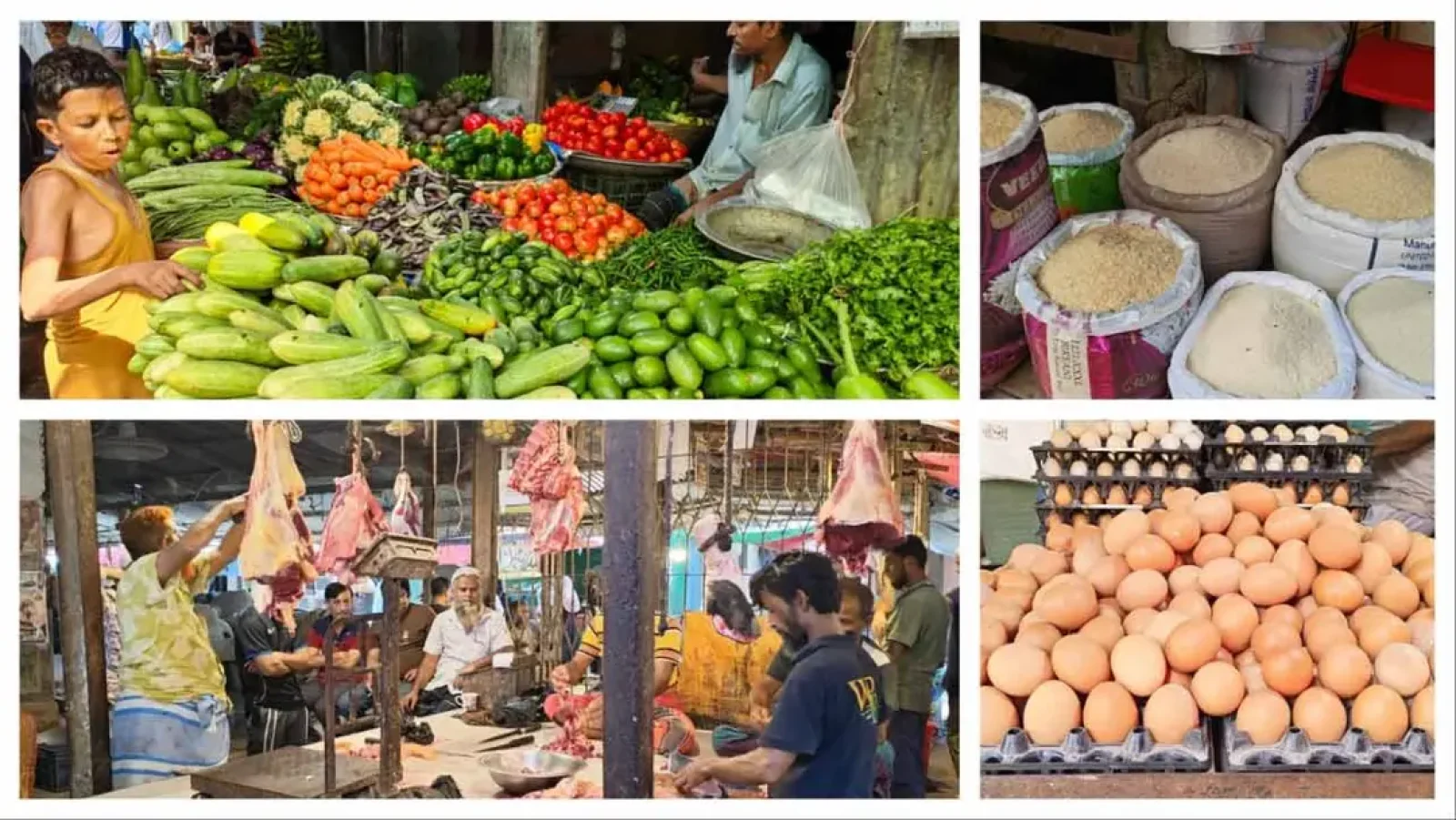
Vegetable prices have fallen in Brahmanbaria as early winter vegetables start reaching the markets in the last week of the month. Over the past week, prices of various vegetables have dropped by Tk 20 to Tk 40, and fish by Tk 20 to Tk 50 a kg, bringing some relief to shoppers. But while vegetables and fish have eased, prices of rice and of broiler, layer and Sonali chickens have gone up. People spend a little less on vegetables and fish but have to pay more for other everyday food, which is putting extra pressure on the monthly food budgets of families on limited incomes in particular.
That was the picture on Friday morning (October 23) at Ananda Bazar, Jagat Bazar, Medda Bazar and Kautali Bazar in Brahmanbaria town. Wholesalers were bringing in vegetables from different areas, and retail shoppers were out in numbers. Compared with last week, cauliflower, cabbage, radish, green chillies, bitter gourd, coriander leaves, tomatoes and bottle gourd have all become cheaper.
On the other hand, shoppers and traders said the price of rice had risen by Tk 70 to Tk 450 per 25 kg sack in a week, and broiler chicken by Tk 30 a kg.
Vegetables cheaper
A cauliflower that sold for Tk 60 last week now sells for Tk 40. Cabbage has fallen from Tk 60 to Tk 40. Per kg, pointed gourd has dropped from Tk 60 to Tk 40, green chillies from Tk 120 to Tk 100, okra from Tk 90 to Tk 70, long aubergines from Tk 80 to Tk 60 and hybrid cucumbers from Tk 100 to Tk 70.
Bitter gourd has also come down from Tk 90 to Tk 70 a kg, coriander leaves from Tk 100 to Tk 70 and tomatoes from Tk 120 to Tk 100. A bottle gourd that sold for Tk 70 to Tk 100 last week can now be had for Tk 50 to Tk 60, depending on size.
Fish and eggs cheaper
Fish prices have fallen as river water recedes in the dry season and fewer shoppers come in the last week of the month. Rui, which sold for Tk 350 a kg last week, is now Tk 320. Catla has dropped from Tk 400 to Tk 350 a kg, grass carp from Tk 320 to Tk 290, carpio from Tk 300 to Tk 280, pangas from Tk 220 to Tk 200 and tilapia from Tk 220 to Tk 200.
Eggs have also become Tk 4 to Tk 5 cheaper per four over the past week. Brown chicken eggs have fallen from Tk 50 to Tk 46 for four, duck eggs from Tk 64 to Tk 60 and local deshi chicken eggs from Tk 85 to Tk 80.
Shoppers buying vegetables and fish showed some relief at the lower prices. But a family’s total daily market spending also depends on the prices of rice, lentils, oil, fish, eggs, meat and other goods.
Rice and chicken cost more
While vegetables have become cheaper, several other everyday foods have gone up. Broiler chicken sold for Tk 150 a kg last week and for Tk 180 on Friday, a rise of Tk 30 a kg in one week.
A 25 kg sack of BR-28 rice cost Tk 1280 last week and now costs Tk 1350. BR-29 rice has risen from Tk 1250 to Tk 1330, Nazirshail from Tk 1700 to Tk 1800, Kataribhog from Tk 1950 to Tk 2150 and Miniket from Tk 1600 to Tk 1750. The steepest rise is in seasonal Boro rice, from Tk 2350 last week to Tk 2800 now.
Prices that held steady
In Brahmanbaria, beef sells for Tk 750 a kg, buffalo meat for Tk 800 and goat meat for Tk 1200. Per kg, onions cost Tk 45, local garlic Tk 80, Chinese garlic Tk 160, ginger Tk 140, local red lentils Tk 150 and coarse red lentils Tk 100. A five-litre bottle of soybean oil sells for Tk 1000, loose soybean oil for Tk 208, Diamond potatoes for Tk 20 and local potatoes for Tk 35 a kg.
Pressure on low and middle-income families
When the prices of essentials rise, people on limited incomes are hit harder, because a large share of what they earn goes on food. They are struggling to meet the cost of necessities such as rice, lentils and meat. Cheaper vegetables help a little, but with rice dearer, overall spending is not falling, and making ends meet on daily essentials is getting harder.
Abdullah, a teacher buying vegetables, told Dhaka Post that everything in the market is out of reach. “Vegetables are cheap for now, but we are struggling to buy everything else,” he said.
Nihar Ranjan Sarkar, who came to buy fish, told Dhaka Post that fish was a little cheaper than a few days ago. “But prices never fall as much as they rise. That makes it hard for low-income families like ours to get by,” he said.
Rais Mia, buying vegetables at Medda Bazar, said the market was in turmoil. “We are a middle-class family, and the days of eating our fill are over. If we can buy vegetables, we cannot buy fish; if we can buy fish, we cannot buy meat,” he said.
Shiplu and Wasim Mia, fish traders at Ananda Bazar, said there are fewer shoppers in the last week of the month. With river water receding, demand for farmed fish is also low, so prices are down, they said.
Rashed Mia, owner of Allahr Dan Enterprise at Ananda Bazar, said chicken prices were rising because viral disease causes more losses in poultry as the winter season sets in.
Probash Uddin of Messrs Jalal Enterprise at Ananda Bazar said rice prices had gone up because old rice stocks are running out at this point in the season and old rice is in high demand.
Vegetable seller Md Mahbub said prices were falling because there are fewer buyers than usual and production of winter vegetables has increased.
Iftekharul Alam Rizvi, assistant director of the Department of National Consumer Rights Protection in Brahmanbaria district, did not answer several phone calls seeking comment.
Shoppers say that while vegetables and fish offer temporary relief, the abnormal rise in the price of staples such as rice is upsetting the daily budgets of middle and low-income families. Whatever little they save in one place is eaten up by extra costs elsewhere, leaving them short at the end of the month. They are calling on the authorities to monitor markets regularly and firmly to stop syndicates, keep supply chains running and end manipulation by dishonest traders.
S M Shaheen, general secretary of the Brahmanbaria district unit of the Consumers Association of Bangladesh (CAB), told Dhaka Post that although winter vegetables and fish have become a little cheaper, the abnormal rise in the prices of basic foods such as rice and chicken is a matter of grave concern. “Just before the new rice arrives, syndicates are creating an artificial shortage of old rice to push prices up. This is putting severe pressure on people with low and middle incomes,” he said.
“Raids on retail markets alone are not enough; monitoring must be stepped up at the rice mills and the wholesale depots. We strongly urge the district administration and the Department of National Consumer Rights Protection to keep up regular, strict monitoring of the markets to stop manipulation by dishonest traders,” he added.
বাংলায় মূল প্রতিবেদন পড়ুন · Read the original Bengali report