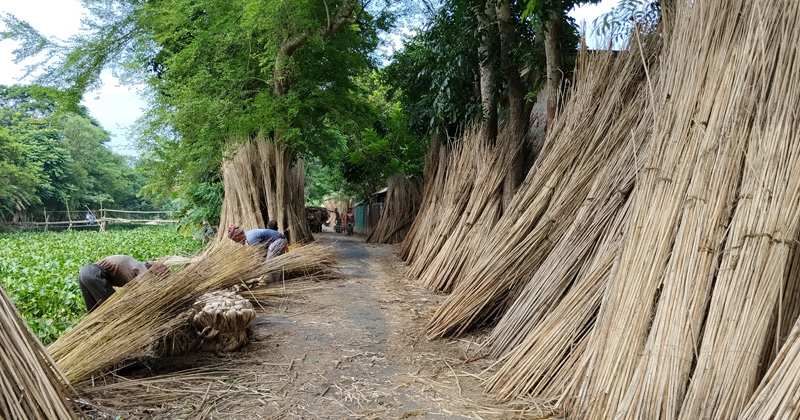
Jute sticks, once left to waste after the fiber was stripped away, had limited use as cooking fuel, fencing material or in building betel-leaf plantations. Over time, that picture has changed. Jute sticks have now become one of the extra income sources for farmers.
Commercial buying and selling of jute sticks is now underway across various parts of Faridpur. Traders collect them from the fields and take them to different markets and industrial enterprises. As the uses for jute sticks have multiplied, so has demand. Besides fuel, jute sticks are now used for betel-leaf plantations, house fencing and building agricultural trellises. Various factories also use jute sticks to produce charcoal and other products, adding to their commercial importance.
A tour of different upazilas in Faridpur found that after cutting jute and stripping the fiber, farmers dry the sticks in the sun and bundle them. Once dried, local traders and wholesalers buy the sticks either from the farmers’ homes or at designated markets. As a result, farmers earn extra money from jute sticks alongside the jute fiber itself.
Alim, a jute farmer from Chandani village in Gunbaha union, Boalmari upazila, said: “Before, jute sticks didn’t fetch much of a price. A lot of the time they’d just be left in the field. Now traders come to our homes and buy the sticks. Selling the sticks along with the jute brings in some extra money, which helps farmers.”
Abu Sheikh, another jute farmer in the same union, said: “The cost of growing jute has risen a lot. Even when the jute price isn’t what we hoped for, selling the sticks helps make up some of the loss. So now, instead of leaving the sticks lying around, we dry them properly and store them.”
It’s not just farmers who benefit — the jute-stick trade has also created a new line of business locally. Traders collect jute sticks from various areas and sell them to wholesale buyers and industrial enterprises.
Md Hasan Molla, a jute-stick trader from Jhenaidah, said: “Demand for jute sticks is much higher than before. We buy from farmers and supply to various places. Because of the demand, more people are getting into this business.” Another trader, Ramzan Biswas, said: “Buyers of jute sticks now aren’t just local people. Various industrial enterprises and large traders are buying them too. So during the season, we try to collect jute sticks from various places, paying farmers 300 to 400 taka per hundred bundles.”
Ibrahim Hossain, a local buyer, said: “I used to use jute sticks only as fuel. Now they’re used in many ways. Dry, good-quality jute sticks are especially in demand.”
Kalipada Chakrabarty, a retired headmaster of Moyna Government Primary School in Boalmari upazila, Faridpur, said: “If the jute-stick market expands further, farmers will be able to earn good income from this byproduct alongside jute itself. That will boost farmers’ interest in jute cultivation and create new potential for the rural economy.”
Alvir Rahman, the agriculture officer for Boalmari upazila in Faridpur, said: “There’s no longer any reason to see jute sticks as waste or a discardable product. With proper storage, marketing and greater industrial use, it can become an important source of extra income for farmers. Faridpur is already showing that potential, with commercial use of jute sticks and demand for them on the rise.”