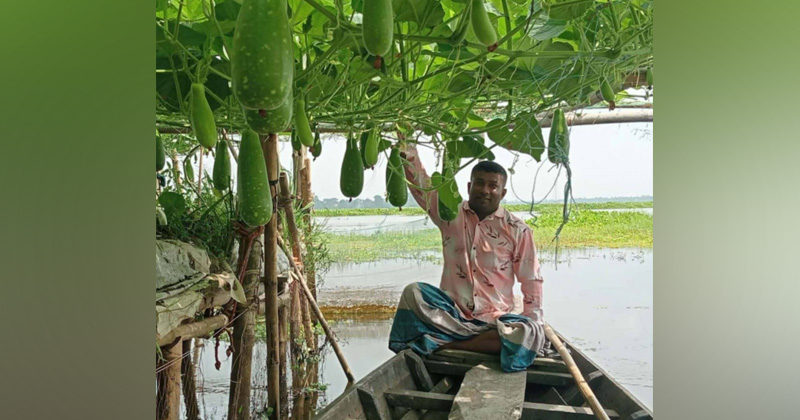
In Brahmanbaria’s Nabinagar upazila, floating “dali”-method vegetable farming is gaining popularity as a way to make use of land that sits waterlogged and fallow during the monsoon. Conventional cultivation is impossible on land submerged for four to five months of the year, but modern techniques are opening new possibilities for farmers. Interest is growing as farmers see the chance to turn previously unproductive, flooded land into a source of production.
In Nabinagar upazila, an area dominated by haors and wetlands, roughly 8,500 hectares of farmland remain waterlogged for extended periods during the monsoon. While these lands produce boro rice and other crops during the rest of the year, most sit fallow once submerged in the rainy season — long a challenge for farmers. To address it, floating cultivation has been introduced to bring waterlogged land into production.
Farmers in the upazila’s Ibrahimpur, Natghar, Rasullabad, Barikandi, Salimganj, Nabinagar East and Satmora areas have been growing vegetables using the floating dali method on the advice of the agriculture department for the past two years. This season, about 20 bighas of land have been cultivated using the method.
Government support has been provided to farmers under the Department of Agricultural Extension’s ongoing FRIP program and the Sustainable Agricultural Technology Extension Project in the Cumilla region. More than 200 farmers have also been trained in the floating dali cultivation method. Under this system, a raised bamboo-frame platform is built on which various vine-type vegetables are grown. Bottle gourd, ash gourd, cucumber and bitter gourd, among other vegetables, yield well using the method. During the monsoon, when vegetable supply in the market typically falls, farmers can earn extra income by selling produce grown this way. Once the rainy season ends, the same structures can be reused to grow vegetables directly in the soil, significantly cutting farmers’ future production costs.
According to local farmers, this method sees comparatively less disease and pest infestation and requires no separate irrigation, creating an opportunity for low-cost, safe vegetable production on waterlogged and fallow land. Because the floating method uses less chemical fertilizer and pesticide, farmers say the produce also tastes noticeably better.
Ismail Mia, a farmer from the Modhya Para area of Ibrahimpur village, said: “I’ve been growing vegetables using the floating method on the agriculture department’s advice for two years now. Before, I had no opportunity to grow vegetables for two to three months of the year. Seeing my results, many others in the area are getting interested too.”
Sujon, a returnee from working abroad who lives in Ibrahimpur South Para, cultivated bottle gourd on 25 decimals of land last year using the floating dali method for the first time, with advice and training from the agriculture department. He first got interested after seeing the method on YouTube and contacted the upazila agriculture office. With the office’s help, he has already started growing kalmi shak (water spinach), cucumber and bottle gourd, and has earned about 30,000 taka so far.
“Good yields and low disease incidence mean farmers’ interest in this method keeps growing,” he said.
Emran, a farmer in Rasullabad union, has grown bottle gourd and ash gourd on 20 decimals of land. Growing vegetables on land submerged during the monsoon once seemed like a dream to him, but with the agriculture department’s help, it has become reality. He has cultivated bottle gourd on 15 decimals using the floating dali method and has already sold about 15,000 taka worth of the crop.
He said he expects to keep harvesting bottle gourd for another two months.
Nabinagar Upazila Agriculture Officer, agriculturist Md Jahangir Alam Liton, said: “Floating-method vegetable cultivation has been introduced in Nabinagar for the first time. Alongside hands-on training for farmers, we are supporting them by setting up demonstration plots, building floating structures, and providing seeds and fertilizer.”
He added: “Floating cultivation is a promising technology for safe agricultural production. It allows low-cost vegetable production using waterlogged and abandoned land. Vine-type vegetables in particular yield well with this method. There is significant potential to expand this technology across Nabinagar’s waterlogged areas in the future. Floating vegetable cultivation on Nabinagar’s waterlogged land isn’t just creating extra income for farmers — it’s playing an important role in safe vegetable production during the monsoon, making the best use of fallow land, and boosting vegetable supply in local markets.”