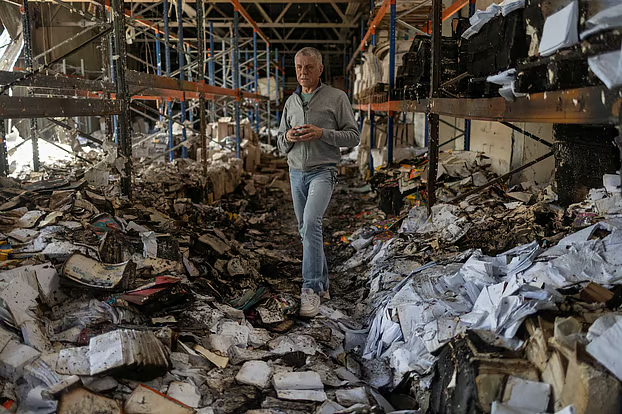
Victoria Haidai stares blankly at the printing house. It was supposed to be a hive of activity ahead of the new school year. Now nothing remains but rubble.
The printing house, on the outskirts of Kyiv, was flattened by a Russian missile strike. At the time of the attack, printing of 1.3 million books for the new school year was in full swing — a figure representing roughly 10 percent of all textbooks used in Ukraine’s schools.
Amid the ash and rubble of the printing house lay a charred page from an English-language textbook. It read: “My name is William. My home is in the UK. My grandmother lives in Nottingham. It is a beautiful city.”
Russia has recently been carrying out a sustained series of attacks on printing houses and publishing companies across Ukraine. These attacks have destroyed 12 million books. Various important sites tied to Ukraine’s history and culture have also been damaged. Local media reports say Russia has destroyed a third of all books printed in Ukraine this year.
Nothing at that Kyiv printing house is salvageable anymore. Even the pages of books that survived the fire have been ruined, either by firefighting water or from being left out in the open.
Haidai, commercial director of the publishing house Konvir, said: “I believe Russia is doing this deliberately. Over the past two months, the supply depots of several of the largest publishing houses have been destroyed in attacks. These depots held huge stocks of books.”
Haidai said: “Russia has tried to erase the Ukrainian nation from history. That’s why they are destroying the printing houses. But honestly, they will not succeed.”
More than 35 publishing and printing facilities across Ukraine have been attacked in recent weeks. New books haven’t been the only target — Kyiv’s old book market has also been hit. Hundreds of stalls and countless valuable books were destroyed.
Before firefighters at the Kyiv printing house could finish putting out the blaze, 28-year-old book blogger Lilia Velyka arrived at the scene. She was making a last attempt to rescue some books, clearing away still-burning debris. In her hands was a soaked science-fiction novel.
Lilia said: “Books keep us alive. Losing them is like losing our hearts.”
Various museums, art galleries, film studios, libraries and opera houses across Ukraine have also suffered severe damage in the war.
Ukraine’s culture minister, Tetiana Berezhna, said: “Russia is targeting the symbols of our long history and our cultural heritage.”
Tetiana said that since the war began, Russia has attacked more than 1,900 heritage sites and more than 2,000 cultural institutions in Ukraine. Given this situation, emphasis is now being placed on digital technology to keep art and literature alive and to keep children’s education going.
Those involved warn that Ukraine’s entire publishing industry is now under severe threat, and that international support is urgently needed to keep the sector alive.
The Russian Embassy in the UK, in a statement to the BBC, instead blamed the Ukrainian government for the destruction of Ukraine’s cultural heritage. It claimed Ukraine itself is tearing down its own old monuments and renaming streets. It alleged that Ukrainian forces are using these cultural centers to hide military installations and weapons.
Since the start of its full-scale military operation in Ukraine, Russia has consistently claimed that it does not deliberately target civilian sites.