Hand-woven fans, or hatpakha, once filled every rural Bangladeshi home in the hot season. When electricity was unavailable, or when the heat became unbearable, the hand fan was one of people’s main sources of relief. Over time, however, the growing use of electric fans, chargeable fans and plastic fans has reduced demand for bamboo hand fans. At the same time, the rising cost of bamboo, the main raw material, has squeezed profits. As a result, craftsmen from a handful of families in Bochaganj now worry about the future of this traditional trade.
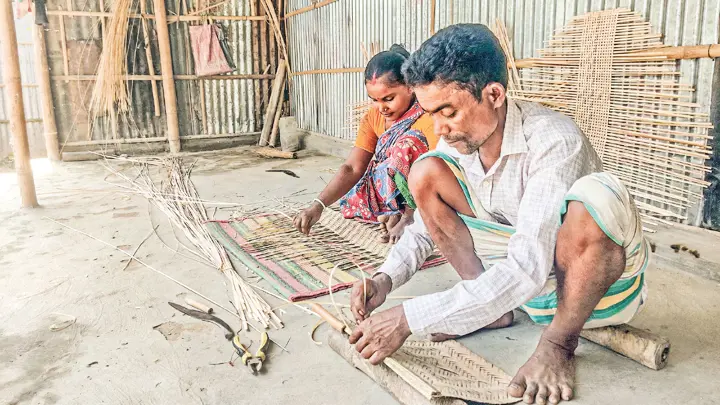
In the Malipara area of Ward 7, Setabganj municipality, in Dinajpur’s Bochaganj upazila, Romen, 30, and his wife, Kalpana, 28, have been making hand fans since the time of their forefathers. Five or six families in the area have long been engaged in the same trade, but as hand-fan use has declined with modernisation, the younger generation shows little interest in taking it up.
Romen said his family has made hand fans since his grandfather’s generation, and that four family members, including himself and his wife, are currently involved in the work. Bamboo, the main raw material, has to be bought from the market, but the right kind is not always easy to find, and when it is available, high prices push up production costs. Making a single hand fan takes about an hour, and the couple make eight to ten a day on average. Raw materials cost around 10 to 15 taka per fan, which they sell wholesale for 30 to 35 taka each, leaving a margin of roughly 15 to 25 taka per fan after costs. Altogether, Romen said, they earn around 150 to 200 taka a day.
Romen’s wife, Kalpana, said she has worked alongside her husband making hand fans for years, alongside her household duties. Work and sales both pick up somewhat as the heat rises, particularly when the power goes out, though demand is nowhere near what it once was year-round. “Modern fans have cut hand-fan use a great deal,” she said. “Even so, we’ve kept this work going, because it helps support the household a little. But with bamboo prices so high, the profit is small too.”
Craftsmen say the season for making and selling hand fans runs from roughly mid-November through mid-June, with demand rising alongside the heat, though the overall market has shrunk considerably compared with the past. Romen said: “Demand for hand fans used to be much higher. Now, because of electric fans, chargeable fans and plastic fans, sales have fallen. Our biggest problem is that bamboo is hard to find, and even when we do find it, it’s expensive. We haven’t received any government support. If we got some financial help, we could keep this trade going — even just the tools needed to cut bamboo would make a real difference.”
The upazila administration has said it will take the problems of hand-fan-making families seriously. Bochaganj upazila executive officer Maruf Hasan said the issues facing these families would be given due attention, and that possible support would be arranged in coordination with relevant government departments.
According to locals, even as electricity and various modern fans have become more common, hand fans remain useful during hot weather and power cuts. But a shortage of raw material, rising bamboo prices, a shrinking market and disinterest among younger generations have raised fears that the trade could gradually disappear. Craftsmen say that if bamboo were made more easily available, along with financial assistance and bamboo-cutting tools, they could keep the trade alive — preserving both several families’ livelihoods and an old tradition of rural Bangladesh.