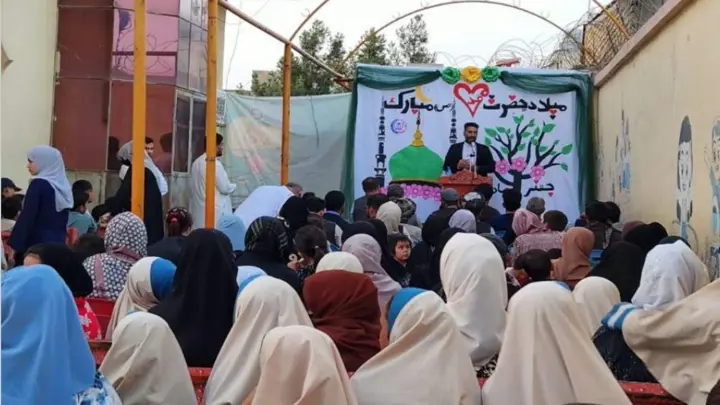
Iran’s cultural adviser to Afghanistan, Dr. Seyed Ruhollah Hosseini, has called on the Muslim world to newly revisit the life of the Prophet Muhammad (peace be upon him) and make his teachings and character part of everyday living. He said the Prophet (peace be upon him) was not sent for any particular nation, land or era; he brought a message of mercy, morality, human dignity and unity for all of humanity.
He made the remarks at an event held in the city of Mazar-i-Sharif marking the birth anniversaries of the Prophet Muhammad (peace be upon him) and Imam Jafar al-Sadiq (peace be upon him). Hosseini said the Prophet’s birthday is not merely the commemoration of a historical event; it is the remembrance of the dawn of a light sent to free humanity from ignorance, oppression and darkness, and guide it onto the right path. Citing the Quranic verse, “We have sent you as a mercy to the worlds,” he said the Prophet’s message is one of mercy, monotheism and human dignity.
Morality is a core foundation of the Prophet’s teaching
Describing the Prophet’s character as one of the most important aspects of his life, Hosseini said the Quran describes him as possessing “a great character.” This makes clear that morality was not a secondary matter in the Prophet’s teaching, but one of the primary foundations of his mission and way of life.
Citing honesty, trustworthiness, forgiveness, kindness, justice, respect for people and responsibility toward the helpless as important examples of the Prophet’s morality, he said these qualities are needed in today’s Muslim society more than at any time before.
He said if love for the Prophet exists in people’s hearts, that love must also be reflected in social conduct. Knowledge about the Prophet should not be confined to discussions, gatherings or birthday observances, but should be reflected in people’s morality, conduct and way of life.
Unity, not division
Hosseini highlighted the unity of the Muslim ummah as another important aspect of the Prophet’s example. In his words, the Prophet established a society founded on monotheism and faith. The Quran, too, instructs Muslims to hold firmly to the rope of Allah and not become divided.
He said that while differences exist between Shia and Sunni Muslims, they share common ground on fundamental matters such as monotheism, the holy Quran, the Prophet’s prophethood and the qibla. These shared elements, he said, can serve as a strong foundation for Muslim unity and solidarity.
Calling for differences not to turn into enmity and division, he said differences of opinion should instead become opportunities for dialogue, mutual understanding and cooperation.
A new civilization through knowledge and culture
Highlighting the importance of knowledge and education in the Prophet’s example, Hosseini said the Prophet’s mission was linked with education, self-purification and human development. The Quran describes the Prophet’s duties as including the recitation of verses, purifying people, and teaching the scripture and wisdom.
In his view, the society the Prophet built was one of knowledge, education and human development. He said it is therefore the responsibility of the Muslim world’s schools, universities, madrasas, cultural institutions and research centers to work against ignorance, backwardness and cultural isolation.
He particularly called on Muslim youth to focus on knowledge, creativity, morality and their own identity. He remarked that by integrating science and technology with Islamic values, the younger generation could play a role in building a new and humane civilization.
Justice and human dignity
Hosseini said that in the Prophet’s teaching, human dignity did not depend on wealth, power, lineage, nationality or social status. Faith, piety and humanity were the fundamental basis of human dignity.
He described standing by the oppressed and taking a stand against tyranny as a moral and social responsibility of Muslims. In this context, he also spoke of the suffering of oppressed people in Palestine and various other parts of the world, and called for awakening the Muslim world’s conscience and sense of responsibility.
The Prophet’s example remains relevant amid modern crises
Referring to today’s scientific and technological progress, Hosseini said that despite such advancement, humanity has still not been freed from war, violence, discrimination, injustice, extremism, moral decay and spiritual crisis. As a result, the Prophet’s message of mercy, morality, human dignity and spirituality is needed in today’s world more than ever before.
Citing the Quranic verse, “Indeed in the Messenger of Allah you have an excellent example,” he said the Prophet’s life is not merely a subject for reading history. His life can still provide guidance today across various spheres of individual, family, social and cultural life.
Following the true expression of love
Toward the end of his remarks, Hosseini said true love for the Prophet means following his path and morality. He said if the essence of the Prophet’s birth message were to be put in a single sentence, it would be this: Muhammad (peace be upon him) is the prophet of mercy, morality, unity, knowledge and justice. Muslims’ responsibility, he said, is to carry these values into the practical sphere of life, rather than confining them to events and speeches alone.