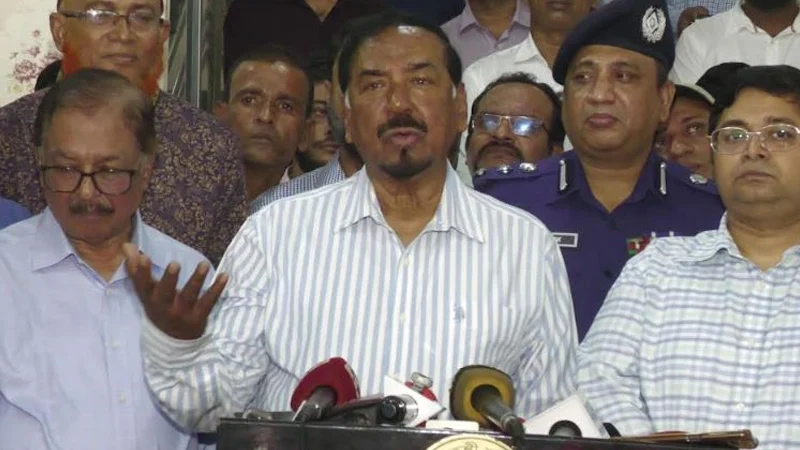
Bangladesh’s relationship with India should not resemble a marriage, but should instead rest on equal dignity, National Parliament speaker Hafiz Uddin Ahmed Bir Bikram has said. “We want our relationship with India to be based on the equal dignity befitting neighbours. In the past, under Awami League rule, India’s foreign minister described the relationship with Bangladesh as being like a husband and wife. We do not want that kind of husband-wife relationship,” he said.
He made the remarks while speaking to reporters at Bhola Circuit House on Monday morning.
On relations with India, the speaker said New Delhi has not yet openly communicated any policy on BRICS to the Bangladesh government, and there is no sign of enthusiasm from the other side either. India did not extend an invitation to Bangladesh’s prime minister with proper dignity, he said. In particular, he said, India has given shelter to the prime minister of the ousted government and allowed her to conduct politics from there. Bangladesh does not view this as neighbourly behaviour.
“In the days ahead, we hope to maintain good relations with India. But so far, there is no sign they want good relations either. We want the kind of relationship that should exist between one sovereign state and another,” he said.
On the Awami League government, Hafiz Uddin Ahmed said the past 17 years, particularly under Awami League rule, saw collapse at every level and in every sector of the country. Killings, enforced disappearances, murder, money laundering and corruption surpassed all past records. The previous government’s illegal activities brought the country to the brink of destruction, he said, adding that recovering from this situation would take a long time.
On the July Charter and reforms, the speaker said the reform process has already begun. Many legal reforms are needed, and discussions are ongoing among political parties on this. Some difficulties have emerged because parties have not reached agreement on certain aspects of implementing the July Charter.
Describing himself as neutral, he said: “I am trying to run parliament impartially. I hope that if BNP and the opposition parties can reach an understanding, the public can be freed from 16 to 17 years of misrule.”
The speaker said both the government and opposition are committed to implementing the July Charter. If the opposition agrees on reform proposals in parliament’s next session, the necessary legal changes can be made quickly. Once constitutional reform is complete, its real benefits will be felt, and the public will be freed from prolonged misrule, he said.
The speaker also spoke about restoring freedom of speech, enforced disappearances and killings, and the Bhola-Barisal bridge.
Leaders of “Amra Bholabashi” later submitted a memorandum to the speaker demanding construction of the Bhola-Barisal bridge. On this, the speaker said a feasibility study for the Bhola-Barisal bridge has been carried out, and a feasibility study for a new highway will also be conducted. The government will proceed with whichever option proves better.
Also present were Bhola deputy commissioner Dr Shamim Rahman, district council administrator Golam Nabi Alamgir, superintendent of police Md Shahidullah Kawsar, and heads of various departments.