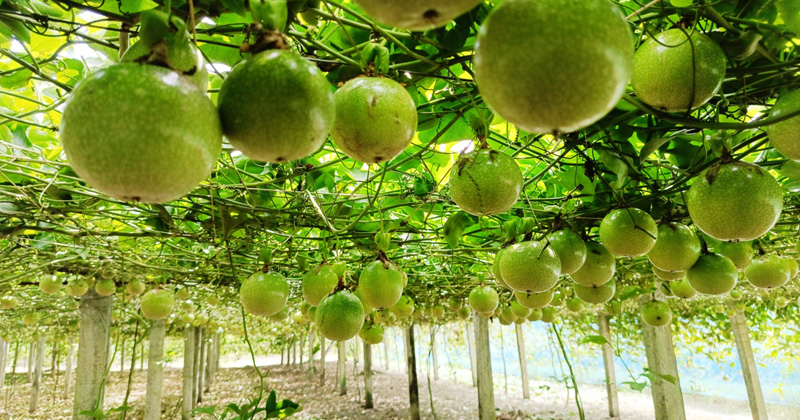
Growing exotic fruit has transformed the fortunes of many farmers in Jibannagar upazila, Chuadanga, reshaping the local rural economy. Farming here was once limited to Boro and Aman rice along with a few common vegetables. Now, using modern methods, farmers are cultivating a range of foreign fruit varieties and earning hundreds of thousands of taka.
Growing various foreign fruit varieties using modern techniques on former paddy land has brought widespread success and put smiles on local farmers’ faces. Exotic fruit cultivation has become hugely popular among farmers here.
Jibannagar upazila, in the southwestern district of Chuadanga, has opened a new door of opportunity through exotic fruit farming.
Farmers in the upazila are now growing avocado, rambutan, longan, malta, dragon fruit, pineberry (anarkoli) and grapes. Cultivation that began 15 years ago as an experiment has now taken on a commercial form. Grapes were once considered nearly impossible to grow in Bangladeshi soil, since they were seen purely as an imported foreign fruit. But times have changed. Thanks to improved varieties, modern cultivation methods and farmers’ enthusiasm, grapes and other exotic fruits are now being grown successfully in Jibannagar. Local farmers say the fertile alluvial soil makes these fruits cheap to grow while yielding good harvests, driving up demand and fetching good prices in the market. Fruit produced in Jibannagar is now supplied to fruit shops in Dhaka and other major cities across the country.
Akshed Ali of Anantapur village achieved success growing pineberries experimentally in Jibannagar. His trees are laden with flowers and green-to-ripe fruit. Given the low cost and profitability, other farmers are showing growing interest in this crop.
Akshed Ali said he had grown dragon fruit and malta for 10 years. Then, in December 2025, after watching videos on YouTube, he obtained saplings of pineberry — a fruit native to Brazil and Paraguay in South America — from Sirajganj. He prepared his land and planted the saplings, then carried out regular care including irrigation, fertilizer and pesticide application. Within just six months, clusters of flowers began appearing. Bamboo poles and wire trellises were set up to properly support the fruit and protect it from rot.
Ripe and unripe pineberries now hang from the trellises. Harvesting of ripe fruit began in early August. This fruit is now being marketed in Dhaka, Sylhet, Chattogram and other districts across the country.
Sajal Ahmed, a young agricultural entrepreneur from Rajapur village in Jibannagar upazila, started with just 9 bighas of guava orchard in 2014. He has since built up nearly 140 bighas of orchards growing various domestic and foreign fruit varieties. His orchard now includes 40 bighas of malta from Moroccan, Pakistani, African and Vietnamese varieties, 35 bighas of various mango varieties, and about 200 varieties of domestic and foreign fruit including dragon fruit, oranges, grapes and avocado.
Sajal Ahmed said that after failing to achieve the expected profit from guava farming, he turned his focus to malta cultivation in 2014. Despite some early challenges, the size and yield of his orchard gradually grew.
Alongside regular green malta, he now grows about 10 domestic and foreign malta varieties, including Australia’s famous “Yellow King” (a yellow malta variety), achieving considerable success. His large-scale operation has grown into an agricultural venture called Bismillah Nursery and Fruit Orchard. Visitors and aspiring entrepreneurs travel from far and wide every day to see his orchard and learn his cultivation methods.
Ashrafuzzaman Milu of Uthali village in the upazila began growing dragon fruit and malta in 2010. He currently cultivates dragon fruit on 22 bighas, malta on 6 bighas and guava on 10 bighas. “We grow our fruit naturally,” he said. “We don’t use any medicine to make the fruit bigger in these orchards. That makes the fruit smaller, and we get a lower price for it.”
Raju Ahmed, from the same village, has been growing fruit for 16 years. He began with apple kul (Indian jujube) in 2010, then moved to Thai guava, followed by malta and dragon fruit.
“Growing Thai guava on one bigha of land can bring in 200,000 to 300,000 taka in sales,” he said.
In Hasadaha village in the upazila, two young entrepreneur brothers, Ashraful Islam and Toriqul Islam, have achieved remarkable success growing grapes commercially. They have planted about 750 Purple and Baikonur variety grapevines on three and a half bighas of land, and are now seeing economic returns from the orchard.
According to the Jibannagar Upazila Agriculture Office, this season Jibannagar has cultivated dragon fruit on 688 hectares, malta on 312 hectares, oranges on 120 hectares, sharifa (custard apple) on 1 hectare, grapes on 9 hectares, rockmelon on 6 hectares, pineberry on 2 hectares, avocado on 4 hectares, rambutan on 0.13 hectares, guava on 748 hectares, pomegranate on 0.50 hectares and year-round jackfruit on 0.50 hectares.
As word of Jibannagar’s fruit orchards has spread on social media, people from nearby villages and as far as Jashore, Jhenaidah, Meherpur and even Dhaka are flocking to see the orchards every day.
Hasan Niloy, a local visitor to one of the orchards, said: “I had only seen fruit like this on TV and YouTube before. Now I can see it up close in my own village.”
Another visitor, Hasibul Islam, said: “These foreign fruits taste great and look beautiful. We’re thinking of starting an orchard like this ourselves.”
Jibannagar Upazila Agriculture Officer Md. Alamgir Hossain said farmers’ interest in growing these exotic fruits is rising. “We’re providing technical support and advice,” he said. “This will open up new income opportunities for farmers. Alongside rice, jute and corn cultivation, commercial exotic fruit farming is opening a new door of possibility for agriculture in Jibannagar upazila. This will increase profits and transform the rural economy.”
He said the special characteristics of Jibannagar’s soil are behind the success of exotic fruit cultivation. As farmers profit, interest in this kind of farming keeps growing, he said, which will reduce dependence on imports and make agriculture more sustainable.