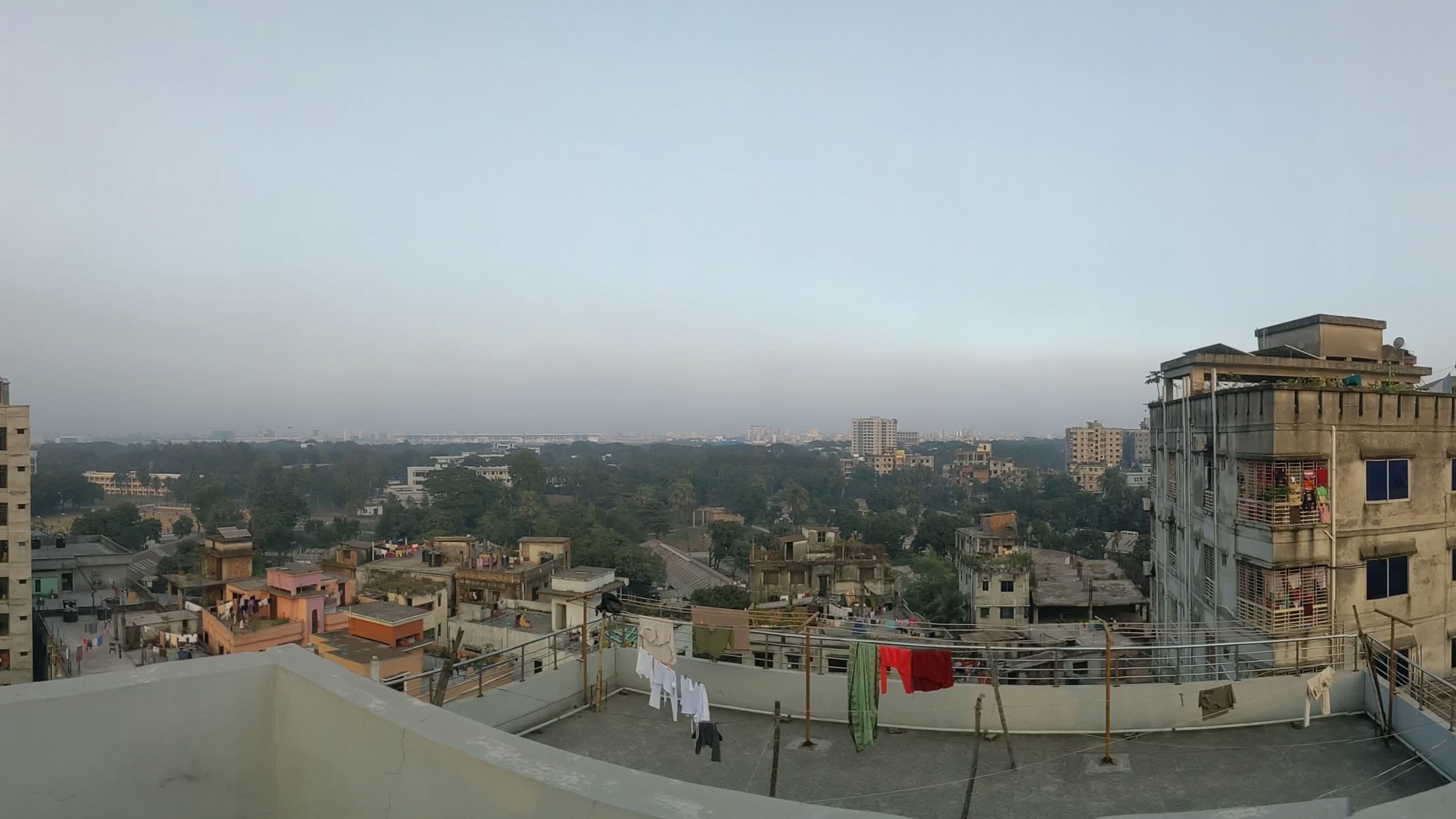
The medium-magnitude tremor on a weekend morning was almost a preview of what a major earthquake could do to the capital, Dhaka. Although there has been no major earthquake in the country in a hundred years, there is a history of tremors — and in that light, yesterday’s earthquake can be called a “foreshock,” one of the small earthquakes that occur before a major one nears. Geologists and earthquake experts see this 5.7-magnitude earthquake, which shook the whole country, as a warning of a future major earthquake and urge preparation now. They say an earthquake of such magnitude has never before occurred so close to Dhaka; had the shaking lasted a few seconds longer, there was a risk of a terrible human catastrophe. Alongside more drills, they said, emphasis must be placed on building awareness to reduce earthquake casualties.
City agencies have identified about 2.146 million buildings across the capital as risky. Most were built without following rules, on old designs or weak foundations. Urban planners warn that a major earthquake could cause a terrible disaster in the capital. Experts said most people felt Friday’s earthquake — close to Dhaka and the strongest in decades — and that panic prevails. Environment, Forest and Climate Change Ministry adviser Syeda Rizwana Hasan said Dhaka and Old Dhaka are most at risk from earthquakes. “Even if today’s buildings follow the code, according to RAJUK’s statistics a great many buildings have gone up, 90 percent of which have no approval. What will happen to them if such an earthquake keeps repeating?” she said.
A joint survey by the disaster-management programme and JICA noted that if an earthquake of magnitude 7 or more is felt in Dhaka, 72,000 buildings in the city would collapse and another 135,000 would be damaged, creating 70 million tonnes of concrete rubble. Experts say Bangladesh sits on the Indian Plate, which is moving northeast; to the north of Sylhet is the Eurasian Plate, moving south, and the two plates are pressing against each other. Bangladesh is also geographically at earthquake risk because of subduction into the Myanmar subplate to the east, the Dauki Fault to the north, and Myanmar’s Sagaing Fault and the Madhupur Fault.
Meteorological Department director Md Mominul Islam said: “This earthquake’s epicentre was very close to Dhaka, so it was felt much more. Even a magnitude-7-plus earthquake in Chattogram’s Rangamati or Khagrachhari would not be felt as strongly in Dhaka. But had this earthquake lasted 5 to 7 seconds longer, many Dhaka buildings would have collapsed. Dhaka and surrounding areas have never faced such an earthquake before.” He explained that a magnitude-6 earthquake is not merely one point stronger than a magnitude-5 one — its shaking tendency is 10 times greater, with each fraction multiplying the intensity, so this earthquake’s intensity reached a radius of at least 100 km.
Earthquakes have been centred on Dhaka and nearby before, but at lower magnitudes — 4.5 on 18 March 2012, 4.8 on 26 July 2008, and 4.5 on 19 December 2001, none causing major casualties. More recently, a 6.2-magnitude earthquake hit Chattogram on 26 November 2011. Historically, too, the region has witnessed major earthquakes: the 1897 “Great Indian Earthquake” (magnitude 8.0) killed more than 1,500 people in then-undivided Bengal, and the 1918 Srimangal earthquake (magnitude 7.6) caused extensive damage.
A recent 2024 study by the Capital Development Authority (RAJUK) said a 6.9-magnitude earthquake on Tangail’s Madhupur Fault could collapse 40.28 to 64.83 percent of Dhaka’s buildings. Casualties would vary by the time of day, the study said: a morning quake could kill 210,000 to 310,000 people; an afternoon one, 270,000 to 400,000; and a night-time one, 320,000 to 500,000. A 7.1-magnitude earthquake on the Sylhet lineament (Dauki Fault line) could damage 40,935 to 314,000 of Dhaka’s buildings (1.91 to 14.66 percent). A 6.9 quake on the Madhupur Fault would also cause severe infrastructure damage, collapsing 49.6 percent of main roads and 59.4 percent of inner-city roads; most alarmingly, 96.22 percent of major bridges and 96.79 percent of city bridges are at risk of destruction. Financial losses are projected at more than 1 billion dollars in transport, 887 million dollars in water and waste-management systems, and 27.1 million dollars in power infrastructure.
RAJUK’s area now has more than 2.15 million buildings, of which 514,000 are concrete structures. The study examined 3,252 buildings and identified 42 as highly risky, recommending immediate demolition. According to the Comprehensive Disaster Management Programme study, a 7.5-magnitude earthquake would collapse 72,000 buildings and severely damage another 150,000. Experts say the main victims would be the many old buildings on weak soil and the over-six-storey buildings built without following the building code.
Experts identified several reasons for Dhaka’s rising risk. In this, one of the world’s most densely populated cities, unplanned high-rises, slums and narrow streets are major obstacles. Many buildings were not built to earthquake-safety standards, turning them into death traps. Bangladesh’s structurally weak soil is another big factor: much of the country sits on loose, waterlogged alluvial soil that can liquefy under strong shaking, causing buildings to collapse. While earthquake-prone regions like Japan or California have extensive public awareness, emergency drills and effective disaster response, experts warned, Bangladesh has a major shortfall.
BUET civil engineering professor Mehedi Ahmed Ansary said: “Dhaka’s 2.1 million buildings need to be inspected right now. This will cost the government nothing — have RAJUK inform the public and, after checking, certify which buildings comply with the building code.” He said: “Friday’s earthquake can be called a foreshock — one of the small earthquakes before a big one. Major earthquakes can return about every 150 years, and from that standpoint magnitude-7 earthquakes are due to return. There has been no major earthquake here since 1930, but research shows the risk of one.” He added: “Many of Dhaka’s buildings were damaged in this earthquake — structures damaged, buildings sunk, cracks formed. If a 5.7 caused this much damage, a magnitude-7 would cause far more, collapsing buildings and causing casualties. Such an earthquake within 100 km of Dhaka would cause 200,000 to 300,000 casualties, with a risk of 35 percent — a third — of Dhaka’s buildings collapsing.”
Warning that a bigger earthquake could come, earthquake expert professor Humayun Akhter said: “Today’s earthquake is giving that warning. The plate that was locked is coming unlocked. There will be bigger earthquakes in this region in future. We have repeatedly told the government there is no alternative to drills for earthquake response. The government keeps crores of taka in budget for post-earthquake rescue — from which corruption can occur — but no proper steps are taken.”
Urban planner professor Dr Adil Muhammad Khan told Kalbela that Dhaka has a severe shortage of the safe, open spaces the public needs to shelter in during a major disaster like an earthquake. “When panicked people rush out to find a little safe or open space, in most areas that open space cannot be found. Dhaka has been built and expanded so that most areas have no empty space; what existed has gradually been converted. So in an earthquake or major disaster, places where people can stand are absent in most areas,” he said. Hundreds of open spaces should have been created in Dhaka, he said, but without state initiative the private sector never would, and this indifference could become a great danger for Dhaka’s residents in a disaster. Playgrounds, he added, are used not only for sport but also as shelter in disasters.
Noting that Bangladesh lies in an earthquake-prone area, Rubaiyat Kabir, head of the Meteorological Department’s earthquake observation and research centre, said: “Historically too, we have a record of major earthquakes here. Since digital earthquake monitoring began in 2007, this 5.7 is the highest around Dhaka. Usually there is a risk of aftershocks after a major earthquake, though nothing of the sort has happened so far.”
বাংলায় মূল প্রতিবেদন পড়ুন · Read the original Bengali report