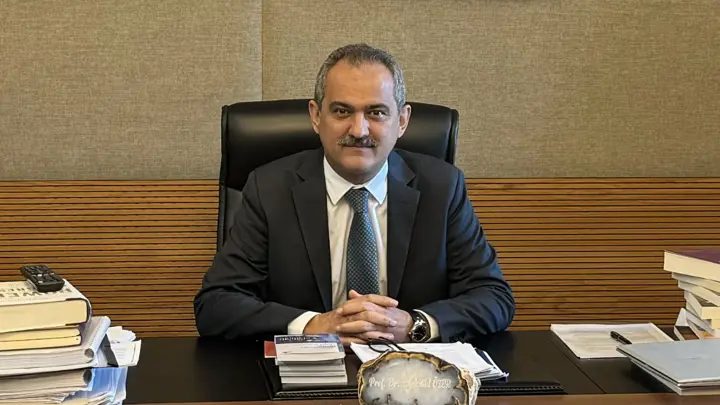
Turkish academic and former education minister Mahmud Ozer has reinterpreted the concepts of “the complete human” and “the just urban society” in light of the book “Justice in Islamic Thought.” The book, edited by Omer Turker and Yunus Kaplan, analyzes how the concept of justice in Islamic thought connects to the individual, the family, politics and the state. The piece’s central argument is that justice is not merely a matter of courts, law or state administration; it begins with human existence and character, and encompasses the entire social order.
Here, “the complete human” and “the just society” are not two separate ideals, but are deeply connected to one another. A person who can establish justice within their own soul contributes to building a just society. And a society founded on justice, ethics and fairness gives the individual an environment in which to develop morally. In other words, the individual shapes society, and society, in turn, shapes the individual.
At the center of this idea is the discipline of the human soul. In the Platonic tradition, the human soul is said to have three main faculties: reason, spirit or the power of courage, and desire or the appetite for pleasure. When balance is established among these, virtues such as wisdom, courage and moderation develop. Justice brings overall coordination among these virtues, making it the unifying foundation of the other moral virtues.
From this view, the complete human is one who has managed to bring their reason, courage and desire into proper balance. Their character holds knowledge, but knowledge has not turned into arrogance; courage, but it has not become extremism; desire, but it does not control them. A sense of justice keeps these instincts in their proper place.
In Islamic ethical philosophy, this idea extends from the individual to the family. In Nasiruddin Tusi’s “Akhlaq-i Nasiri,” ethical philosophy is viewed across three interconnected levels: the individual, the family and the state. Here, morality and justice are not separate matters. Just as the individual establishes justice within their own character, the same principle applies to running a family and to broader political life.
In the modern era, we generally associate justice with law, courts, rights or state policy. But in classical Islamic thought, the scope of justice is much broader. There, justice doesn’t simply mean protecting someone’s rights; it means placing everything in its proper position and managing every relationship in its appropriate balance. Injustice is removing something from its rightful place.
This idea is also important in al-Ghazali’s thought. To him, justice is a real, practical moral virtue that must manifest in human conduct. Simply knowing about justice is not enough; justice must become part of one’s character and be expressed in the actions of daily life. Ethics, therefore, is not a matter of lectures or theoretical discussion — it is a matter of how one lives.
The relationship between the individual and the state is especially important here. A society’s justice is not ensured by good laws alone. Those who enforce the law, the administration, political leadership, families and ordinary citizens — all must practice a sense of justice. Just institutions cannot be sustained without just people. And without just institutions, an individual’s moral development becomes difficult as well.
This is the core strength of al-Farabi’s concept of the “virtuous city.” A virtuous city is a society that creates an environment for people to attain the highest good, or happiness. Education, law, the family, commerce, administration — all social institutions play a role in a person’s moral development. The state, then, is not merely an instrument for security and economic management; it also creates the environment for shaping human character.
There is an important difference between this idea and modern political thought. In the modern state, the state’s primary responsibility is generally to secure citizens’ rights, safety and welfare. But in classical Islamic political philosophy, the state’s aim is broader — to create an environment where the individual can improve themselves, toward the moral and overall excellence of human beings.
That is why the question of justice is most important not just for the people, but for the ruler as well. A state’s justice depends heavily on the moral character of its leadership. In classical Islamic thought, the ruler is considered a person who must themselves be advancing along the path of justice and self-purification. Because the ruler’s character has a profound impact on the state system. Drawing on al-Ghazali’s discussion, the author shows that a ruler’s justice is not just a matter of their personal conduct; it is reflected in the power structure and society around them.
An important political lesson can be drawn here. A just state cannot be established merely by making laws. If state officials are corrupt, the judiciary is biased, the powerful stand above the law, and citizens’ sense of justice is weak, then justice will not be established in society even if a constitution and laws exist.
Justice, then, is a holistic culture. It is needed in the family just as much as in the state. It is needed in business just as much as in politics. It is needed in the courts just as much as in personal relationships. A citizen’s sense of justice and a ruler’s sense of justice are part of the same moral principle.
In Islamic thought, justice is connected to an even greater cosmic order. In Ibn Arabi’s thought, Allah’s name “Al-Adl” — the Just — is related to the order of creation. Injustice in the human world disrupts that order. Establishing justice in the individual, society and state is therefore not merely a political necessity; it is also part of humanity’s relationship with a larger moral order of existence.
This is where an important connection forms between the crises of the modern world and classical Islamic thought. In today’s world, we discuss corruption, political polarization, social inequality, family crises, abuse of power and a crisis of trust. To solve these problems, we often speak of new laws, new institutions or new administrative structures. But how effective these institutions will be without a change in human character is a question that often remains in the background.
The concepts of “the complete human” and the “virtuous city” bring exactly that point to the fore. A good society needs not only good institutions, but also good people. And producing good people requires social institutions, an education system and a political culture that encourage morality.
In other words, change does not flow in one direction only. It is not entirely true that society changes only if people change. Nor is it enough to say people will change if institutions alone change. Individuals and institutions must change together. Just citizens build just institutions, and just institutions help produce the next generation of just citizens.
This is where the journey from “the complete human” to the “virtuous city” begins. The individual establishes justice within their own soul; the family puts that justice into practice in relationships; society shapes it into social institutions; the state preserves it through law and governance. And in turn, that just environment created by the state and society further strengthens the individual’s moral development.
The greatest lesson of this perspective is that justice is not an isolated political slogan. It is a philosophy of life. If the individual is not just, justice is not established in the family; if the family lacks justice, justice weakens in society; if justice weakens in society, state institutions ultimately weaken as well.
So the question of a just state ultimately returns to the question of an individual’s soul. A state’s justice begins from within the person, while a just state and society are needed for a person’s moral development. This mutual construction of the individual and society is the deepest lesson of “the complete human” and the “virtuous city.”
In today’s world, when justice is often confined to questions of courts, rights and law alone, this broader concept from Islamic thought creates an opportunity to reconsider. Justice does not simply mean putting a criminal on trial; it means giving every person, institution and relationship its proper dignity and place. Justice means restraint in the exercise of power, balance in the distribution of resources, responsibility within the family, and self-purification in personal life.
In this sense, a just city or state is not simply the name for advanced infrastructure, a strong economy or effective administration. It is a moral environment in which people can improve themselves and create a path for others’ improvement as well. And that society begins with a person establishing justice within themselves.
The complete human and the virtuous city, then, are not two separate dreams. One is both the cause and the effect of the other. Justice is the bridge between them. When the individual is just, society’s foundation grows stronger; when society is just, the path to individual excellence widens. Within this mutual relationship lies the possibility of a just civilization.
Humans were not created to live alone. Because of mutual needs and relationships, humans form families, build societies and, ultimately, give rise to states and urban civilizations. But how human collective life should be organized so that both the individual’s and society’s welfare are ensured — this question has been one of the central subjects of philosophy and political thought since ancient times.
From Plato and Aristotle to al-Farabi, Ibn Sina, al-Ghazali, Nasiruddin Tusi, Ibn Bajjah and Ibn Khaldun, many Muslim and non-Muslim thinkers have searched for answers to this question. Two important concepts in this discussion within the Islamic intellectual tradition are “al-insan al-kamil” — the complete or perfect human — and “al-madinah al-fadilah” — the virtuous or just city-state. Al-Farabi built one of the primary foundations of this thought.