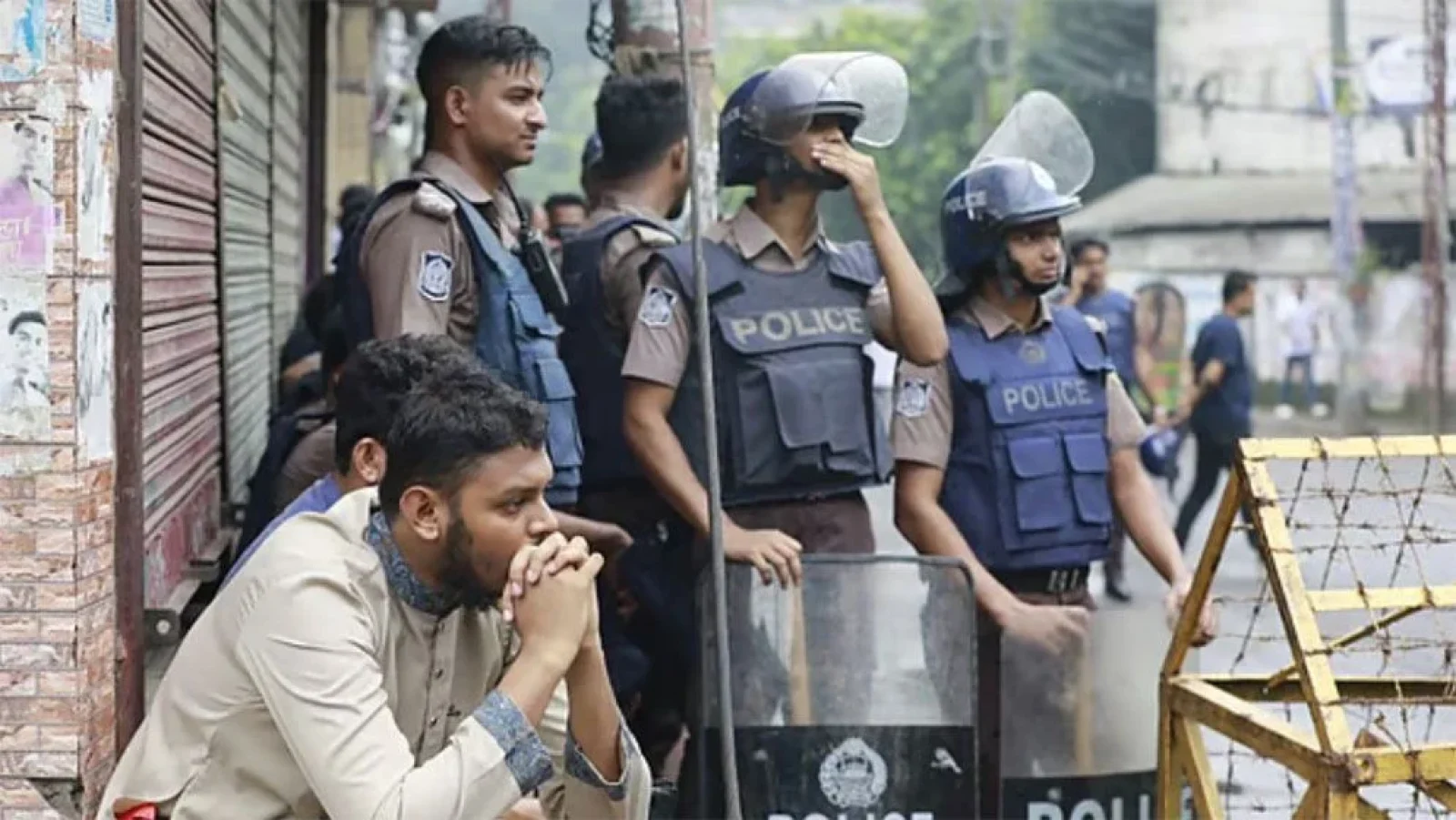
Under Sheikh Hasina’s government, toppled in a mass uprising, a “culture of fear” prevailed, and Bangladesh was said to have become a “police state”. Analysts now believe the opposite has happened: it is widely said that no one fears the police any more. As a result, although hundreds of offenders are being arrested, law and order is somehow not fully under control. Many say a “don’t care” culture has replaced the culture of fear, and in many places, instead of fleeing police, people are attacking them.
On Wednesday, a police vehicle was attacked during the eviction of pavement hawkers in Mirpur, which turned into a battlefield. Several Dhaka North City Corporation vehicles were set on fire, and an excavator used in the eviction and a police vehicle were vandalised. Many say law enforcement agencies now face constant challenges, and those involved describe the security picture as extremely worrying.
Before the Mirpur incident, the Radda Maternal and Child Health-Family Planning Centre was attacked and demolished on Thursday night; nine people were arrested, and an MP is under investigation over alleged involvement. On Saturday night, New Guinea Properties in South Manikdi near the ECB Chattar was attacked by armed men who ran amok, including vandalising content creator Salman Muqtadir’s studio; seven people, including former army officer Golam Mohiuddin Chowdhury, were arrested. An armed mob attack to seize land in Mohammadpur, an attempt to seize an eight-storey building in Adabar, a series of clashes over teen gang dominance and other incidents became the “talk of the country” in recent days, embarrassing the government. The government has stepped up its response, arresting more than 400 offenders in the capital on Wednesday alone.
On Tuesday at the Secretariat, Dr Zahed Ur Rahman, the prime minister’s information and broadcasting adviser, said the government faced great embarrassment over these attacks. The country has largely emerged from the extreme instability after August 5, and the police have been brought back to normal operations through very difficult circumstances, he said, claiming some crimes had risen while others had fallen, and that those whose guilt is proven in the recent incidents would face strict punishment.
The police force was thrown into deep crisis after the Awami League government fell in the 2024 student-led uprising. The interim government tried to recover from that, but the police have still not truly got back on their feet. Soon after the BNP government took office in February, Home Minister Salahuddin Ahmed announced there would be no more mob terror and the situation would improve quickly. Various steps were taken to make the police professional and people-friendly, with a zero-tolerance policy and sweeping drives against criminals, extortionists and teen gangs, and a monitoring team working round the clock at police headquarters. But in practice these have not delivered, and one brutal and chaotic incident after another is spreading fear and anxiety.
At a briefing at the Secretariat on Wednesday, Home Minister Salahuddin Ahmed said it would be wrong to judge the country’s overall law and order by one or two isolated incidents. The government and law enforcement are working round the clock to ensure public safety, strict action is being taken against offenders regardless of political identity, and police respond immediately to 999 calls and arrest wrongdoers, so the government bears no blame or failure, he said. “It could be called a failure of the government or police only if we were not taking action,” he said. Extortionists, criminals, armed men and drug dealers are being arrested regularly and the drive will be stepped up, he added. “A criminal is a criminal; no political identity is being considered.”
AHM Shahadat Hossain, AIG (media) at police headquarters, told Jugantor that police have stepped up intelligence surveillance, patrols and checkpoints, gathering information on crime-prone areas and offenders, and are quickly bringing offenders to justice with public cooperation. Yet recent events reveal a fragile security picture. On September 18, a class seven student at Border Guard High School went missing in the Kotbari area of Cumilla after going out to take photos with an iPhone; his brutally mutilated body was found the next day in a remote forest in the Lalmai hills, causing a nationwide outcry.
Crime experts and former police officials say several basic factors are keeping offenders out of control. Such sensational attacks are not possible without the backing of influential circles or those in power, they say, so arrests alone are not enough: the government must set strong examples that deter other offenders, and take tough and impartial action.
“Visible and strict legal action must be taken to ensure public relief and safety. If law and order cannot be brought under control, public anger at the government will grow day by day,” former IGP Abdul Kaiyum told Jugantor. No political identity of an offender should be considered, their backers must be identified and prosecuted, and police morale and administrative capacity must be raised to enforce a zero-tolerance policy, he said.
Dr Tauhidul Haque, associate professor at Dhaka University’s Institute of Social Welfare and Research and a criminologist, said the fear of the law and police that offenders once felt is now completely absent, which is why unpleasant incidents keep happening. News of arrests is reassuring, but without pulling up the roots of crime there can be no lasting solution, he said. When offenders see an influential or political network’s invisible hand behind them, they have no respect for the law, and unless offenders are prosecuted regardless of political identity, a major crisis of public trust in the government could follow, he warned.
বাংলায় মূল প্রতিবেদন পড়ুন · Read the original Bengali report