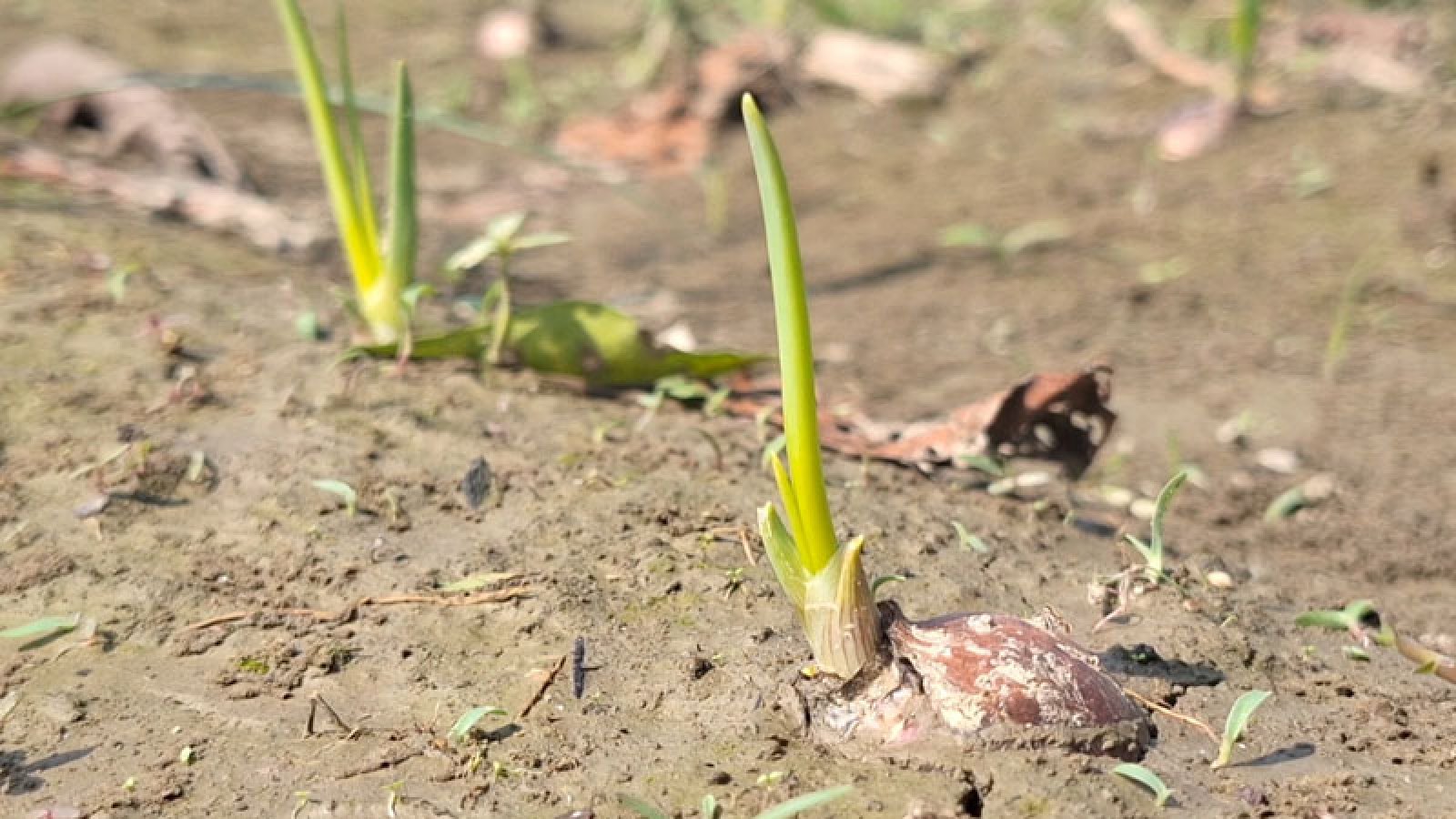
Green onion plants stretch across the fields. In some places the leaves are drying out; in others the bulbs under the soil have begun to rot. Even with care, farmers cannot save the crop they hoped for. At the start of the season they invested thousands of taka in these onions. Now, seeing the state of the crop, they have given up hope of a profit and worry about getting their money back.
This is the picture in the murikata onion fields of Pakundia upazila in Kishoreganj this season.
Farmers say excessive heat is rotting the onion bulbs and killing plants and seedlings. Fields grown for onion seed are being damaged too.
As a result, growers are unsure how they will meet production costs, labour wages and the cost of tending the crop.
According to the upazila agriculture office, murikata onion has been planted on about 290 hectares in Pakundia this season. Farmers usually plant the bulbs between the last week of September and mid-October. A little after planting, once the leaves have grown, they can sell them and recover part of what the bulbs cost. The onions can then be lifted and sold within 90 to 100 days.
Murikata onion has long been grown in the upazila’s Jangalia, Charteki, Tarakandi, Charkaona, Muniarikanda, Charfaradi and Jhaugarchar areas. Sandy loam soil and favourable weather give these areas good yields. Besides murikata onion, the upazila is known for growing onions from seed. Its onions meet local demand and are supplied to markets across the country.
A trade in bulbs and seed has grown up around onion farming in the upazila. At the start of the season traders bring bulbs from the north of the country, Faridpur and elsewhere. Local seed traders and wholesalers are part of the trade alongside the farmers, so onion growing is not only farmers’ income but an important part of the local economy. With the crop now at risk, this farm-dependent trade faces uncertainty too.
Shafiqul Islam, an onion farmer in Charteki village, has planted onions on two kathas of land, using six maunds of bulbs. With pesticides and fertiliser he has spent about Tk 25,000 so far, and more costs for tending and labour lie ahead.
“Last year I made a good profit from onions, and I planted again hoping for the same,” Shafiqul Islam said. “But the heat has left the field in bad shape. I am worried about what the yield will be. Without a good yield and a good price, it will be hard to get my investment back.”
Manik Mia of Tarakandi village has grown onions on eight decimals of land and spent about Tk 10,000 so far. With the heat hurting the crop, he fears a loss this year.
He complained that agriculture department staff are not checking on farmers in the field.
Nasim Uddin has planted onions on three kathas. “The heat is ruining the onions,” he said. “The seed onions are being damaged by the heat as well. I have spent Tk 15,000 to 20,000 so far, and there are more costs ahead, including lifting the crop and labour.”
Seeing the crop as it is now, he fears he will not even get his investment back.
In the past, he said, an agriculture officer came to the fields regularly to check on them. Now nobody like that is seen.
For Suruj Mia, a 70-year-old farmer in Charkaona village who has grown onions for many years, this season is unlike any other.
By his reckoning, one kani of land needs 12 maunds of bulbs, and a good harvest yields 80 to 90 maunds of onions. This year he has spent about Tk 50,000 on fertiliser, pesticide and labour.
“Last year I spent Tk 40,000 and sold Tk 80,000 worth of onions,” Suruj Mia said. “This year the heat has rotted the onions. I have grown onions for so many years and never seen it this bad. Forget a profit; I am worried whether I will have to take a loss.”
Minhaj, a farmer in Muniarikanda village, planted two and a half maunds of murikata bulbs on 14 decimals of land and has spent about Tk 15,000 so far. Fertiliser and labour costs lie ahead, and with the heat damaging the crop he is anxious.
Good fields for some, losses for others
Not every farmer’s field is in the same state. Hafiz Uddin Habib, a farmer in Charfaradi village, said onion growing gives three products from the same land: leaves, bulbs and flowers, which is why it is so popular in the area. He has spent about Tk 20,000 to 22,000 to grow onions on one bigha.
If the yield is good, he hopes to sell Tk 60,000 to 65,000 worth of onions.
Rafiq, a farmer in the same village, has grown onions on half an acre this year. Besides selling the leaves and flowers, he said, seed can also be saved. His field is in somewhat better shape than others’.
Sarufa Akter of the same village has had a different experience. She has grown onions on 11 decimals. Some plants are doing well, but part of the field has been lost to the heat. She made a good profit last year but fears a loss this time.
She complained that no agriculture officer has come to see her field so far.
Upazila Agriculture Officer Nur-e-Alam said: “Pakundia’s soil and weather suit murikata onion. This season onions have been planted on 290 hectares, with the potential to produce 20 to 25 tonnes per hectare. To raise output, farmers are being encouraged to use dolomite lime, and steps have been taken to supply the fertiliser they need.”
He added: “We have a target to expand cultivation to 300 hectares. We have also begun distributing airflow machines for storing onions. Murikata onions may reach the market within next month. But along with production, making sure farmers get a fair price is essential.”
বাংলায় মূল প্রতিবেদন পড়ুন · Read the original Bengali report