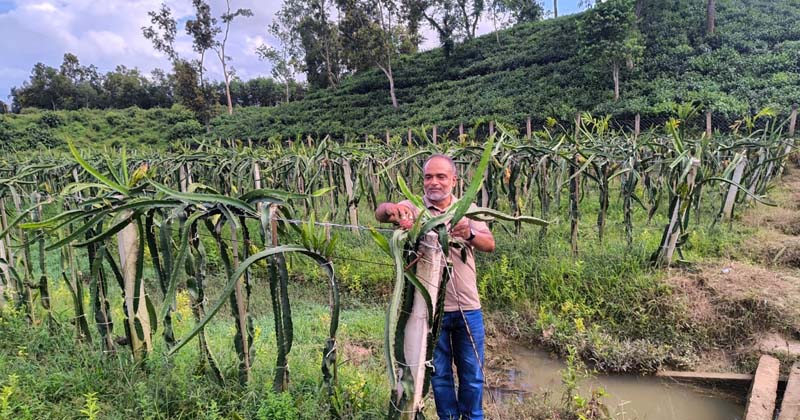
The land was once covered in weeds. Having lost its suitability for tea cultivation, it lay fallow for years. That same abandoned land is now lined with rows of dragon fruit plants. Deep red and pink fruits hang between the green leaves. Seen from a distance, it looks as though countless red lamps are scattered across a sea of green.
This scene at Sirajnagar tea estate in Kulaura upazila, Moulvibazar, is now a source of economic potential as well as scenic beauty. A commercial dragon fruit orchard has been built on nearly one hectare of land unsuitable for tea cultivation. The orchard, home to about 14,000 plants, grows Thai Red, Jumbo Red and White Pink varieties of dragon fruit.
Launched in 2024 with an investment of about 1.2 million taka, the project began yielding fruit from its second year. About 1.2 million taka worth of fruit has already been sold this season, and orchard authorities expect sales to rise further by the end of the season.
A field visit found the familiar green of tea bushes as soon as one enters Sirajnagar tea estate. But amid that green, the dragon fruit orchard tells a different story. Rows of dragon fruit plants grow on rows of posts. Some plants bear flowers, some green fruit, and others hang with ripe, deep-red dragon fruit. Amid the green leaves, the abundance of fruit creates a striking scene across the entire orchard.
The orchard’s beauty grows even more striking in the morning light or the soft afternoon sun. And behind that beauty, commercial production is running at full pace. Orchard authorities said the dragon fruit initiative began with the idea of bringing land unsuitable for tea cultivation into alternative agricultural use, rather than leaving it fallow. The project began in 2024 with an investment of about 1.2 million taka. After a first year of tending and growth, yields began from the second year onward. Production is now gradually increasing.
About 1.2 million taka worth of dragon fruit has already been sold this season. Orchard authorities expect sales to increase further once the season ends.
Another major success of this orchard is not just income — it has also transformed employment opportunities for tea workers. Alongside their regular tea estate work, workers are employed in the dragon fruit orchard. They are involved in tasks including tending the plants, caring for the flowers, weeding and harvesting fruit, creating additional work and income opportunities.
Not only that, dragon fruit grown in the orchard is given to workers free of charge. As a result, fruit that many worker families could not regularly afford to buy from the market can now be brought home from their workplace.
Tea worker Josna Pashi said: “We can now get good-quality dragon fruit for free from the orchard. Everyone in the family eats the fruit as a result. It brings us joy, and it also provides nutrition.”
Tea worker Kanchan Bauri said: “Working here brings in a regular income. Alongside the tea estate, we’re getting the chance for extra work as well.” Orchard workers said dragon fruit plants become ready for harvest about 25 to 26 days after flowering, allowing fruit to be collected from the same plot in successive rounds.
Dragon fruit project manager Khan Md Al Mikat said: “We started this dragon fruit project to make use of abandoned land unsuitable for tea cultivation. Fruit began arriving after just one year. Now, production is gradually and steadily increasing. This scenic orchard has fresh, delicious dragon fruit. That’s why people come from far and wide to buy this fruit. Seeing this orchard’s success, many young entrepreneurs in Kulaura and the surrounding area are also becoming interested in commercial dragon fruit farming. This is creating new potential for alternative fruit farming on fallow land, alongside the tea-dependent economy.”
Sirajnagar tea estate manager Shamim Islam said: “The dragon fruit orchard was created on fallow land outside the tea plantation to enhance the estate’s value. Now its commercial potential has emerged.”
He said no pesticides or harmful chemicals are used in the orchard. Because it is produced organically, the fruit is safe and of good quality.
Kulaura Upazila Agriculture Officer Md Jashim Uddin said: “Fallow land unsuitable for tea cultivation is no longer being left idle — such land is being brought under planned production, giving rise to dragon fruit orchards. This is creating new potential for extra income at tea estates. At the same time, the dragon fruit produced is playing an important role in meeting workers’ nutritional needs. Dragon fruit farming on fallow tea-estate land is therefore not just an alternative agricultural initiative, but a promising new model for ensuring both additional income and nutritional security.”