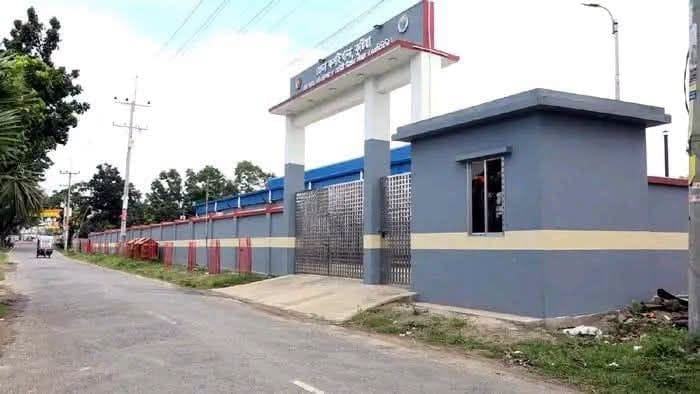
A modern slaughterhouse has begun operations in Kushtia. The facility was formally launched Wednesday. In its initial phase, the technologically advanced slaughterhouse is processing livestock meat using both machinery and traditional methods. The district livestock department built the roughly 9-crore-taka project near the GK Canal Bridge at Lahini Bottala on the outskirts of the city.
Livestock department officials said the project was completed roughly two months ago and was then handed over to Kushtia Municipality, which will operate the facility.
Kushtia District Livestock Officer Dr Md Al Mamun Hossain Mondol said livestock at the slaughterhouse will first be slaughtered according to Islamic tradition, with the rest of the process, through to meat preparation, carried out by machine.
Kushtia Municipality authorities said the slaughterhouse will use both machine and traditional methods in its initial phase. Officials say the modern facility will help curb the environmental pollution caused by unregulated slaughter elsewhere in the city, while also saving meat traders time and labor.
Consumers, meanwhile, are expected to get more hygienic meat, officials say, and locals hope the new slaughterhouse will make the city’s meat supply system more orderly and clean.
Livestock department officials say the modern facility will play an important role in improving public health. Once fully operational, it will end unregulated slaughter in random locations, reducing environmental pollution and preventing the slaughter of diseased cattle. Residents will be able to eat meat processed in a scientific and hygienic manner, and hides from animals slaughtered at the facility will also be free of defects.
On the question of machine slaughter and halal meat, Maulana Khalid Hossain Sipahi, director of Hoqqani Darbar, said the meat of an otherwise halal animal can, in some cases, become forbidden. Meat from a halal animal that is not slaughtered in the name of Allah is not permissible for Muslims to eat, he said, and slaughter must therefore be carried out in Allah’s name.
He noted that certain parts of an otherwise halal animal are also forbidden to eat. Under Islamic law, eight parts of a halal animal are prohibited: the male and female reproductive organs, the bladder, the spinal cord, the gallbladder, the testicles, tumor-like raised flesh beneath the skin, and flowing blood. Of these, flowing blood is unambiguously forbidden, while the rest are considered strongly discouraged.
There is no objection to meat being prepared at a modern slaughterhouse, local Islamic scholars and civic leaders said, but they called for animals to be slaughtered and meat prepared in accordance with Islamic law for the Muslim community, and said they expect authorities to remain attentive to that requirement.