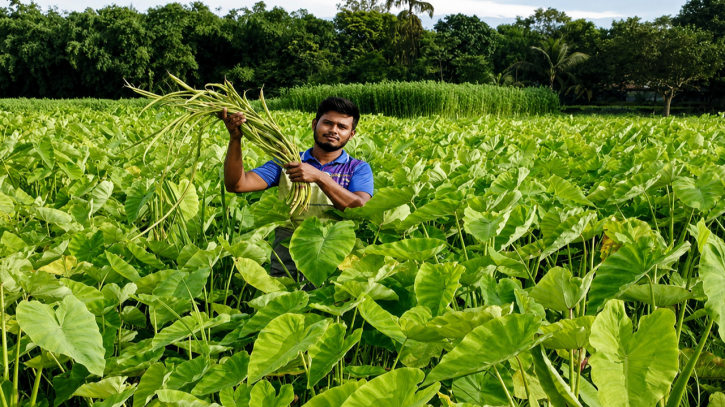
Commercial cultivation of taro stems (kochur lati) is expanding in Jashore, a district long known for vegetable farming. Fields across various upazilas of the district now grow taro stems alongside other vegetables. Favorable weather, fertile soil and agriculture department guidance have made this a low-cost, profitable crop, drawing growing farmer interest.
The stems produced meet local demand and are also sent through wholesalers to Dhaka and other parts of the country. With relatively better prices than rice and other crops, and the ability to harvest over a long period, many farmers see taro-stem cultivation as a profitable alternative.
Taro-stem cultivation is now visible in fields across Fulsara, Pashapol and Sinhajhuli in Chougachha upazila; Bandabila, Jahurpur and Raipur in Bagharpara upazila; Dihi, Kayba and Nabharan in Sharsha; Bakra and Magura in Jhikargachha; Nehalpur, Horihornagar and Monoharpur in Manirampur; Panjia and Suphalakati in Keshabpur; Churamankati, Kashipur, Ichali, Deara, Lebutola and Satmile in Jashore Sadar; and Siddirpasha and Prembagh unions in Abhaynagar.
Rice once dominated large portions of these fields, but taro stems now occupy a share of the land. Farmers say the crop yields for an extended period with regular care.
Abul Hasan, acting deputy director of the Jashore District Agriculture Extension Department, said, “Vegetable farming has always been strong in Jashore. This season, under the early Kharif-2 vegetable program, various vegetables were grown on a total of 6,665 hectares across the district, of which 165 hectares were used for commercial taro-stem cultivation. Fertile soil and proper farmer care have produced a good yield. The agriculture department is providing technical assistance and advice to farmers, alongside guidance on the timely use of balanced fertilizer.”
At Puler Hat market, beside the Jashore-Magura highway, taro stems are bought and sold daily. Saturday and Tuesday are the designated market days, though trading continues on other days as well.
Farmers from Bagharpara and nearby upazilas bring stems by van and other vehicles at dawn. Buying and selling also takes place at various markets around Puler Hat.
Wholesalers say several thousand maunds of taro stems are traded at Puler Hat every day. Trading begins at dawn, with laborers packing the stems into sacks and loading them onto trucks. Traders from across the country also collect stems from markets in Churamankati, Satmile, Abdulpur, Chougachha Kachabazar and Bakra Hat, later shipping them to major wholesale markets in Dhaka, Chattogram, Sylhet and elsewhere.
Profitability is a key reason for farmers’ growing interest in taro-stem cultivation. Facing the risk of natural disasters and uncertainty over fair rice prices, many farmers are choosing taro stems as an alternative crop.
Shahidul Islam, a farmer from Fulsara village in Chougachha, said, “I used to grow rice regularly on my land. But once, continuous monsoon rains badly damaged the crop, and I suffered a big loss. After that, on the advice of the sub-assistant agriculture officer, I started growing taro stems experimentally. In the very first year, I made better profit than expected. Since then, I’ve given up rice and focused fully on taro-stem cultivation. Stems fetch a higher and more stable price than almost any other vegetable in the market, so the risk is much lower.”
Pradip Kumar Roy, a farmer from the same area, said cultivating taro stems requires somewhat more physical labor than rice, but is financially more rewarding.
He said, “This season, I spent about 40,000 taka on fertilizer, saplings and care for 45 decimals of land growing taro stems. So far, I’ve sold about 100,000 taka worth of stems. After all expenses, my net profit stands at 60,000 taka. It’s not possible to earn this much from any other crop in such a short time with such little investment.”
Farmers and traders say the quality of taro stems grown in Jashore’s soil and climate has created distinct demand for it in the market.
Zakir Hossain, a wholesaler at Puler Hat, said, “Wholesalers and retailers from various districts eagerly seek out Jashore’s taro stems. They taste excellent, so they sell out as soon as they reach markets in Dhaka or elsewhere. Because of the strong demand and quality, we’re able to offer farmers good prices.”
Bagharpara upazila agriculture officer Sayeda Nasrin Jahan said, “Previously, only a handful of farmers — four or five — grew taro in Bandabila in this region. But once the soil and climate proved suitable, it spread commercially to nearly all suitable land here. Taro-stem saplings from here are now going to various parts of the country. Sub-assistant agriculture officers regularly visit the field to advise farmers on balanced fertilizer application, timely pesticide use and modern care techniques.”
Information from farmers, traders and the agriculture department suggests taro-stem cultivation in Jashore is gradually becoming commercial. If demand and good prices can be sustained in the market, this cultivation could expand further in the future.