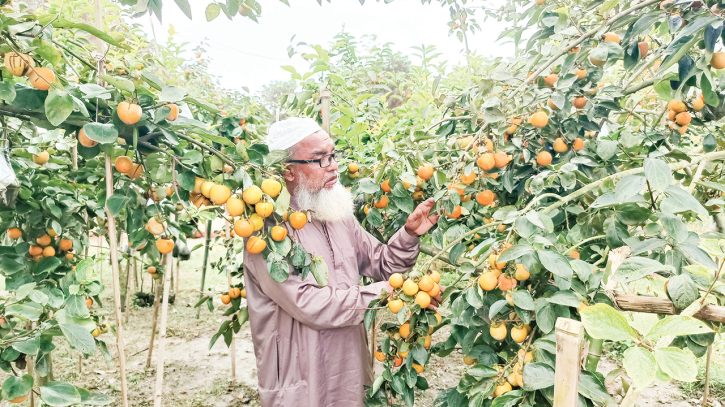
Hijoli village in Jashore’s Chougachha upazila. From a distance, the trees look like they are bearing apples or ripe gab (a local fruit). But get closer, and the picture changes.
It looks like an apple, with a hint of orange in its color. It tastes sweet and is packed with nutrients — almost like the flavor of apple, gab and date all at once. This is persimmon, Japan’s national fruit, now being cultivated in Hijoli village. The man behind it is local farmer Zulfiqar Siddique, who has already turned a profit from the crop.
In an interview, Zulfiqar Siddique said he bought persimmon saplings from Natore in 2021 and planted 30 trees on five kathas of land. After nearly three years of regular care, the trees began bearing fruit. This season, the trees have produced abundant persimmons — fruit hanging from branch after branch, clearly a bumper harvest.
He said hopefully, “A day will come when you’ll find persimmon sweet even unripe. These are just starting to bear fruit, one or two at a time. With support from the agriculture department and tissue-culture propagation, it’s possible to spread this across the country.”
Zulfiqar Siddique is also producing saplings himself. He said, “I want at least 100 more farmers to take up this cultivation through me. If the government provides training and sapling support, Jashore could have a large persimmon orchard within three years.”
News of the fruit in Zulfiqar’s orchard has spread to nearby villages. People come to see the persimmons every day. Local farmers are growing interested in cultivating this attractive, apple-like fruit.
Visitor Monirujjaman said excitedly, “I’ve seen many fruits in my life, but this one is incredibly delicious. The tree bears fruit like kul (jujube), and it’s a joy to see. We’re proud to be able to eat Japan’s national fruit here in this country.”
Many visitors are considering collecting saplings after touring the orchard. Curiosity and interest in this new fruit are growing among farmers.
Agriculture officials say persimmon is being grown experimentally in various other parts of Jashore as well, not just Hijoli. Depending on quality, persimmon sells for 800 to 1,000 taka per kilogram.
Traders say the high price is because the fruit is still rare — demand exists but supply is limited. Its taste and nutritional value are also quickly gaining popularity among urban buyers.
Chougachha upazila agriculture officer Mushabbir Hossain said, “Only one farmer has grown it so far, and he’s been reasonably successful. We presented this at our research and linkage workshop. If a government research institution approves it, we’ll be able to work on it in more detail.”
He added, “If we can create a new market for it and produce new entrepreneurs among farmers, it could spark a revolution similar to strawberries or dragon fruit. Jashore’s soil is famous for vegetables, and there’s good potential for fruit cultivation here too.”
The agriculture department says persimmon cultivation doesn’t require any particularly difficult technology — good yields are possible with the same care given to an ordinary fruit orchard. Choosing the right variety and pruning at the right time, however, are essential.
Dr. Tanvir Islam, assistant professor at the Department of Food and Nutrition Science at Jashore University of Science and Technology, said, “Persimmon is Japan’s national fruit. It’s rich in vitamin A, vitamin C, iron, potassium and antioxidants. Eating persimmon regularly boosts immunity, and it’s good for the eyes and skin. Its high fiber content also aids digestion. It’s a very popular fruit in Japan, Korea and China, and people in our country will gradually come to embrace it too.”
Dr. Tanvir also said there are two types of persimmon — one that softens when ripe, and another that can be eaten crisp. The variety currently grown in Bangladesh becomes soft and juicy when ripe.
Agricultural experts say the persimmon tree is drought-tolerant and does not like standing water. It should do well on Jashore’s elevated, well-drained land. The tree is also relatively disease-resistant and requires comparatively little pesticide use.
According to agricultural economists, like strawberries, dragon fruit and avocado, persimmon could become a new cash crop for Jashore. Once planted, a tree bears fruit for 20 to 25 years, with low maintenance costs.