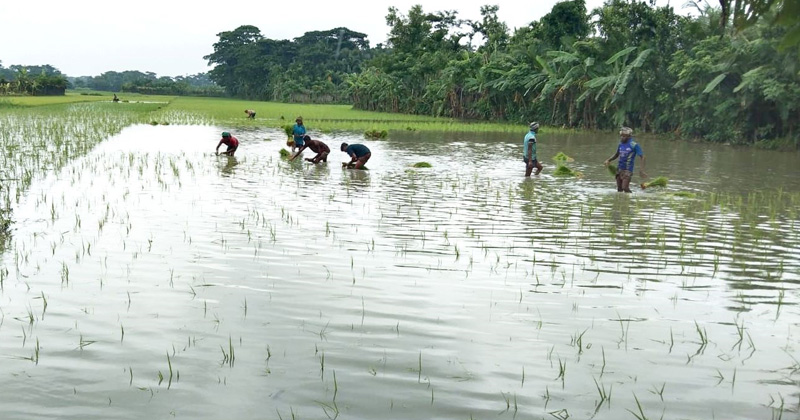
Farmers in Lalmohan upazila, Bhola, have faced severe difficulties in Aman rice cultivation this season — from waterlogging caused by heavy rain to damaged seedbed saplings in some areas, and drainage disrupted elsewhere by unplanned home construction. As a result, this year’s Aman planting has been somewhat delayed. Having worked through these setbacks, farmers are now busy transplanting Aman seedlings, according to upazila agriculture officer Shah Md Ariful Islam.
He said: “Unplanned home construction has blocked a number of culverts, which has slowed the drainage of rainwater pooling in Aman fields. Because water couldn’t flow out of the fields fast enough, standing water delayed planting. But from the start, our office advised farmers to raise more Aman seedlings than the target requires. That’s why, even though some seedbeds were damaged by rain, farmers didn’t face much trouble getting enough saplings.” He added: “So far, Aman has been planted on roughly 12,340 hectares. The remaining land should be fully transplanted within the next few days. Our sub-assistant agriculture officers are working regularly in the field to give farmers the advice they need.”
According to the upazila agriculture office, Lalmohan upazila has set a target of 23,870 hectares for Aman cultivation this season. Of that, 22,750 hectares are targeted for high-yielding varieties including HYV and Swarna, 1,100 hectares for local transplanted Aman varieties, and 20 hectares for the new Hybrid-4 variety.
Although heavy rain caused early setbacks for Aman cultivation, farmers are now in the busy season in the fields. Such scenes were visible across various parts of the upazila during a visit.
Md Belal, a farmer in the Taragonj area of Charbhuta union, said: “This year I’ve prepared roughly 188 decimals of land for Aman cultivation. I’ve already begun transplanting seedlings on some of it. Standing water from the heavy rain caused some delay. The first batch of seedbed saplings was damaged by rain, so I had to raise a fresh batch. From raising the seedlings to finishing transplanting, it will cost roughly 90,000 taka.”
Md Abu Taher, a farmer in the Balirtek area of Ward 9, Dhaligournagar union, will cultivate Aman rice on 360 decimals of land this year.
He said: “The rain caused some trouble with the seedbeds. But I’m hoping to overcome that. I’ve finished plowing the land and prepared it for transplanting. From raising seedlings in the seedbed to preparing the land, I’ve spent roughly 35,000 taka so far. If the weather stays favorable, I’m hoping for a good Aman harvest this year.”