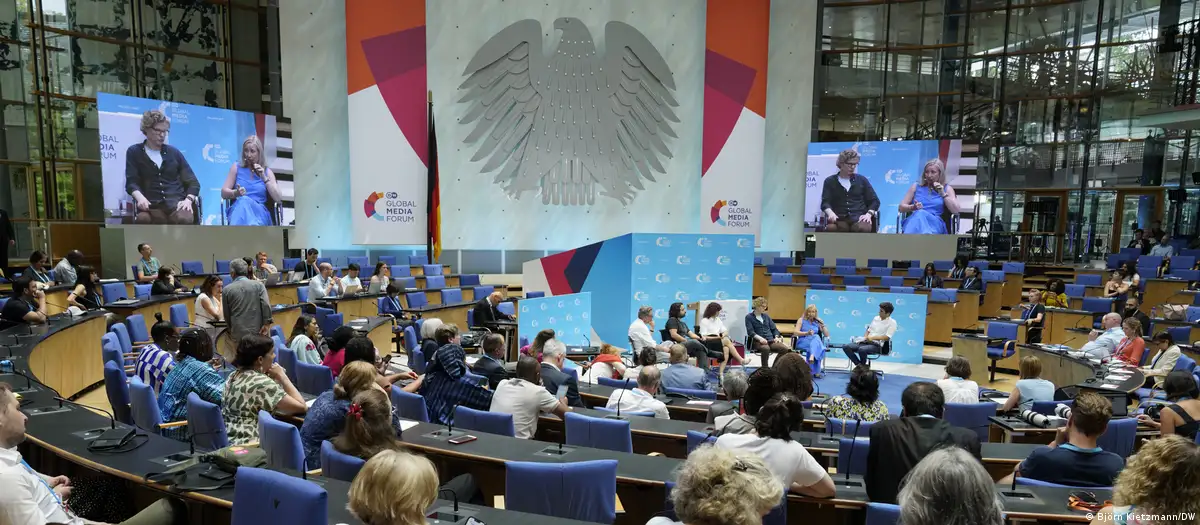
Deutsche Welle Director-General Barbara Masig opened the 19th Global Media Forum (GMF) at the World Conference Centre Bonn (WCCB) with a call for journalism to raise its voice in an age of information overload. The two-day forum brought together more than 1,400 participants from over 100 countries.
“This year our theme is Journalism Out Loud. Because in an increasingly noisy world, journalism must be louder,” Masig said.
“The good news is that even in the age of social media and artificial intelligence, established media organisations remain among the primary sources of information for most people. That gives us a strong foundation — it reflects the payoff of credibility, accuracy, context, and long-term commitment to journalism,” she added.
Masig said digital platforms and AI benefit greatly from journalism-based content that journalists produce, “which we would never accept in any other field.” She called for sustainable business models that support quality journalism and ensure content creators receive a fair share of the value their work generates. “In this way we can make the best use of technological innovation and journalistic expertise in the service of democracy and security.”
On the second day of the GMF, DW Academy published a meta-study titled “The Value of Journalism” examining the public contribution of independent journalism. Masig said the research showed that every dollar invested in independent journalism can generate more than $100 in public value through improved public services and reduced corruption. By contrast, misinformation costs societies between $350 billion and $500 billion per year worldwide.
“We must keep acknowledging the importance of journalism and ensure that media organisations remain economically viable. Otherwise we risk losing diversity and plurality in the media — and in doing so, we weaken one of the foundations of democracy,” she said.
North Rhine-Westphalia’s Minister for Federal, European and Media Affairs, Nathanael Liminski, said it is becoming increasingly difficult even in Germany and across Europe for those who contribute diversity of information and opinion to secure the funding needed to sustain their work.
বাংলায় মূল প্রতিবেদন পড়ুন · Read the original Bengali report