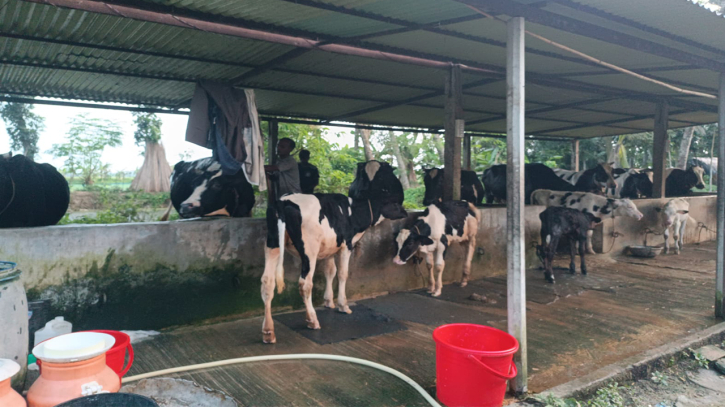
Abul Hasan Sobuj of Chougachha upazila, Jashore, has built an integrated agricultural farm by putting his education, experience, and hard work to use. What began with just three cows and 10 goats has grown into an integrated farm producing milk from 29 cows, along with ghee, fish, fruit, vegetables, poultry, organic fertilizer, and biogas. Beyond meeting his own family’s needs, the venture has also created employment for local residents.
Abul Hasan Sobuj is a native of Hauli village in Pashapol union, Chougachha upazila. Early in his career, he worked for five years at Renata Bangladesh, a company in the country’s pharmaceutical and livestock sector, gaining field-level experience in dairy and livestock management. Combining that experience with his agricultural science background, he later set out to establish his own dairy farm.
He currently teaches in the agricultural science department at Jhikargachha Shahid Mashiur Rahman Degree College, running his farm alongside his teaching career.
From small beginnings to a large farm
Sobuj started his farm with three cows and 10 goats of various breeds. He gradually expanded its scope. His farm now has 29 cows of varying sizes, of which 16 produce an average of 300 to 350 kilograms of milk daily, he said.
The farm’s milk meets local demand and is also supplied to various organic supermarkets, including Bismillah Dairy, Adi Ghosh Dairy, and Satkhira Ghosh Dairy in Jashore city. Sobuj also sells milk directly to 30 to 35 families in the village. The farm’s milk is also used to make ghee.
Scientific approach to cattle feed management
The farm follows a specific routine for feeding and caring for the cows. Fresh Napier grass with balanced feed is given in the morning, grain feed in the afternoon, and dry straw at night.
Cows are bathed regularly to ensure cleanliness. Sobuj said the farm spends roughly 7,000 to 8,000 taka daily on livestock feed, covering grain feed, bran, oil cake, straw, and green grass.
To reduce feed costs and ensure a year-round supply of green grass, he has planted Napier grass on three bighas of his own land.
Fish, fruit, and vegetables alongside cattle
Sobuj’s venture isn’t limited to dairy farming. He grows bananas, dragon fruit, mangoes, and various seasonal vegetables in his home’s yard and surrounding land. He also raises indigenous chickens, ducks, and pigeons. Various fish species are farmed in a pond next to his home.
The farm also puts cow dung and other waste to use, producing organic fertilizer, vermicompost, and biogas. The biogas is used for household cooking, while the organic fertilizer and vermicompost are used on the fruit, vegetable, and grass plots.
Employment at the farm
Alongside family members, two permanent workers are employed at Sobuj’s venture. One of them, Milon Hossain, said: “I work here for a monthly salary of 12,000 taka. With a regular salary, my family is doing well. The working environment here is good too. The owner treats us like his own family.”
Sobuj’s father, Wazzel Hossain, said: “We are proud today because of our son’s hard work. Instead of chasing a job, he built this farm using his own talent. Because of him, our family is now financially secure, and people in the area are getting milk too.”
Sobuj’s younger brother and veterinarian Shahinuzzaman Toni said: “Applying scientific knowledge of agricultural science and livestock management on the farm is producing good results. I regularly check the cattle’s health and provide necessary treatment.”
Regular milk buyer Jahangir Alam of Bariari village said: “The milk from Sobuj Bhai’s farm is good. We regularly buy milk and ghee from here.”
Plans to expand further
On his venture, Abul Hasan Sobuj said: “With proper planning, appropriate training, and a mindset of hard work, success is possible in any sector. I want to grow this farm further. This will create employment for more unemployed people and let me play some role in meeting the country’s nutritional needs.”
Jashore District Livestock Officer Dr Siddiqur Rahman said: “Abul Hasan Sobuj’s initiative in creating employment for young people and producing milk is commendable. If educated and experienced young people come forward like this in agriculture and livestock, the country’s dairy and agricultural sectors will grow even more prosperous.”
বাংলায় মূল প্রতিবেদন পড়ুন · Read the original Bengali report