During the Awami League government’s rule, the banking sector was held hostage by a handful of industrial groups. In the government’s last two years, the looting of money from these groups’ banks intensified further. After the Awami League government’s fall through the July uprising, the interim government began reforms in the country’s banking sector, and that process is still under way.
Over the past two years, steps taken include policy support to cut bad loans, reconstituting the boards of captured banks and moves to merge five weak banks. Risk-based supervision has been strengthened, and necessary legal reforms have also begun.
Despite many reform efforts, the sector still carries the burden of the bad loans, capital shortfalls, provision gaps and liquidity crisis created over the Awami League government’s decade and a half. Over the past two years, however, there has been a positive picture of reserves, a stable dollar market, and remittance and deposit growth.
Bank-sector insiders say the financial damage done to the sector over the past 15 years through political influence, uncontrolled lending and money laundering cannot be undone in a short time. The current government has continued the reforms begun by the interim government, but the depth of the crisis is such that it will take several more years for the sector to recover; if the reforms cannot be sustained, it will fall into deeper crisis.
When the interim government took charge after the July 2024 uprising, the banking sector was in acute crisis. Foreign-exchange reserves were falling fast, the dollar market was volatile, the economy was under high inflationary pressure, and dozens of banks in severe liquidity crisis were struggling even to return depositors’ money.
To tackle the situation, Bangladesh Bank took a series of corrective steps, including launching investigations into big industrial groups over embezzlement and laundering, bringing bad loans to light and framing new bad-loan policy, reconstituting weak banks’ boards, proposing amendments to the Bank Company Act, reforming the bankruptcy law, proposing an asset-management company and merging five Islamic banks. The current government has continued these reforms.
Reserves up by $11 billion
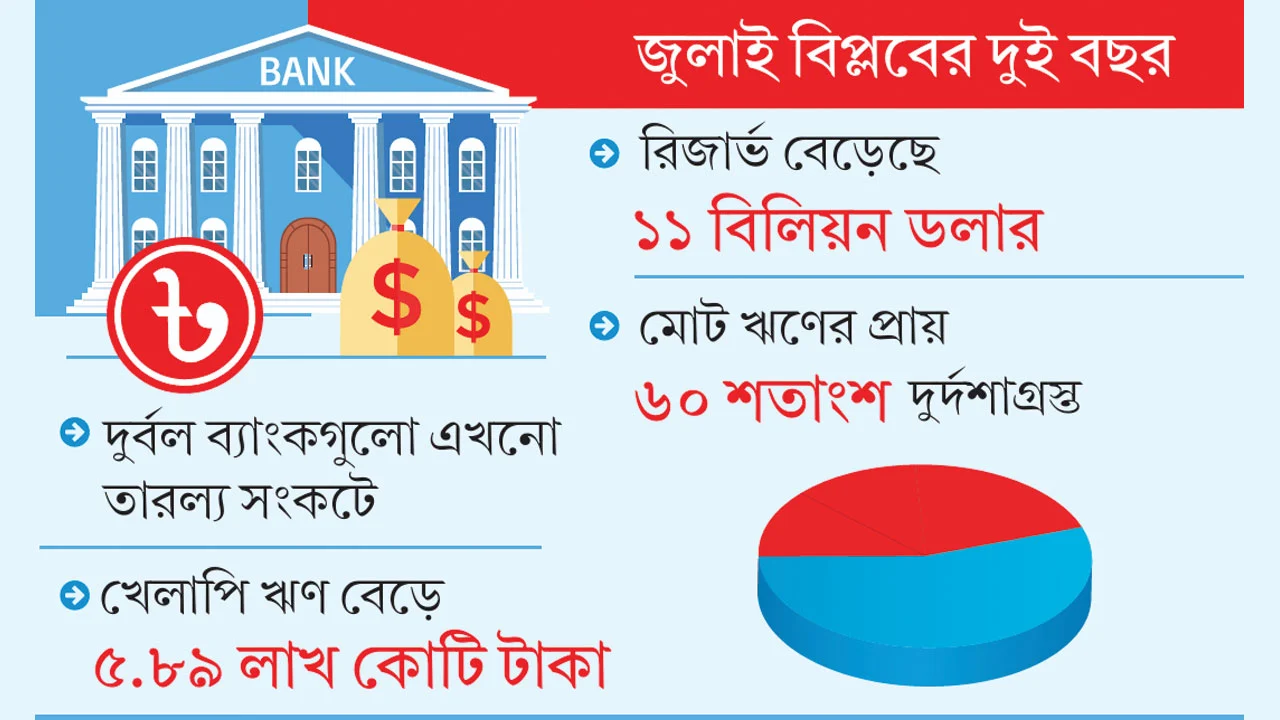
Over the past two years, foreign-exchange reserves have risen significantly, and stability has returned to the dollar market. Before the Awami League government’s fall, total reserves were $25 billion; at the end of July they had risen to $36 billion — a rise of $11 billion in two years.
The dollar market, which had become so unstable under the Awami League government that import curbs had to be imposed and the central bank had to sell large amounts of dollars — causing reserves to fall fast — has since stabilised. After the interim government took charge, Bangladesh Bank on 14 May 2025 introduced a market-based exchange-rate system in line with IMF conditions. This stabilised the foreign-exchange market; as the gap between open-market and official rates narrowed, remittance flow rose and international lenders began disbursing funds.
Remittance growth
Since the Awami League government’s fall in the uprising, there has been strong growth in remittance flow. What was around $2 billion a month under the Awami League government has now crossed $2.5 to $3 billion. In the outgoing 2025-26 fiscal year, Bangladesh received record remittances. According to Bangladesh Bank, total remittances of $35.56 billion came in last fiscal year, 17.30 percent more than the previous year. In 2024-25, $30.32 billion in remittances came in, about 26.80 percent more than the year before; in 2023-24, $23.91 billion came in, 10.66 percent more than the previous year; and in 2022-23, $21.61 billion came in. Insiders say that after the uprising, routes for laundering money abroad have narrowed sharply, cutting demand from hundi operators — and that when black-market demand falls, remittance flow through legal channels rises.
High deposit growth
Late in the Awami League government’s tenure, the tendency to keep deposits in banks fell, with deposit growth between 7 and 8 percent. After the change of government, bank-sector initiatives lifted deposit growth to 11.5 percent. But not all banks benefited equally: while deposits rose at comparatively strong banks, weak banks still cannot meet daily withdrawal demand from daily deposits and must borrow from the central bank and other banks to meet liquidity needs.
Inflation down
In the Awami League government’s final years, inflation rose significantly, driven mainly by excess money printing, the dollar crisis and large bank loans. At the time of the government’s fall, inflation was 9.72 percent; by June this year it had fallen to 9.16 percent. To lower interest rates, the central bank raised the policy rate in steps to 10 percent, pushing bank lending rates up too, so private-sector credit growth is at its lowest.
Bad loans rising
The sector’s biggest worry is still bad loans. According to the central bank, before the Awami League government’s fall, bad loans stood at 211,000 crore taka as of 30 June 2024, with a provision shortfall of 24,810 crore taka. But there are allegations that the sector’s real financial condition was concealed at the time. After the interim government took charge, banks’ real financial picture began to emerge, bringing to light huge amounts of previously hidden bad loans and capital shortfalls. At the end of March this year, bad loans had risen to 588,704 crore taka, and the provision shortfall to 205,665 crore taka.
The capital situation is also worrying. The central bank’s latest financial-stability report showed that the sector’s capital-adequacy ratio against risk-weighted assets fell last year to minus 2.64 percent, against a minimum of 12.50 percent required under the internationally practised Basel III framework. Insiders regard an entire banking sector’s average capital turning negative as a rare event in the modern world.
Bangladesh Bank officials say special policy facilities were given to cut bad loans, letting borrowers reschedule loans by paying 1 percent, along with interest waivers and exit facilities. Even so, bad loans are not falling as expected, as a large share of the money is alleged to have been laundered abroad, making recovery complex and pushing provision and capital shortfalls higher.
Distressed loans up
High-risk distressed loans have risen further. Even after a record 170,503 crore taka of loans were rescheduled last year, most indicators worsened. At year’s end, distressed loans stood at 1,087,590 crore taka — 59.73 percent of total loans — a rise of 331,037 crore taka in a year.
According to Bangladesh Bank, at the end of 2025 the sector’s total outstanding loans stood at 1,820,915 crore taka, of which 557,217 crore was shown as bad, 446,894 crore remained unpaid after rescheduling, and 83,479 crore was written-off but unrecovered. A year earlier, total outstanding loans were 1,711,138 crore taka, of which rescheduled unpaid loans were 348,461 crore, bad loans 346,547 crore and written-off unrecovered loans 62,327 crore — together about 756,553 crore taka, or 44.21 percent, of loans disbursed up to that point.
Insiders say most of these distressed loans were created under the Awami League government but were shown as regular through tactics at the time. After the government’s fall in 2024, the interim government began showing the real picture. Many influential businesspeople involved in irregularities and fraud have fled, and some are in jail. From before the 2014 election, one facility after another was given to please businesspeople — rescheduling loans on token down payments, or renewing or restructuring loans for 12 years under special arrangements on 2 percent down payments — but with a large share of those loans now bad, the situation has worsened. After the abnormal rise in bad loans, a special rescheduling facility was again offered late last year.
Reforms
Several important steps have been taken to reduce risk, ensure good governance and revive weak banks. These include strengthening risk-based supervision — instead of conventional compliance-based supervision — so weaknesses can be identified early, and implementing a bank-resolution framework to restructure troubled banks and merge or wind up the five weak banks. Efforts to establish good governance in weak banks’ boards and management, strengthen the regulatory framework and advance legal reforms are also under way.
According to economists, significant progress has been made in restoring stability over the past two years. But the sector’s long-term crisis cannot be overcome without recovering bad loans, bringing back money laundered abroad, filling capital shortfalls and restructuring weak banks. In their view, sustaining the reforms begun after the uprising is now the sector’s greatest need.
বাংলায় মূল প্রতিবেদন পড়ুন · Read the original Bengali report