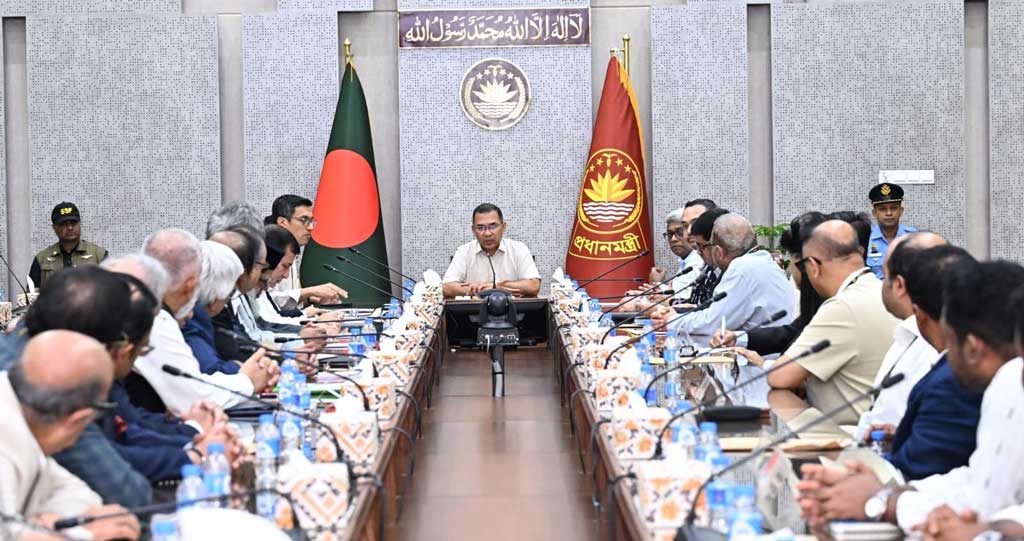
Prime Minister Tareque Rahman has expressed hope that gas supply to industry will return, from tomorrow, to the level it was at a month and a half ago. He also sought cooperation from business leaders and the media in implementing the government’s plans for the power and energy sector.
The prime minister called on everyone involved to refrain from creating instability and instead allow these plans to be implemented during the government’s term.
He made the comments Monday during an exchange-of-views session with business leaders and media figures at the Prime Minister’s Office in the Bangladesh Secretariat. Over the three-hour discussion, participants shared their views on various issues. The prime minister’s deputy press secretary, Hasan Shiplu, confirmed this, adding that power, energy and mineral resources deputy minister Anindya Islam Amit gave a presentation titled “Challenges and Future Roadmap of Bangladesh’s Power and Energy Sector” at the meeting.
The prime minister described the country’s current power and energy sector crisis as an “inherited problem.” He said the crisis cannot be fully resolved within six months or a year. However, he said, the government has identified the problems, drawn up a plan, and is now at the implementation stage.
Tareque Rahman said the government is working to a specific timeline to normalise power and energy supply. Once the plan is implemented, he said, both business and the overall economy will benefit.
Explaining the cause of the current gas shortage, he said supply was disrupted following an accident at one of the country’s two floating LNG terminals, affecting various sectors including industrial plants. The accident-related problem, he said, has already been resolved.
The prime minister further said: “We expect gas supply to return to its level of one to one and a half months ago from tomorrow evening.” He also spoke of an initiative to set up a third floating LNG terminal to address the shortfall, saying preparations for another terminal on a government-to-government basis had been largely completed over the past month, with work to begin soon.
Tareque Rahman also expressed hope that the government would be able to connect the third terminal to the supply system by December 2027. He said the power sector’s problems are also long-standing, noting that since taking office, the government has reviewed the issues, consulted with stakeholders, and drawn up plans to resolve them, which are now being implemented.
The prime minister added that planning and implementing anything takes time. The energy and power problems, he said, are inherited, and cannot simply be resolved within six months or a year by choice.
A possible timeline for when the government intends to complete each task was also presented to business leaders at the meeting. Noting this, the prime minister said the timing of implementation could shift somewhat, but the government has a clear plan and schedule in front of it.
Seeking the business community’s cooperation, the prime minister said that when trade and industry suffer, the overall impact falls on the country’s economy. As a result, resolving the energy and power problems is not just a matter of business interests — it is tied to the country’s overall economic progress.
The prime minister further said that achieving the goal of reaching a one-trillion-dollar economy by 2034 requires ensuring an uninterrupted and adequate supply of energy and power. The government has drawn up long-term plans with that goal in mind.
Saying there was no reason for despair, the prime minister said the business community is already aware of the scope and complexity of the current problems. The government, he said, has laid out the problems openly rather than concealing them, while also explaining how it intends to solve them. “I want to assure you that we are working on this. There is no reason to feel discouraged,” he said.
Calling for cooperation in implementing the government’s plans if they seem reasonable, the prime minister said that once implemented, not just the business community but the whole country and nation would benefit.
The prime minister also expressed concern that instability in the country could harm trade and the economy. He said the public would decide in due course who is given the responsibility of running the government, but whichever government is in office at a given time should be given the opportunity to complete its planned work.
Explaining why media professionals and figures were invited to the discussion, the prime minister said the government’s intentions and plans need to be clearly conveyed to the media. Otherwise, he said, fragmented information could create various kinds of confusion. If the media has a clear understanding of the government’s plans, he said, it can present them accurately to the public.
The prime minister said an effective team is needed to successfully carry out any major task. Everyone involved in the government is working together, he said, so that implementing these plans brings positive change to the lives of people across all classes and professions. Addressing the business and media representatives, the prime minister said: “Please cooperate with us, so that we can do even better for you.”
Also present at the meeting were commerce minister Khandaker Abdul Muktadir; the prime minister’s adviser on finance and planning, Rashed Al Mahmud Titumir; education, expatriate welfare, and labour and employment adviser Mahdi Amin; Bangladesh Investment Development Authority chairman Ashik Chowdhury; the prime minister’s principal secretary, A B M Abdus Sattar; Bangladesh Bank governor Mostakur Rahman; power secretary Mirana Mahrukh; and energy secretary Md Ziaul Haque.
Business leaders present included FBCCI administrator Fazlul Haque; BGMEA president Mahmud Hasan Khan; International Chamber of Commerce president Mahbubur Rahman; BKMEA president Mohammad Hatem; Bangladesh Chamber of Industries president Anwar-Ul Alam Chowdhury Parvez; Bangladesh Jute Mills Association acting president Abul Kamal; Chittagong Chamber of Commerce and Industries president Amirul Haque; and Bangladesh Agro Processors Association president Mahbub Anam, among others.
Also present were Daily Manabzamin editor Matiur Rahman Chowdhury; BNP media cell convener Dr Maudud Hossain Alamgir Pavel; English daily Waadar editor Shafiqul Alam; and journalists Ashraf Kaiser, Mostafa Feroz, Abdun Noor Tushar, Akbar Hossain, Shahed Alam, Rezaul Karim Rony, Azizur Rahman Ripon and Tariqul Islam Sourav, along with Jahangirnagar University teacher Dr Nahrin Islam Khan.