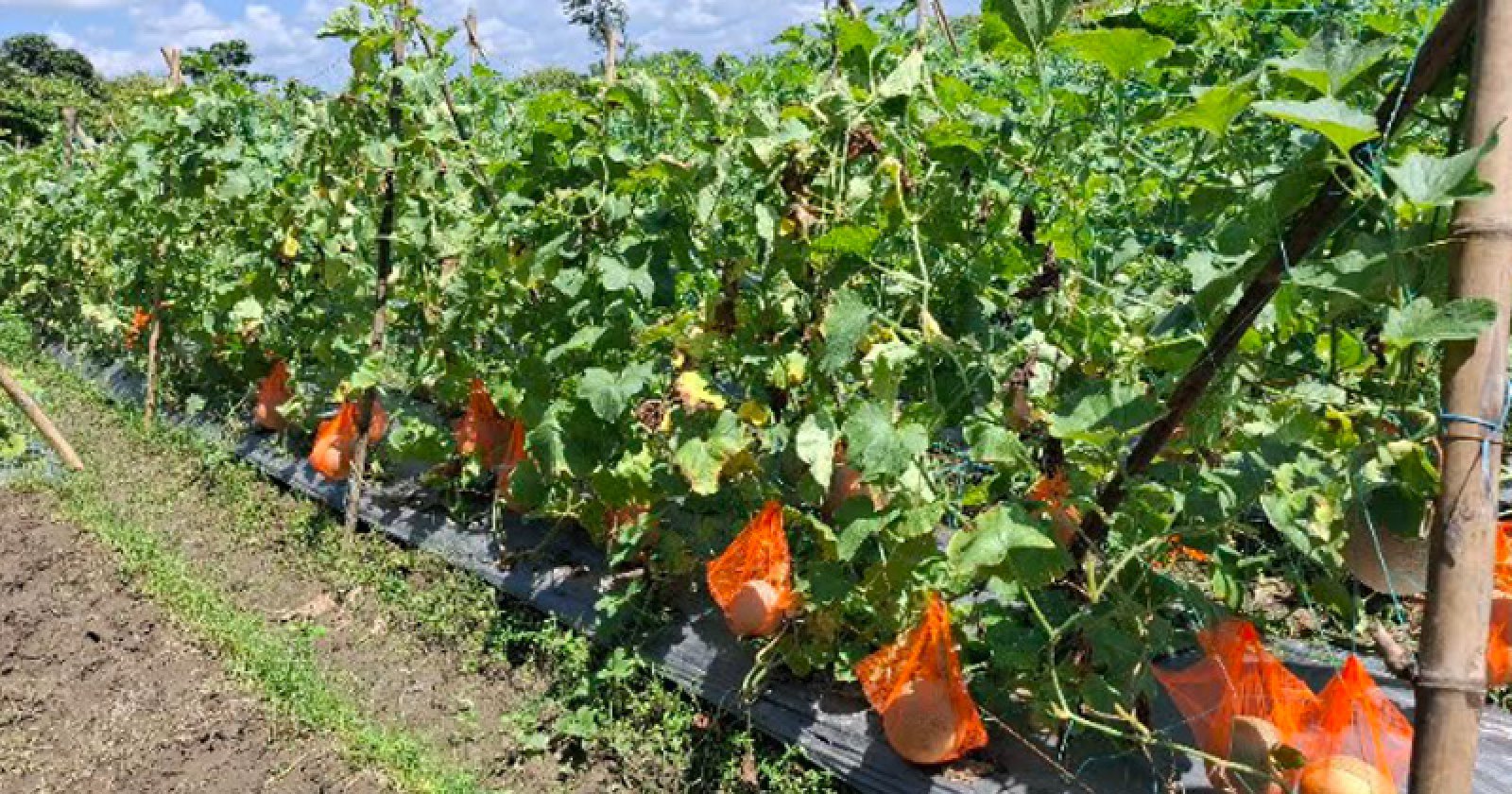
GAZIPUR, Sept. 26 — Rows of foreign fruit now hang from land that once lay unused. The green-yellow fruit looks much like watermelon, but it is called sammam, also known as rock melon. Agricultural entrepreneur Md Kamruzzaman Khan is dreaming of new possibilities by growing the fruit on leased land in Kapasia, Gazipur.
Kamruzzaman, a resident of Suryanarayanpur village in the upazila, has cultivated sammam using modern methods on land in the Uttar Khamar area of Targaon union. He is caring for the plants with mulching film. He has already sold about 50 thousand taka worth of fruit in the first round. He expects total sales to exceed 6-7 lakh taka if all the fruit is sold.
But his investment has also been substantial. According to the farmer, he has spent about four lakh taka so far on land, seedlings, labor, fertilizer, irrigation, mulching and care.
A recent visit to Kamruzzaman’s orchard in Uttar Khamar found mulching film spread across the land. Sammam seedlings had been planted at fixed intervals over it. The vines were climbing onto trellises. Some plants had small fruit, while others carried larger fruit nearing maturity.
Workers were also busy in the orchard. Some cleared weeds, some watered plants and others cared for fruit and vines.
Kamruzzaman Khan said he had spent about four lakh taka so far and had sold around 50 thousand taka worth of sammam in the first round. If the fruit is fully sold, he said, he hopes for sales of six to seven lakh taka.
He said fruit from the orchard is being sent to Dhaka wholesale markets as well as local markets. He is currently selling sammam to wholesalers for about 80-100 taka per kilogram.
Kamruzzaman Khan graduated from Kapasia College. Instead of a job or a conventional profession, he chose agriculture as a source of income. He said the initiative has helped him support his five-member family while also creating work opportunities for several laborers.
Kamruzzaman said he is cultivating with modern methods based on advice from the agriculture office. He said he has not faced losses so far and plans to establish a larger foreign fruit orchard in the future.
According to him, he plans to expand foreign fruit cultivation from January.
Kapasia Upazila Agriculture Office Additional Agriculture Officer Syed Shakil Ahmed said rock melon or sammam cultivation usually takes 75-90 days. With proper care and market prices, sales may reach 2-3 lakh taka per bigha, he said. Production costs may be around 30 thousand taka, though actual costs can vary depending on land type, labor, inputs and management.
He said sammam contains beta-carotene, vitamin C, potassium, folic acid, calcium and magnesium. Regular care, water management and disease control are essential for the crop, he said.
The agriculture officer said the loamy soils in the old Brahmaputra and Shitalakshya river basins in Kapasia’s Targaon, Tok, Barishab and Sanmania areas may be suitable for sammam cultivation.
Alongside yield, the market has become the most important issue for farmers growing sammam. Kamruzzaman is currently sending his fruit to Dhaka wholesale markets. Although he is getting 80-100 taka per kilogram there, it is not certain whether the same price will hold through the end of the season.
People involved in agriculture say marketing is the major challenge after successful production in the commercial cultivation of any new fruit. Because the fruit can spoil quickly, transport and sales must be arranged soon after harvest. Prices may also fall if supply increases in the market at the same time.
As a result, the actual financial success of Kamruzzaman’s sammam orchard will depend on how many kilograms of fruit are ultimately produced, the price received and how much remains after total expenses.
Farmers from nearby areas are also visiting the new fruit orchard. Some ask where seedlings can be found, some ask how much it costs per bigha, and others ask how long the fruit takes and what price it can fetch in the market.
Kamruzzaman’s initiative is therefore not limited to one orchard. It is also creating interest among local farmers in cultivating new and high-value fruits beyond traditional crops.
The agriculture department says commercial potential for sammam may develop in Kapasia if cultivation expands with agricultural advice, market analysis and proper accounting of production costs. But long-term success cannot be determined from the yield and sales figures of a single season.
Many fruits are still waiting to mature in the orchard. Once they reach the market, it will become clearer whether this new foreign fruit on Kapasia soil is merely a novelty for farmers or truly a new path to income.
বাংলায় মূল প্রতিবেদন পড়ুন · Read the original Bengali report