India’s Tata Group is one of Apple’s main suppliers. Allegations have recently emerged that waste discharged from Tata’s iPhone-components factory has polluted farmland and caused skin diseases among farmers, prompting a local state health authority to open an investigation. The information comes from three government officials and an official document reviewed by the news agency Reuters.
According to the sources, on May 25 the state pollution control board sent a warning notice to this Tata Electronics plant in Hosur, in the state of Tamil Nadu, over allegations of contaminating groundwater at a neighbouring farm. The plant, which opened in 2021, makes some key components, including the back cover of the iPhone. After a series of complaints from farmers, local health officials have been investigating the factory since late May.
Anish Parveen, the government medical officer of Ullugurukkai — the village where the plant is located — sent a letter on May 27 to the Vector Control and Zoonoses Institute in Hosur. The letter, seen by Reuters, said the waste from Tata’s factory was causing a ‘severe stench’ in the area and that the water had become so polluted it was ‘unfit for animals to drink.’ It also said wastewater from Tata Electronics had collected on nearby farmland and was contaminating the clean water of surrounding wells. People were said to be suffering from skin diseases and various other health problems as a result of the pollution. Although no specific case has yet been medically proven, Anish Parveen confirmed receiving numerous complaints of skin disease from farmers.
Health officials collected two water samples from the farmland and sent them to a state government laboratory for testing. According to a public health laboratory report dated May 30, both samples were found to contain E. coli bacteria, which mainly indicates contamination from sewage or human waste. Rajesh Kumar C, the senior government official overseeing public health in the region, said the health department’s investigation was still under way and that the results of a second round of testing were awaited.
Earlier, in April, the pollution control board had collected water samples from two open wells near the factory. The ‘total dissolved solids’ (TDS) — the amount of minerals, salts and metals dissolved in water — were found to be 1,084 and 1,286 milligrams per litre respectively. According to the Bureau of Indian Standards (BIS), the acceptable level for drinking water is a maximum of 500 milligrams per litre — meaning the water in the wells around the factory contained more than double the acceptable level of harmful substances.
This week Tata Electronics claimed in a statement that the pollution control board had withdrawn its investigation because tests on recent water samples collected from inside the factory premises showed no contamination. However, neither the pollution control board, the Tamil Nadu government nor the parent company Apple gave a formal response to Reuters’ emails or phone calls. A source connected to the factory said that last December a pump at the factory’s waste-treatment plant had failed, causing some sewage to flow into its rainwater-storage pond and later overflow into an outside lake. Tata, however, claimed it had immediately stopped the overflow and repaired the pump.
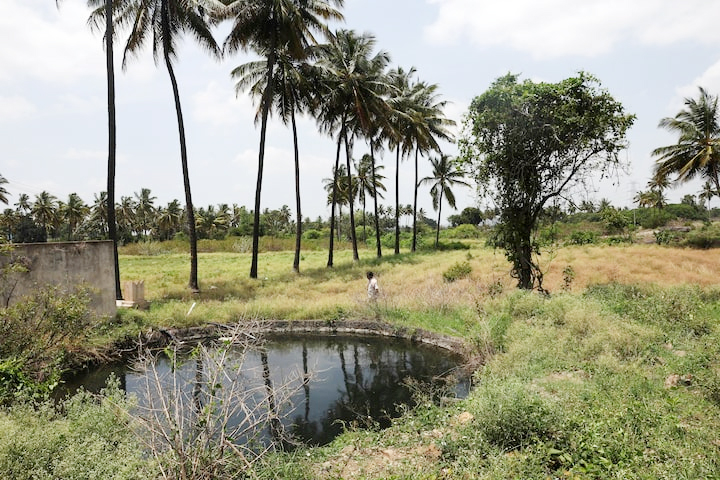
Reuters reporters who visited the factory area saw that the water in the open wells had turned completely black, and that water pooled against the factory wall was green and covered with algae. Gurumurthy V, a 40-year-old local farmer, said with regret: ‘If you sow seeds with this water, the seedlings sprout, but a few days later they dry up and die.’ Meanwhile, last Monday a member of a local farmers’ group climbed over Tata’s boundary wall to photograph the pooled, polluted water. A factory security guard raised a firearm to stop him. Angry farmers then began shouting ‘shoot us,’ and the situation grew tense, but it returned to normal without any untoward incident.
Having shifted production away from China, Apple now relies heavily on India; 26 percent of all iPhones in the world are currently made there. At such a time, these allegations — that a major industrial giant is destroying the land and health of poor local farmers — have raised serious questions about the effectiveness of India’s environmental compliance in the global supply chain.
বাংলায় মূল প্রতিবেদন পড়ুন · Read the original Bengali report