There was a time when, alongside a farmer’s granary full of rice, a clay pot, a bamboo bin, or a spot carefully kept under the roof held the next season’s seeds. Cultivation for the new season would begin with seeds selected from a good harvest. Seed was the farmer’s own asset, the farmer’s own security. But that picture has changed with time. Packets from the market have taken the place of seed once kept in farmers’ homes. Having lost their own seed, farmers are increasingly dependent on the market.
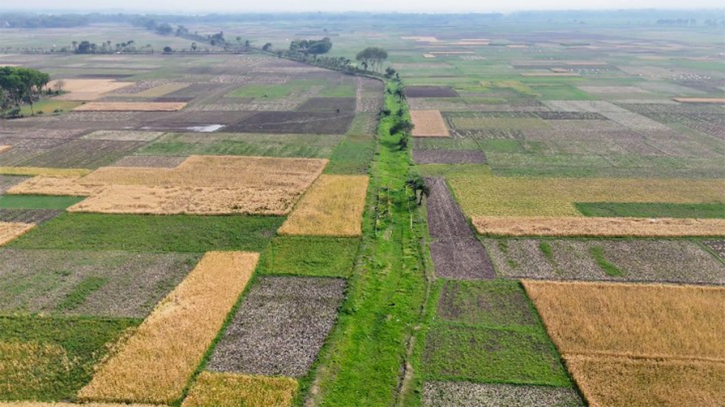
That shift is now clearly visible in Jhenaidah’s fields. Even though farmers still hold their land, in many cases they no longer control the seed for the next season. Because government supply is limited, a large share of demand has to be met through private companies and local markets. This is raising production costs on one hand, while on the other, farmers could face major risk if the seed supply in the market is disrupted for any reason. Over the long term, this could also affect agricultural diversity and food security.
Private seed at high prices
Hashem Hossain, a marginal farmer from Hazramina village in Shailkupa upazila, has planted Aman rice on 35 bighas of land this season. Hoping to get government seed, he went repeatedly to a dealer authorized by the Bangladesh Agricultural Development Corporation (BADC), but couldn’t get the seed he expected. In the end, he bought packaged hybrid seed from a private company at a high price from the local market and used it in his seedbed. The seedlings grown from that seed are what’s now planted in his field.
Moslem Uddin, a farmer from Kacherkol village in the same upazila, has had a similarly unpleasant experience. Part of the seed he received failed to germinate. He said: “There was a time when, after harvesting rice, good grains would be set aside and preserved separately as seed. Cultivation the following year was possible with that seed, carefully kept in a clay pot or a bin. Now there’s no such assurance. Every season, you have to look to the market for seed.”
Growing dependence on the private sector
According to the district agriculture department, Jhenaidah has roughly 150,235 hectares of total cultivable land. Of this, BADC supplies roughly 19 percent of high-yielding variety (HYV) seed and roughly 1 percent of hybrid seed. In other words, a large share of seed demand is being met through private companies and the market.
According to the agriculture department, roughly 10 years ago, about 90 percent of farmers in the district preserved seed for the next season from their own harvest. Today, that picture has changed considerably. Most farmers now buy seed from various companies and the market to cultivate.
Jhenaidah’s seed market includes products from various private companies, including Lal Teer, ACI and Bayer. Because government supply is limited relative to demand, a large share of farmers have to rely on the private market.
New seed every season
In hopes of higher yields, farmers’ use of hybrid seed is also increasing. But with hybrid seed, the harvested crop cannot be used to preserve seed of the same quality and characteristics for the following season. As a result, new seed has to be purchased every season.
This further reduces farmers’ own control over seed. Even with land in hand, farmers must depend on the market for seed, one of the most essential inputs for cultivation.
Masud Molla, a farmer from Damukdia village in Shailkupa, said: “Before, when we harvested rice, we’d set aside good grains. The next season, we’d make seed from that rice and cultivate. Now we have to buy company seed. The habit of keeping our own seed has largely disappeared.”
Local varieties disappearing
Alongside growing market dependence for seed, concern has also emerged in Jhenaidah over the loss of local, traditional seed varieties.
At one time, roughly 40 to 45 rice varieties, 22 to 25 pulse varieties, and around 30 vegetable varieties were cultivated across different seasons. Today, the number of rice varieties has grown to roughly 60-65, pulses to 32-35, and vegetables to 55-65. But even as the number of varieties has grown, cultivation and preservation of many local varieties has declined.
Local rice varieties such as Jhingashail, Latishail, Katarivog, Rajashail, Dudhkolom, Bansful, Rupshail and Digha are extinct or nearly extinct. Similarly, local varieties of khesari pulse, red mung bean, black gram, magi mustard and sesame are also being cultivated less than before.
According to agricultural experts, local varieties aren’t just part of heritage — they’re also an important resource for managing farmers’ risk. When farmers have multiple varieties of seed on hand, if one variety is damaged by disease, pests or bad weather, production can still be maintained with another variety. In contrast, excessive dependence on a limited number of commercial varieties can put agriculture at major risk.
Cesar Zikrul, a farmer from Monoharpur village, said: “Various companies’ seeds are available in the market. Sellers offer seed, promising good yields. But if the seed isn’t good, we’re the ones who suffer most. Fertilizer, pesticide, irrigation and labor costs are all tied to the seed.”
Bashir Ahmed, a farmer in Kaliganj, said: “If seed is stored at home, cultivation costs drop significantly, and farmers benefit. But that isn’t happening now. Buying seed eats into the farmer’s profit.”
Growing need for seed banks
Habibur Rahman, a farmer from Kacherkol village in Shailkupa, also described the limits of government seed supply. He said that after seeing an agriculture department demonstration plot, he cultivated a new rice variety and got a good yield. But the following year, when he tried to collect seed of that same variety, he was told the government allocation had run out. He was then forced to buy more expensive private seed instead.
Field-level agriculture officials also acknowledge that while initiatives exist to produce and preserve quality seed at the farmer level, their reach remains limited. As a result, most farmers remain outside this benefit.
Given this situation, calls are growing louder for building seed banks at the union level, training farmers in scientific seed preservation, collecting and preserving local variety seed, and increasing BADC’s production and supply capacity.
Jhenaidah Department of Agricultural Extension deputy director Kamruzzaman said: “Alongside using quality seed, farmers are being advised to collect and preserve seed from their own good harvests.”
He said: “If farmers can collect seed at the right time from good, disease-free land and preserve it properly, they’ll be able to use their own seed the following season. This would reduce the cost of buying seed on one hand, and on the other, somewhat reduce dependence on the market when it’s needed most.”
Noting that field-level officials are advising farmers in various ways on producing and preserving quality seed, he said: “Through demonstration plots, farmers are being introduced to improved crop varieties. When good yields are achieved, farmers are encouraged to preserve seed suited to their own land.”
Kamruzzaman added: “When it comes to seed preservation, it isn’t enough just to collect the seed — it has to be properly dried, kept disease-free, and stored in a suitable environment. Farmers are being made aware of this.”