The BNP government has announced a Tk 9.38 lakh crore budget for the 2026-27 fiscal year in Parliament. It is a huge budget. Allocations have risen in many sectors. I searched the budget to see how much agriculture had been given. The striking thing is that the agriculture allocation appeared so faintly in the newspapers that even searching with a torch turned up little of note. Yes, there is a budget allocation. The agriculture, food, and fisheries and livestock ministries together received Tk 43,335 crore, which is 0.63 percent of the country’s GDP. In the revised budget for the 2025-26 fiscal year, this sector was allocated Tk 37,126 crore (0.61 percent of GDP). A total increase of Tk 6,209 crore has been proposed in the 2026-27 budget. That rise is very small. This agriculture allocation is 3.2 percent of the total budget, the lowest of any sector apart from energy and power.
This so-called agriculture allocation has two other claimants: the food sector and the fisheries and livestock sector. Yet agriculture, food, and fisheries and livestock are three separate and distinct ministries; this time the government has grouped agriculture, food, and fisheries and livestock together. There is one full minister overseeing agriculture and food, and one state minister overseeing fisheries and livestock. The government’s budget announcement still does not make clear how much agriculture alone is receiving, nor how much food, and fisheries and livestock, are receiving separately. We still do not know. Their work is separate, so they must work according to their own allocations. As always, this allocation is again far below what is needed. The government pays far more attention to food stockpiling and procurement. The finance minister said the government has moved to raise foodgrain storage capacity to 24.50 lakh tonnes in 2026-27 and to lift the procurement target to 41.29 lakh tonnes. In the 2025-26 fiscal year, the revised foodgrain procurement target was 38.19 lakh tonnes.
Here a single allocation has been given for three ministries, namely Tk 43,335 crore. The agriculture ministry’s job is to raise the output of all kinds of crops, including foodgrains. Broadly, the ministry’s main responsibility is to ensure food security by producing foodgrains, especially rice. In our country, about 3.9 crore tonnes of rice is produced across three seasons each year. According to the Bangladesh Trade and Tariff Commission, the country’s annual rice demand is about 3.5 crore to 3.8 crore tonnes. When floods, drought or natural disasters cause a production shortfall, the food ministry imports rice to keep the market stable. Their aim is to keep the domestic market stable and to ensure fair prices for farmers’ crops.
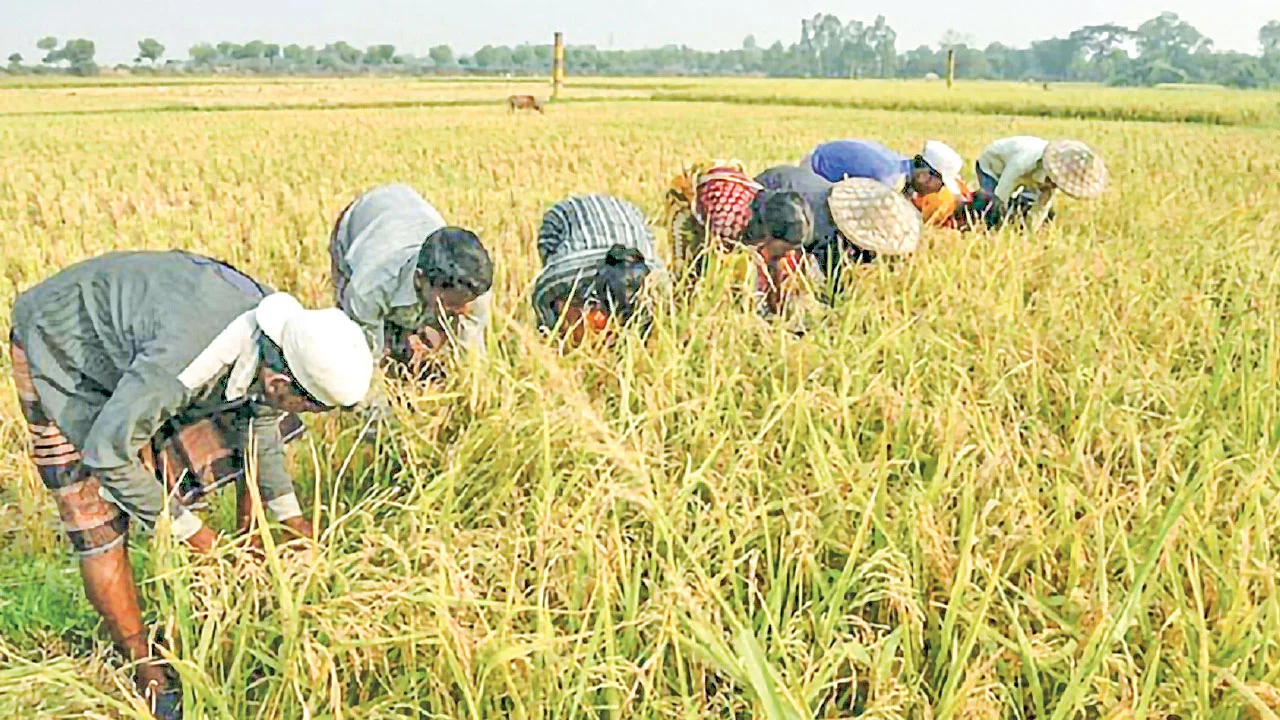
The agriculture ministry’s core task is to support farmers in order to secure foodgrain, especially rice, production, and this is done through the existing agricultural policy, which is not really an agricultural policy but rather ‘industrial food production’. This agriculture depends mainly on chemical fertilizers and pesticides, on irrigation from deep tube wells, and on the use of machinery from planting to harvesting rice. The flaws of this distorted farming system were exposed this Boro season. During the nationwide fuel crisis caused by the illegal and aggressive U.S.-Israeli war on Iran, a diesel shortage made it impossible to irrigate the Boro crop; and untimely rain in the haors destroyed much of the nearly ripe rice. There were no laborers to harvest the rice quickly at that time, and even the combine harvester machine, long held out to farmers as a false promise, could not be brought into the mud. Boro rice, the haor’s only crop, was lost before farmers’ eyes, drowned in water. Needless to say, most of the rice now produced in the haors is of high-yielding and hybrid varieties. Of the three rice seasons, the Boro season accounts for 55 percent, and about 20 percent of total Boro rice is produced in the haors.
According to newspaper reports, Boro rice losses in the haors this year amounted to 2.14 lakh tonnes, and about two lakh farmers were affected. But in his budget speech the finance minister blithely forgot the many challenges of survival facing farmers, including their ruin. He offered no incentive for the affected farmers. A pity. An allocation for agriculture means a subsidy on fertilizers and pesticides, that is, securing the profits of the poison companies and the fertilizer companies. This time was no exception. In the proposed 2026-27 budget, the government is fully withdrawing the existing 7.5 percent VAT and tax on fertilizers and pesticides, with the stated aim of expanding the agriculture sector and cutting production costs. But it must be understood that this benefit is not coming for farmers; it is coming for the fertilizer and pesticide traders. Where the agricultural policy should have shifted away from a fertilizer- and poison-dependent farming system and made that shift its main backbone, the government has always done the opposite. There is no way to deny the cost of fertilizers and pesticides, but there are other costs too. For example, the cost of farm labor for planting and harvesting rice, the cost of irrigation water, the cost of post-harvest processing, and so on. But the government does not take on those costs. More urgent still is ensuring fair prices for the crops produced, which most of the time stay below production costs, so the farmer’s debt does not ease. The government’s trade policy, including food imports, always protects the interests of traders and works directly against the interests of farmers. Yet the budget says nothing about this. Is there any guarantee that the Tk 10,000 in agricultural loan waivers and the farmer-card benefits will reach every farmer?
Moreover, given the way agricultural productivity is being damaged by climate change, energy problems and other factors, what is needed even more than fertilizer and pesticide subsidies is a fundamental overhaul of agricultural policy. This farming system cannot supply safe food to 18 crore people. The excessive use of pesticides in food is spreading cancer and other non-communicable diseases, which account for about 71 percent of all deaths. Raising the health sector allocation alone will not improve the health situation unless food production is made safe.
Agriculture’s contribution to the national economy is steadily falling and now stands at just 10.9 percent. In 1975, Bangladesh’s economy was agriculture-dependent, with agriculture contributing 62 percent. But the country is gradually moving toward industrialization (34 percent) and the service sector (51 percent). Industrialization mainly means the ready-made garment industry, which, while supplying some money to our economy in the short term, is not building a productive sector in the long term. Because of the government’s lack of attention to agriculture, the decline in agriculture’s contribution to GDP is happening rapidly. In the decade from 2010 to 2020 it fell from 17 percent to 12 percent, that is, a five-percentage-point drop in 10 years. The livelihoods of nearly half the country’s population are bound up with agriculture. When they are uprooted from farming, they have to move to the cities. Their daughters go to garment factories and their sons go abroad as laborers. That opportunity, too, is gradually narrowing.
Another claimant within the agriculture allocation is the fisheries and livestock sector. Through this sector, animal protein such as fish, meat, milk and eggs is supplied. Like agriculture, a vast group is tied to this sector, such as fishers, poor women who raise cattle, goats and poultry, and lakhs of small farmers. There is no mention of what budget benefits they will receive.
Fisheries and livestock together contribute about 4.3 percent of GDP. In terms of employment, 25 percent of working people are linked to this sector. There are about 18 lakh registered fishers. Livestock involves about 14 lakh farms, where about one crore women are engaged in raising cattle, goats and poultry. A vast population is tied to this sector yet remains overlooked at budget time.
It is not known how much fisheries and livestock will be allocated in this budget, but of the last budget’s Tk 39,620 crore, the crop sector was allocated Tk 27,224 crore (68 percent), while fisheries and livestock got only Tk 3,392 crore, just 8.5 percent.
Neglecting agriculture in the overall budget is dangerous. Within that, fisheries and livestock are especially neglected. Yet the two sectors together not only supply food but also hold every prospect of becoming a leading source of nutrition security and foreign-exchange earnings.
There is no doubt that neglecting agriculture will make the country’s food and nutrition security uncertain. This neglect will bring no good for the country’s economy.
The writer is a former adviser to the interim government.
বাংলায় মূল প্রতিবেদন পড়ুন · Read the original Bengali report