Paritosh Haldar had cultivated boro paddy on six bighas of land. The yield was good. But with rising production costs, making a profit has become difficult for this farmer of the Sriramkathi area in Pirojpur’s Nazirpur upazila.
Paritosh alleges that when he takes paddy to the warehouse, it is not bought, on the pretext that it is damp or of low quality. Yet the paddy of influential people is being procured with ease.
It is not only Paritosh; many farmers in the upazila have much the same complaint.
They have raised allegations of various irregularities in the procurement of boro paddy at the government-fixed price.
Farmers say that, instead of procuring paddy from genuine cultivators, the government warehouse is taking paddy from business people and the politically influential. As a result, many farmers are being denied the chance to sell paddy at the government-fixed price.
Farmers said that even when they take paddy to the Sriramkathi food warehouse in the upazila, they are turned away on various pretexts. With no clear schedule for when paddy will be accepted, cultivators are left in uncertainty, the farmers said. Forced by circumstances, many are selling paddy to market wholesalers at low prices. Recently, farmers also protested at the Upazila Parishad square against being denied the chance to sell paddy at the government warehouse.
According to the farmers, the situation has arisen through collusion between some officials and staff of the food warehouse and worker representatives, and influential quarters.
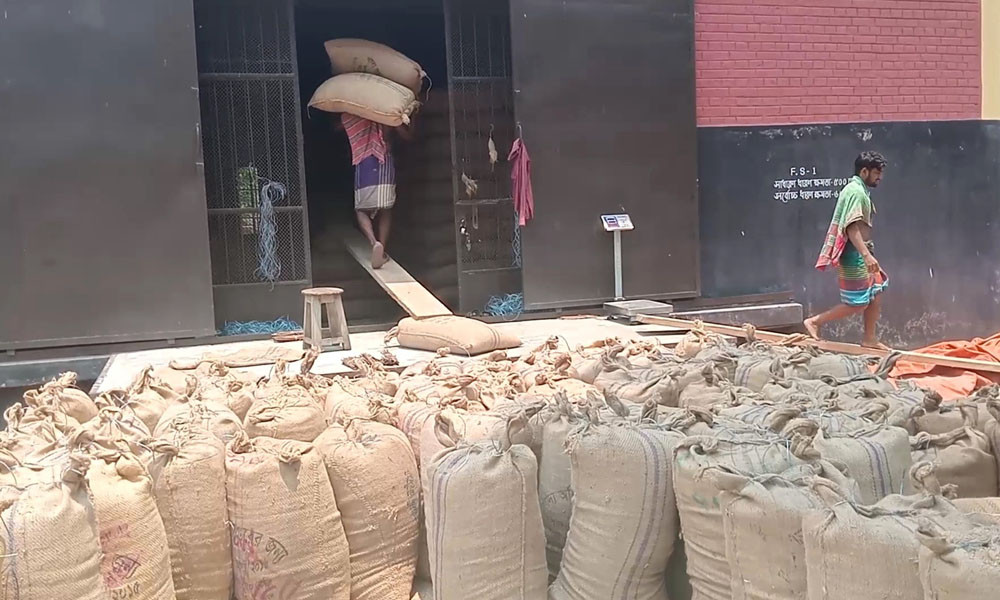
Shariful Bepari, a farmer of Dirgha union in Nazirpur upazila, alleged that he took 25 maunds of paddy to the warehouse but was sent back, citing a long queue. He claimed that with thousands of sacks of paddy stockpiled in front of the warehouse, the chance for ordinary farmers to get their paddy accepted has shrunk. Unable to sell at the government price, many farmers are being forced to sell paddy on the market at low prices, he said.
A visit to the warehouse area showed sacks of paddy piled up outside the warehouse. Several farmers present there alleged that everything had been arranged so that other cultivators could not supply paddy. They also alleged that some farmers’ agriculture cards were being used to supply other people’s paddy.
Denied the chance to sell paddy at the government warehouse, the farmers recently protested at the Upazila Parishad square. They claimed that although good-quality paddy is turned away, low-quality paddy supplied by business people and political leaders is being bought.
Mahima Akhtar, acting officer of the Sriramkathi LSD (local supply depot), denied all the allegations. She said paddy was being procured in line with government rules and that no one who brings paddy is turned away. Owing to a temporary shortage of sacks at present, some difficulties had arisen, she said. She added that it was not her responsibility who is buying, selling or stockpiling paddy outside the warehouse, and that paddy is accepted when a person holding an agriculture card brings it.
According to the upazila food department, the government procurement price for the current boro season in Nazirpur upazila has been fixed at Tk 1,440 per maund. This year, the government has set a target of procuring a total of 1,306 tonnes of boro paddy in the upazila.
The farmers demanded that, unless transparency is ensured in the government procurement programme, genuine producers will be deprived of fair prices and may lose interest in farming. They called for the matter to be investigated and for necessary action to be taken.
বাংলায় মূল প্রতিবেদন পড়ুন · Read the original Bengali report