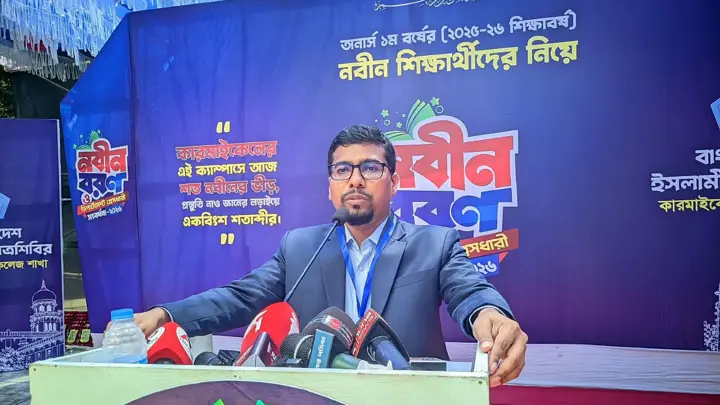
Islami Chhatra Shibir’s leaders and activists faced unjust persecution and repression over the past 17 years, the organisation’s central president, Nurul Islam Saddam, has said. He said nearly 700 brothers were forcibly disappeared, 108 were permanently disabled, and more than a thousand were injured under Awami fascist rule. Beyond this, he said, 75,000 false cases were filed to harass party leaders and activists. Despite this repression, he said, Chhatra Shibir’s activities never stopped — rather, the organisation’s size grew three to four times over during this period.
He made the remarks Monday afternoon at a freshers’ reception organised by the Islami Chhatra Shibir unit at Rangpur Carmichael College’s central Shaheed Minar grounds.
Nurul Islam Saddam said that among all student organisations in Bangladesh, Islami Chhatra Shibir alone accounted for 31 percent of enforced disappearance cases. “We have been able to file this complaint with the government. Many of our brothers who fell victim to these disappearances are still abroad and unable to return to the country, unable to file complaints. That number is large,” he said.
Remembering those killed in the July mass uprising, including martyr Abu Sayed, he said: “I remember martyr Abu Sayed, whose standing with his chest bared shook the whole of Bangladesh. Countries around the world remember this earth-shaking revolution. When we travel to various countries, people who speak those languages ask us about this uprising in Bangladesh. They want to know this story. Because a monster, a giant demon, was driven off our necks. We dreamed of a new Bangladesh, one that would be built on the foundation of justice and fairness. But we have failed to build that Bangladesh. Only a change of power has taken place. But no change has yet occurred in the state itself in our country. The referendum’s verdict has not been implemented.”
Criticising BNP, he said: “In North Bengal, they said, please vote yes in the referendum. That is the kind of begging they did. This nation of beggars, after coming to power, has now started thinking of itself as the master. Now they say they were betrayed. If we hadn’t accepted the yes vote, they wouldn’t have even held the vote. Out of that fear, we accepted the yes vote. Coming to power was their only concern.”
Chhatra Shibir’s central president alleged that the verdict delivered by the “yes” vote in the referendum is not being implemented. He said that if genuine structural reform of the state takes place, no single side would be able to permanently arrange power for itself. That, he said, is precisely why there is reluctance to pursue fundamental constitutional reform. Political parties reached consensus on 30 issues in the referendum, with commitments made to implement them after the election. But the Constitutional Reform Council has still not been sworn in.
Demanding reform of the Public Service Commission (PSC), Chhatra Shibir’s central president said the marks allotted for viva voce in government job recruitment need to be reduced. He said they had submitted a memorandum on this during the interim government’s tenure.
Nurul Islam Saddam alleged that because vivas allow room for recommendations from relatives and acquaintances, meritorious candidates face discrimination. He said references from brothers, uncles and other relatives are given, and through such references, some candidates are awarded 190 out of 200 marks. Meanwhile, he said, others who perform well are denied even 40 marks and instead made non-cadre or shown as failed. Demanding that viva marks be reduced from 200 to 50, he said necessary reforms at the PSC are essential to ensure merit-based recruitment.
The event, chaired by Carmichael College unit Islami Chhatra Shibir president Mahmudul Haque Masum, also featured remarks from Rangpur-3 MP Mahbubur Rahman Belal, Rangpur city Jamaat ameer A T M Azam Khan, central student welfare secretary Rezaul Karim Shakil, and city Chhatra Shibir president Anisur Rahman, among other leaders. They gave a reception to 2,500 new students and honoured 200 outstanding students.