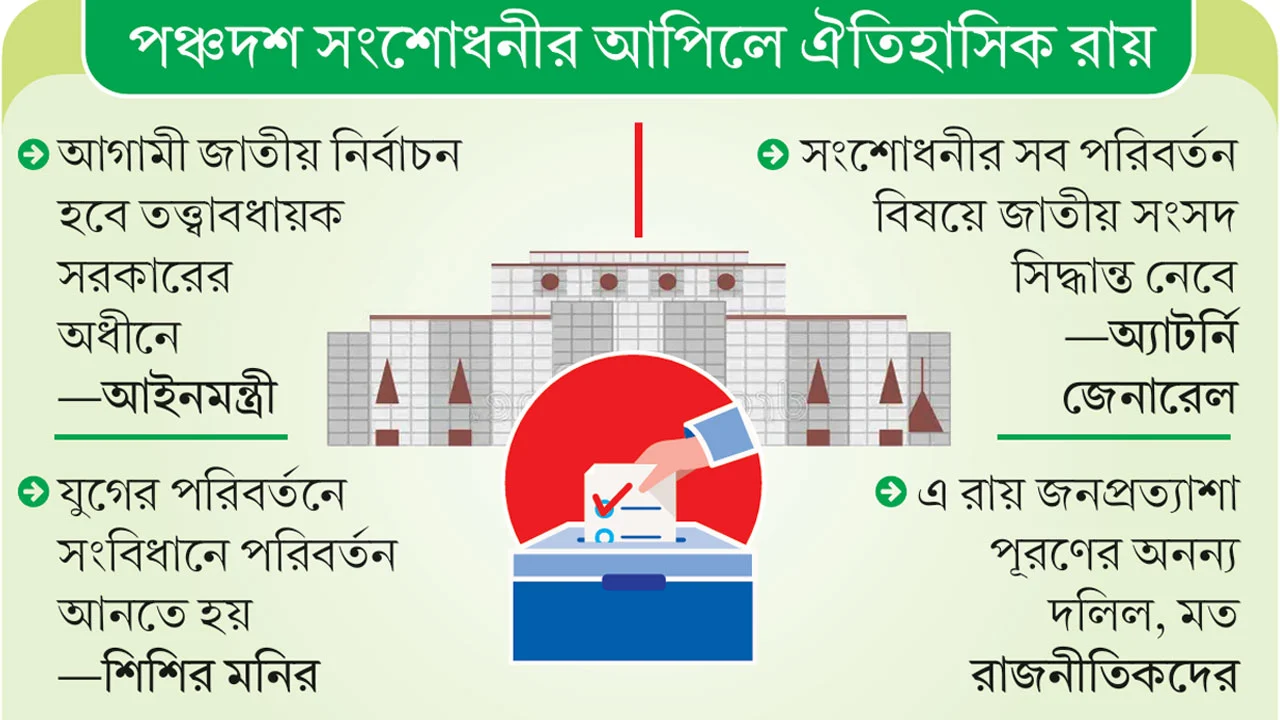
The non-party caretaker government system and the referendum provision are returning to the constitution. On Thursday, the Appellate Division upheld the High Court’s ruling on incorporating the caretaker government system and the referendum into the constitution. Government policymakers, politicians and lawyers described the verdict as historic and a unique document fulfilling the people’s expectations.
After the verdict, Law Minister Md Asaduzzaman told journalists that the ruling had ‘closed the path for fascism to return to the country’, and that the non-party caretaker government system and the referendum provision would be incorporated into the constitution.
Lawyers said a non-party, neutral caretaker government was a universally accepted mechanism for holding acceptable, credible elections. The government of Sheikh Hasina — which had itself come to power through an election held under that system — moved to abolish it, they said. On her direct instruction, the then chief justice, ABM Khairul Haque, delivered the ruling scrapping the caretaker system; the lawyers called his decision to hand down such a verdict after retirement one of the most abhorrent precedents in the country’s history. Leveraging that heavily contested ruling, Hasina’s government unilaterally passed the fifteenth amendment to the constitution in the National Parliament on 30 June 2011, changing 54 articles and sub-articles — including abolishing the caretaker system and the referendum provision.
After the fall of the Awami League government and Hasina’s flight in the student-people’s uprising of 5 August 2024, a writ was filed challenging the validity of the fifteenth amendment. On that writ, the High Court ordered the caretaker government system and the referendum provision restored to the constitution. On Thursday, a full four-member Appellate Division bench led by Chief Justice Jubayer Rahman Chowdhury upheld the High Court’s ruling.
Noting that the next general election would be held under a caretaker government, the Law Minister said after the verdict: ‘Inshallah. This is our political commitment. It is the fruit of the BNP’s long, 16-year movement. The core aim of the ‘Save the country, save the people’ struggle under Khaleda Zia’s leadership was that people should be able to cast their own votes themselves.’
Answering journalists, the minister said the fifteenth amendment had ‘dug the grave of the country’s democracy and drawn up a blueprint for fascism’. ‘We said from the very beginning that the controversial Justice Khairul Haque’s ruling on this was against the constitution,’ he said. The High Court had declared some parts of the amendment illegal and left the rest to the National Parliament, and the Appellate Division had upheld that ruling, he added. The government would take steps to reform the constitution in light of this verdict and the July Charter.
He said all 54 matters mentioned in the ruling would be addressed thoroughly, with the July National Charter as the main consideration. Whatever amendments, additions and refinements were needed to ensure the country’s independence, sovereignty, democracy, good governance, human rights and justice would be made, he said.
Attorney General Ruhul Kuddus Kajol told journalists that when the fifteenth amendment was challenged by writ, the High Court had given observations on four matters — among them the return of the non-party caretaker system, the return of the referendum, and the upholding of the ruling cancelling articles 7(a) and 7(b). In the end, he said, the High Court’s ruling stood.
He said the ousted Awami League government had brought the fifteenth amendment, altering the constitution in 54 areas. Alongside a provision for the maximum penalty for illegally seizing power, and recognition of Sheikh Mujibur Rahman as Father of the Nation, the amendment had restored the four national fundamental principles — nationalism, socialism, democracy and secularism — to the constitution.
After the Awami League government fell in the July mass uprising, two separate writs were filed in the High Court in 2024 over the validity of the entire fifteenth amendment law and several of its provisions. Following final hearings, the High Court delivered its verdict on 17 December 2024, declaring void sections 20 and 21 of the constitutional amendment law, which had removed the caretaker system and the referendum. Along with those, the court declared articles 7(a), 7(b) and 44(2), inserted by the amendment, to be in conflict with the constitution and void.
The full High Court verdict was published on 8 July last year. Against it, four prominent citizens including Badiul Alam Majumder, secretary of Citizens for Good Governance (SHUJAN), and others filed separate leave-to-appeal petitions.
The Appellate Division granted leave on 13 November last year, after which three separate appeals were filed against the High Court verdict — all dismissed on Thursday. As a result, the Attorney General said, the referendum and the caretaker government system had returned to the constitution, and the authority to decide on the remaining changes made through the fifteenth amendment now rested with the National Parliament.
Reacting to the verdict, Jamaat-e-Islami lawyer Shishir Monir, one of the writ petitioners, said the High Court had declared four matters in the fifteenth amendment unconstitutional and that the Appellate Division had upheld this. The four, he said, were: that changing certain constitutional matters would amount to constitutional treason; the cancellation of the referendum provision; the granting of writ powers to lower courts; and the abolition of the caretaker government.
He said a constitution was not a penal code. ‘If someone commits an offence, the penal code determines the offence and the criminal procedure code follows the process. No constitution in the world lays down punishments,’ he said. Arguing that a constitution must remain open to change, he added: ‘After 50 years none of us will be here; a new generation will come, with its own understanding and education. That is why a constitution is called a living document. It has to change with time and with the age. If we say no change can ever be made, does that make it the Bible? Is it the Quran? The answer is no.’
Badiul Alam Majumder, the SHUJAN secretary and a petitioner, said it would become clear only after receiving the full verdict which matters the court had left to parliament and what observations it had made on each.
In the appeal hearings, lawyers Sharif Bhuiyan, Karishma Jahan and Riduanul Karim appeared for SHUJAN; senior lawyer Shishir Monir argued for Jamaat-e-Islami’s secretary general; senior lawyer Imran A Siddiq appeared for the Human Rights Support Society; and lawyer ASM Shahriar Kabir represented another appellant. Additional Attorney General Anik R Haque and Deputy Attorney General Abdullah Al Masud appeared with the Attorney General for the state.
বাংলায় মূল প্রতিবেদন পড়ুন · Read the original Bengali report