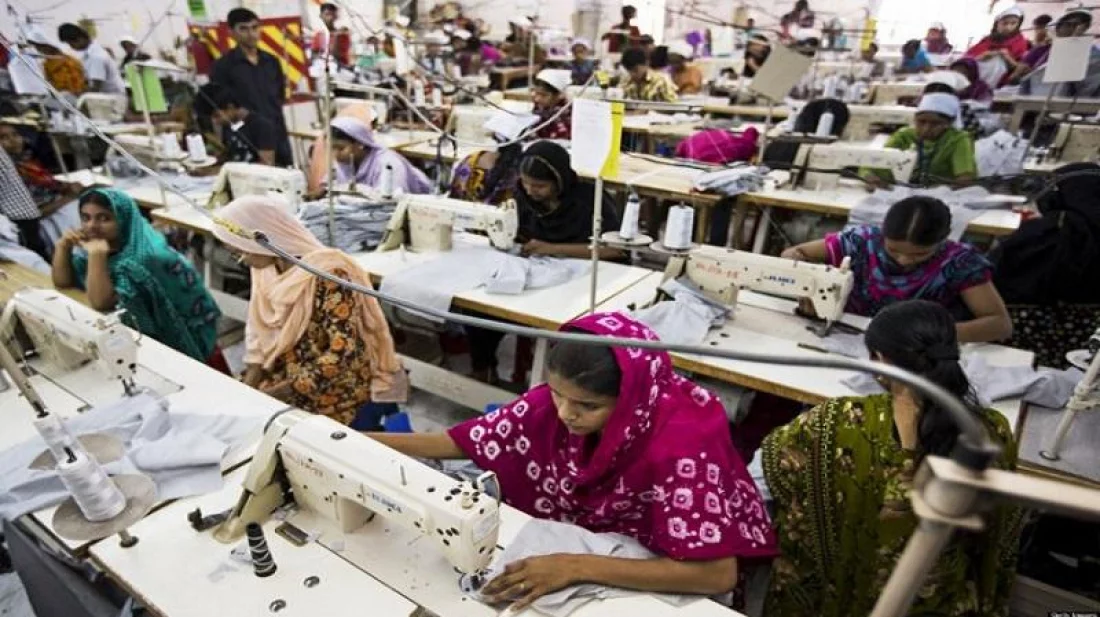
Bangladesh’s garment industry faces another tough test. Just as the country’s biggest export sector was trying to move towards new growth despite long-running global competition, price pressure, geopolitical instability and buyers’ tough compliance demands, a severe gas crisis has pushed the industry into fresh risk.
Industry entrepreneurs fear that if the crisis is not overcome quickly, the damage will not be limited to a few weeks’ production or some export shipments. Failing to deliver on time could erode international buyers’ confidence, and losing that confidence risks handing part of a market built over many years to rival countries.
A severe gas crisis in various industrial areas has cut output at many factories by 30 to 40 percent. In some places output has fallen even more, and some dyeing and processing units have had to close temporarily. The industrial areas of Gazipur, Savar, Dhaka, Narayanganj and Mymensingh have been worst hit, while the situation in Chattogram and Sylhet is relatively more bearable.
International buyers’ worries grow
Thousands of international brands and retailers source garments from Bangladesh each year. Many of the world’s top brands — including H&M, Inditex, Marks & Spencer, Primark, Gap, Walmart, Nike, Levi’s, PVH, Next, Mango, Target and American Eagle — are now closely monitoring Bangladesh’s production situation.
Whether goods can be produced and shipped on time despite the gas crisis has become international buyers’ main concern. Many buyers have already asked factories by email for the latest situation. Some are collecting data on production capacity and records of power and generator use. Some brands’ compliance teams are even visiting factories directly to verify the real situation. Industry insiders say buyers are no longer satisfied with verbal assurances alone; they want to know how long the crisis will last, what the government’s long-term energy-security plan is, and what steps are being taken to avoid a repeat.
BGMEA-buyers’ forum emergency meeting
Against this backdrop, the Bangladesh Garment Manufacturers and Exporters Association (BGMEA) held an emergency meeting in Dhaka with representatives of the international buyers’ body Buyers’ Forum Bangladesh. The BGMEA said repairs to the faulty floating LNG terminal (FSRU) at Maheshkhali could be completed by 6-7 August. Gas supply would then gradually improve, with the situation in industrial areas expected to improve after 8 August, and supply largely normalising by 14 August if all went to plan. The BGMEA also requested that buyers consider, case by case, allowing one to two weeks’ shipment delay for factories hit by the crisis.
The biggest crisis is confidence, not output
BGMEA president Mahmud Hasan Khan said the gas crisis had cut garment factories’ output by 30 to 40 percent on average, and by up to 60 percent in some places. In his view, a bigger concern than the financial loss was retaining international buyers’ confidence — because while extra production costs could somehow be adjusted, buyers could easily turn to alternative sources if deliveries were missed, and once a brand builds a supply chain in another country, that market is very hard to win back.
Dyeing and finishing worst hit
The gas crisis has hit the dyeing, washing and finishing sectors hardest, as these processes need uninterrupted, high-pressure gas. But in many industrial areas where at least 15 psi of pressure is needed, gas pressure has dropped to 1 to 3 psi, and at times close to zero. As a result, boilers cannot be kept running, and key steps such as double dyeing, compacting, finishing and steaming are disrupted — leaving half-finished fabric piling up, lengthening production cycles and slowing the whole supply system. In entrepreneurs’ words, keeping only the sewing factories running is not enough; if dyeing and finishing are shut, shipments cannot be delivered on time.
Alternative fuel raises production costs
With gas short, many factories have to rely on costly alternatives such as diesel generators, LPG or CNG, significantly raising production costs. But garment prices in the international market are set in advance, so entrepreneurs must bear this extra cost, adding to financial pressure for many firms.
Greatest concern in Narayanganj
The situation is more worrying in Narayanganj’s garment and knitwear industry. Business leaders say more than 1,000 export-oriented factories in the district cannot run normally as the gas crisis disrupts output. Many dyeing factories are effectively shut; output has fallen 15 to 20 percent at many firms, and some can run only a few hours. BKMEA leaders warned that if the situation does not improve quickly, many more dyeing factories could shut within one to two weeks, putting not just production but thousands of workers’ jobs at risk.
A real risk of losing markets
According to analysts, competition in the global garment market is now fiercer than ever. Rivals such as Vietnam, India, Cambodia, Indonesia and Pakistan are active in attracting new orders. So if Bangladesh cannot consistently ship on time, international brands could turn to alternatives. In the garment industry, losing an order often means not just a lost shipment but a risk to future long-term business relationships. Experts say international buyers now want not only cheap goods but also reliable supply, punctual shipment and a stable production environment — so energy security has become one of the key indicators of Bangladesh’s export capacity.
Mohiuddin Rubel, founder and chief executive of Bangladesh Apparel Voice and a former BGMEA director, said the sector’s biggest crisis now was not rising production costs but retaining international buyers’ confidence. Bangladesh’s main strength in the world market was its ability to deliver quality goods on time, he said, and if the gas crisis called that into question, the impact would be far greater than a few weeks’ lost output.
He said international brands were now following risk-reduction strategies in their supply chains, quickly turning to alternatives when production in a country became uncertain, and that competitors such as Vietnam, India, Indonesia, Cambodia and Pakistan were ready to take the opportunity. So missing shipments could put not just an order but future long-term relationships at risk, he said.
Mohiuddin Rubel said the gas crisis should not be seen only as an energy problem; it was now an economic challenge directly tied to Bangladesh’s export competitiveness, investment climate and credibility in the global supply chain. In the short term, timely gas supply to affected factories and regular, transparent communication with buyers were essential, he said, while in the long term, new LNG infrastructure, land-based gas storage, diversification of energy sources and uninterrupted gas supply to industrial areas had to be ensured — because confidence in the world market is easily lost but takes years to rebuild.
No end to the risk without long-term solutions
According to factory owners, while the current crisis can be overcome temporarily by repairing the LNG terminal, a lasting long-term solution is essential. They stressed quickly installing new floating LNG terminals, building land-based LNG storage, modernising gas-supply infrastructure and ensuring uninterrupted energy supply to industrial areas.
They said Bangladesh’s garment industry was not only the country’s main export sector but also a foundation for the jobs of millions, foreign-currency earnings and economic stability. If that sector began losing competitiveness in the international market because of energy uncertainty, the impact would not be confined to the industry but would have a long-term negative effect on the whole economy. The current crisis, therefore, is not just an energy problem but an important test of whether Bangladesh can hold its strong position in the world garment market or begin losing part of its hard-won market to rivals.
বাংলায় মূল প্রতিবেদন পড়ুন · Read the original Bengali report