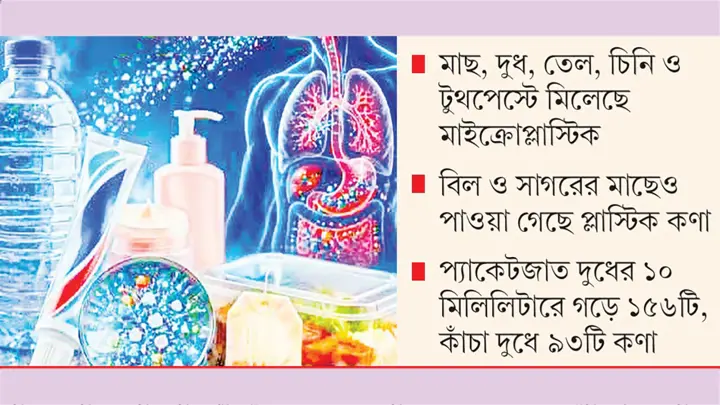
From toothpaste to cooking oil, milk, sugar or local fish, microplastics are quietly entering the human body through everyday food and household products. After several studies in Bangladesh detected these tiny plastic particles in fish, milk, oil, sugar and toothpaste, fresh concern has emerged over public health. Researchers say the long-term effects of these particles could be severe, making regular monitoring, risk assessment and effective controls on microplastics in food products essential.
A study by the Fisheries Management department at Bangladesh Agricultural University found microplastics in five types of local fish from Arial Beel — koi, bata, meni, gulsha tengra and puti. The highest concentration was found in koi fish. A recent study found that an adult consumes an average of 6,441 microplastic particles a year from soybean oil alone, while for children the figure is around 28,180.
A joint study by Jahangirnagar University and the Bangladesh University of Professionals found 45,000 to 70,000 particles per litre in loose soybean oil, and 44,000 to 54,000 particles per litre in bottled oil. Dr Shafi Muhammad Tarek, who led the research team, called these levels alarming and urged urgent action.
Significant amounts of microplastics have also been found in milk. The research found an average of 156 particles per 10 millilitres in packaged milk, and around 93 particles in raw milk. Research led by Professor Omar Faruq of Jashore University of Science and Technology identified various polymers in milk, including Teflon, PET, nylon-6 and PVC. Another study of seven types of sugar samples from Dhaka found microplastics in 95 percent of samples, with branded sugar averaging 322 particles per kilogram and loose sugar 403 particles per kilogram.
According to researchers, the main sources of microplastics entering food are contact with plastic bottles, packets and sacks, friction from factory machinery parts, plastic gloves and environmental pollution. Bangladesh generates around 8,000 tonnes of plastic waste every day, more than half of which is not properly managed. This waste breaks down and enters the food chain.
Earlier research by ESDO found microplastics in 26 of 34 toothpaste brands on the domestic market, at a rate of 76.5 percent. Among six children’s toothpaste brands tested, four also showed the presence of microplastics. Supreme Court lawyer Abdullah Al Mamun has filed a writ petition in the High Court seeking an investigation, naming the health, environment and commerce secretaries, along with the Bangladesh Standards and Testing Institution (BSTI) and the Directorate of National Consumer Rights Protection, as respondents.
BSTI says no international standard has yet been set for microplastics in toothpaste, but the agency has taken the initiative to collect samples from the market for re-testing, and is also gathering information from relevant research institutions and manufacturers.
Microplastics found in the human body too
Studies around the world have detected microplastics in human blood, heart arteries, muscle tissue and even the brain. A study by University of New Mexico professor Matthew Campen found nearly ten times more plastic in the brains of people who died with dementia compared with healthy individuals. Another study found micro- and nano-plastics in the blood of 84 percent of heart attack patients, compared with 32 percent among healthy individuals.
Public health expert Dr Shamim Ahmed said these particles can cause inflammation in blood vessels, raising the risk of heart disease and stroke, can cause intestinal inflammation and digestive problems, and can disrupt hormone function. Professor Md Shahjahan of Bangladesh Agricultural University’s Fisheries Management department, who led the research team, told Amar Desh on Sunday night that microplastics have also been found in fish muscle tissue, which he called a cause for concern. Another study found microplastics in fish from the Brahmaputra, Chalan Beel, the haor region and the sea, with the highest levels found in dried fish. Professor Shahjahan said pollution of various kinds ultimately accumulates in the sea, which is why fish caught there show relatively higher levels.
He said there is still not enough research in the country on exactly what harm microplastics cause once inside the human body. However, he said, the presence of tiny plastic particles or fibres in fish intestines and muscle tissue poses a serious risk to both human health and the aquatic environment.
Additional chief medical officer at Rajshahi University Medical Centre, Abdul Wadud (Najib Wadud), told Amar Desh that the extent of harm from microplastics depends on many factors, and that specific research on the subject is still limited. However, he said, microplastics can have harmful effects on nearly every system and organ in the body. According to him, these particles can weaken the body’s immune system and cause cellular damage through inflammation. They can also damage blood vessels, raise the risk of stroke and heart attack, disrupt hormonal balance and function, harm the digestive system, and negatively affect the nervous system. Fertility can also decline as a result.
At a recent public hearing on the issue, the prime minister’s adviser on information and broadcasting, Zahed Ur Rahman, said microplastics have spread not just in toothpaste but also in food and water, and that coordinated action is needed, with the government to take measures in the public interest. However, representatives of leading industrial firms including Square, Pran-RFL and Nestle argued at the hearing that regulators should be informed before research findings are published, warning that incorrect or incomplete information could cause irreparable damage to business reputations. BSTI director-general Kazi Imdadul Haque also said it would have been better if the regulatory body had been informed before the research findings were published.
CAB wants swift action
Meanwhile, Consumers Association of Bangladesh (CAB) vice-president S M Nazer Hossain told Amar Desh that any negligence by food-quality monitoring agencies needs to be examined, and that contaminated products need to be withdrawn from the market urgently. Experts say reducing the risk from microplastics will require coordinated efforts in packaging, food processing and plastic waste management, alongside rapid, wide-ranging research to determine their effects on the human body and establish safe exposure limits.