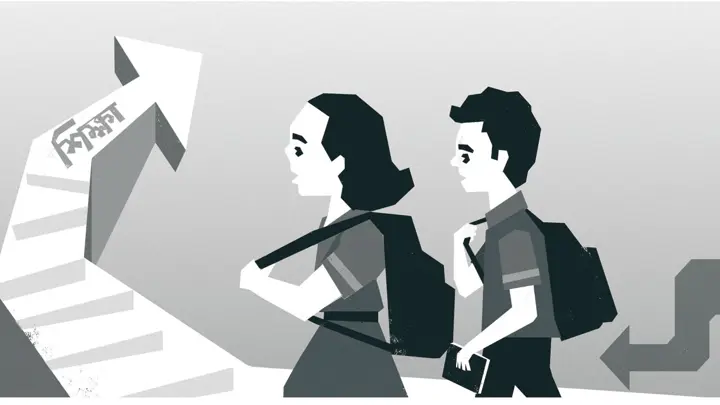
The July 2024 revolution marked a watershed moment in Bangladesh’s social and political history. Through unprecedented sacrifice on the streets, young people did not merely uproot a fascist regime — they took on the historic responsibility of fundamentally transforming the machinery of the state. But to give the dream that this new arrangement made possible a solid foundation, the sector that matters most to those young people, who paid for this opportunity with their blood, is education. If reforming the political system was the revolution’s first phase, then the fundamental overhaul of the education system is the second and greatest battle for making the state sustainable.
Over the past decade and a half, Bangladesh’s education sector went through deep structural paralysis. Our entire education system became a certificate-obsessed, rote-learning process, completely disconnected from the global job market. According to UNESCO’s international benchmark, a country should allocate at least 6 percent of GDP or 20 percent of the national budget to education. Yet according to Bangladesh’s finance ministry, our education budget has remained stuck at just 1.2 to 1.4 percent of GDP for years, even after being raised to 2 percent for fiscal year 2026-27 — still the lowest in South Asia. UNESCO’s Global Education Monitoring Report has repeatedly flagged this budget constraint. A large portion of this allocation also goes toward infrastructure and administrative expenses, contributing nothing to innovation or research.
The consequences of this qualitative bankruptcy in education have been devastating. A review of the Bangladesh Bureau of Statistics’ latest labour force survey and International Labour Organization data shows the unemployment rate among the highly educated is alarmingly higher than overall unemployment. Research from BIDS found that a large share of National University degree holders remain unable to find suitable employment for a long time after completing their postgraduate studies. The core reason is the mountain-sized gap between industry’s real needs and our university curricula. In an era of the fourth industrial revolution, artificial intelligence, data analytics and world-class skills, our classrooms are still clinging to syllabuses from two decades ago.
This poor quality of education is also reflected in global rankings. The absence of our universities from the top 500 or 1,000 in the QS or Times Higher Education World University Rankings has become a regular occurrence. A lack of research, and more importantly, the prioritising of naked political loyalty over merit in teacher recruitment and promotion, is the core reason for this decline. Universities were turned into arenas for the ruling party to flex its muscle. The chaos of subservient party politics rendered student unions ineffective, choking off ordinary students’ independent thinking and natural leadership development.
Alongside this, the foundation of our primary and secondary education has also stumbled badly. Repeated curriculum changes, poorly planned exam systems, and a shortage of adequately trained teachers have destroyed the basic quality of education. Students have been forced to rely on coaching centres and private tuition rather than classroom learning, creating a severe form of economic inequality in education. A child from an ordinary, marginalised rural family today starts out already behind students at expensive urban institutions.
Standing at this juncture, the young generation’s first and foremost demand is a merit-based, discrimination-free state. These young people, who emerged from the quota reform movement, do not want a fragmented solution; they want transparency, accountability and proper recognition of merit. Ensuring merit-based recruitment across every level of the state, including the Public Service Commission, and ending party-based nepotism for good, is now the central demand of the moment.
Second, young people want an end to subservient party politics in educational institutions. That does not mean turning away from politics — rather, they want a healthy democratic environment. Regular student union elections (such as DUCSU, JUCSU, RUCSU and others) must be ensured at every public university. Instead of cadre-based occupation in the name of gonorooms and guestrooms, student unions should be the only recognised platform for securing students’ rights, practising free thought, and shaping future national leadership.
Preventing brain drain is likewise a major challenge today. Every year, thousands of talented young people leave the country for higher education and a better life abroad and never return. The sole reason is that there is no recognition of their talent here, and no adequate research environment. If we fail to retain these talented people, the dream of a developed, self-reliant Bangladesh by 2041 will remain only on paper.
For the sustainable overhaul of the education system, several urgent policy steps are now essential.
- Curriculum reform and technical education: Beyond generic theory-based education, information technology, coding, formal language skills and practical education must be made mandatory from the secondary level onward. Universities need to update their syllabuses every three years in coordination with industry experts.
- An independent national education commission: A fully independent “National Education Commission” or “Teacher Recruitment Commission” could be formed to stop party influence and financial corruption in teacher hiring, appointing faculty at public universities and colleges through a transparent, merit-based process alone.
- Budget and incubation for research: A target of allocating at least 3 to 4 percent of GDP to education must be set. Alongside building adequate research funds at universities, startup incubation centres and a legal framework for easy, collateral-free loans should be established to help young people become entrepreneurs.
- Removing inequality at the primary and secondary levels: Classroom learning must be assured to reduce dependence on coaching, and recruitment of qualified, well-trained teachers to government schools in remote areas of the country must be accelerated.
Education is not charity; it is the core driving force of a nation’s sovereignty and progress. A strong Bangladesh cannot be built on a spineless, corrupted education system. The young generation of 2024 has fulfilled its responsibility — it has opened a new path for change. It is now the responsibility of the state and policymakers to embrace this aspiration of the young and modernise the education system. Let the foundation of an education system that inspires the young toward independent thought, wisdom and patriotism, rather than servitude, be the core pledge of the new Bangladesh.