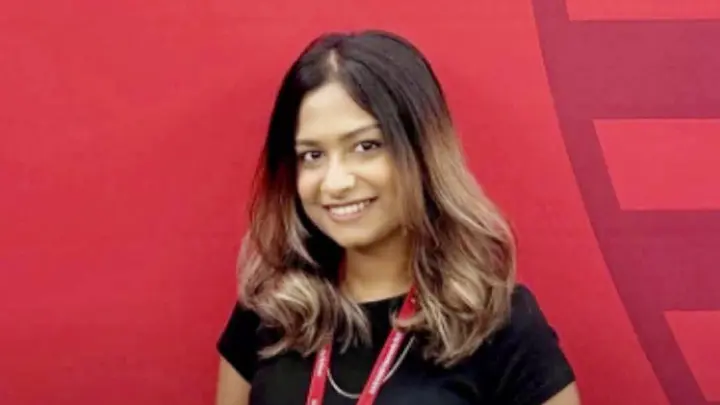
Chhatra League is currently a banned militant organisation in Bangladesh. Citing a Facebook post from one of the organisation’s fugitive central leaders, the country’s top news outlets published stories about her. Many on social media have described these stories as “emotional news.” In these “emotional” reports about the Chhatra League leader, her political identity was omitted and she was instead introduced simply as a “student.” Alongside this, without verifying the claims in her Facebook post, she was presented as a “victim of mob attack” or a “victim of fundamentalist mob.”
Digital investigative outlet The Dissent found that this Chhatra League leader fled abroad after the August 5 mass uprising, and took part in her honours viva exam at Dhaka University while still staying abroad. Several teachers and students in her department have denied that any kind of mob incident occurred against her.
What did Chhatra League leader Tahsin claim?
In a post on her personal Facebook account on September 14, A R Tahsin Jahan announced that she was rejecting the Dean’s Award. In that post, she raised several allegations against the university administration and the current situation.
Explaining why she rejected the award, she said: “No award’s prestige outweighs an institution’s moral accountability, to me. Accepting this award would have meant celebrating the recognition of an institution whose administration, despite watching thousands of its own students’ academic lives and futures be destroyed solely because of their political identity and ideology, failed to fulfil its responsibility toward them.”
On being a “mob” victim and facing institutional obstruction, she said: “In 2024, I was attacked by a mob solely because of my political identity. Despite having no involvement in any violence, I faced threats within my own department and university. I was barred from taking part in my final viva and submitting my graduation thesis. After a certain point, for my own physical safety, I could no longer return to campus.”
Accusing the administration of supporting a “fundamentalist mob,” she said: “More than 10,000 students like me at Dhaka University and other public universities across the country did not get that opportunity. The administration stayed silent and silently supported the fundamentalist mob, and continues to do so. The administrations of public universities have taken no meaningful steps to protect their own students’ rights. Rather, these institutions also bear responsibility for the blood of Tofazzal, Masud, Shamim and many other innocent people.”
Questioning the current situation and justice, she said: “If democracy has truly been restored after the government’s fall, why can these thousands of students still not return to their classrooms? What’s the excuse now? If justice isn’t for everyone, it isn’t justice at all. And please don’t tell us, ‘we are the alternative, we are the change,’ because one injustice can never be a substitute for another.”
‘No evidence of a mob, she was abroad’
Tahsin Jahan claimed in her Facebook post that she was a victim of a “mob” on campus, and that she was barred from submitting her thesis and taking her viva.
But according to teachers in the Development Studies department, this claim is entirely false.
Teachers say Tahsin was not even in the country at the time in question.
When The Dissent contacted Dhaka University Development Studies department professor Dr Taiyebur Rahman, he directly rejected the allegation of a mob attack.
He said: “She wasn’t even here at that time. When we held the viva, she wasn’t in the country — she was in Canada. We never saw her in the department. She wasn’t even available here. I mean, at the time this supposedly happened, she wasn’t here — she wasn’t even in the country. We aren’t aware of it, so to speak. We didn’t see anything happen in the department. In fact, whatever the department did for her, she should be grateful for. It was approved by the vice-chancellor’s office that her exam would be taken online. There was no such response from the department. We don’t know.”
He further said: “She was a very good student of ours. We wanted her to graduate from here. But we could never have imagined she would bring this up. I think this is irrelevant. If anything, the department supported her, and the university supported her.”
Development Studies department chair Professor Dr Naeem Sultana said: “I haven’t seen any kind of problem in our department. We don’t know anything about a mob incident with her. She applied to us from Canada saying she was afraid to come and sit for the exam. We took her exam online with special permission from the university. Her online exam was conducted with special permission from the VC and the controller. She wasn’t in the department, wasn’t on campus. She applied saying she was afraid to come, and we, the department, supported her.”
Asked about Tahsin’s allegation that she was a mob victim, Professor Naeem Sultana said: “No, I haven’t seen any of this. I haven’t even heard that anything like this happened.”
Teachers said that when she applied to take her viva exam online from Canada, the request was considered and she was allowed to sit for the exam.
Classmates boycotted her over her Chhatra League post
Immediately after the August 5 uprising, general students across various Dhaka University departments called for academic meetings regarding office-holders of the banned militant organisation Chhatra League. This followed resentment that built up against the organisation’s leaders over multiple incidents during the July quota reform movement, in which Chhatra League carried out armed attacks on students and forced them out of dormitories. Tahsin Jahan was deputy convener and secretary for innovation of Chhatra League’s central executive council.
At least two of Tahsin’s classmates told The Dissent that, because she was a Chhatra League leader, department students decided no one would sit for exams alongside her. When this was reported to the department authorities, they arranged for her to take her exam separately. These students said Tahsin then moved to Canada with her family.
One of Tahsin’s classmates told The Dissent: “Since she was socially boycotted, our batch decided her viva would be held separately. It’s not that we, or the department, blocked anything for her. That’s the whole story.”
Another junior student also told The Dissent: “No mob happened in the department. She was boycotted because of her position [in Chhatra League].”
Tahsin’s classmate Poddo Alam wrote in a Facebook post that 33 of the 34 students in their batch had jointly decided not to sit for exams with Tahsin because of her Chhatra League leadership position. She asked: “What exactly is the ‘mob’ I supposedly formed against her? Where? When? How? I want specific proof of this from A R Tahsin Jahan.”
Another person, Kathleen Dhar, wrote on Facebook: “The mob attack Tahsin is talking about never happened, because she was in Canada at the time.”
Ties to Awami League’s propaganda wing, CRI
Tahsin Jahan’s personal website, her Facebook posts, and media reports reveal direct ties to Awami League, its student wing Chhatra League, and Awami League’s propaganda wing, the Centre for Research and Information (CRI).
In the bio on her personal website, she wrote: “I also serve as a student politician of the former ruling party of Bangladesh (comprised of 5 million youth activists) where I’ve advised policymakers and contributed to both domestic and international government initiatives.”
In other words, she has worked as a student politician for the former ruling party and has advised policymakers.
A report in Kalbela described her as “deputy convener and secretary for innovation of the central executive council of the banned organisation Bangladesh Chhatra League.”
A report published in BDNews on December 28, 2023, said she took part directly in the question-and-answer session at a CRI-organised event called “Let’s Talk with Sheikh Hasina.” As a student in Dhaka University’s Development Studies department, she raised a question with the prime minister about daycare centres for working women.
On December 23, 2023, Tahsin shared several photos from the event on her Facebook account. The photos show her in front of a backdrop bearing the CRI logo, and in the same frame as Sheikh Hasina.
In the caption, she wrote: “Had a wonderful evening at Let’s Talk with Sheikh Hasina organized by CRI!”
On her website, Tahsin also describes herself as co-founder of a policy blog called “The Confluence.”
A UNB report published on March 29, 2023, said the blog’s founder-publisher was Barrister Shah Ali Farhad.
Shah Ali Farhad was a special assistant to former prime minister Sheikh Hasina, a member of Awami League’s central sub-committee, and a longtime senior analyst and consultant for CRI.
On November 7, Tahsin posted a photo on Facebook, writing: “The Confluence team had an amazing evening with the policymakers from Bangladesh Government, National Parliament, and CRI.”
The photo shows her with CRI officials.
Mainstream media omitted Tahsin’s Chhatra League identity
At least 13 national and online news outlets had published reports on Tahsin Jahan’s rejection of the Dean’s Award by the time of this report.
But none of these reports, in their headlines or body text, mentioned her organisational identity with Chhatra League or Awami League.
These reports include The Daily Star (in both Bangla and English), BDNews (in both Bangla and English), Kaler Kantho, Jago News 24, Daily Ittefaq, The Financial Express, Asia Post, Agamir Somoy, Citizens Voice BD, Rokeya Collective and Kalbela.
The Daily Star’s headline read: “‘Thousands of students’ lives were ruined’: DU topper refuses Dean’s Award,” alongside a Bangla headline asking why thousands of students still cannot return to their classrooms.
BDNews’s headline read: “DU student rejects Dean’s Award protesting administration’s ‘support for fundamentalist mob’,” alongside a Bangla version making the same claim.
Kaler Kantho’s headline read: “‘Mob victim’ Tahsin rejects DU Dean’s Award.”
Jago News 24’s headline read: “‘Mob victim’ Tahsin Jahan rejects DU Dean’s Award.”
Asia Post’s headline read: “Tahsin rejects DU Dean’s Award.”
Agamir Somoy’s headline read: “Mob victim Tahsin rejects DU Dean’s Award.”
Rokeya Collective’s headline read: “Why DU’s top first-class graduate Tahsin Jahan rejected the Dean’s Award.”
Daily Ittefaq’s headline read: “DU student tops first class, then rejects Dean’s Award.”
A review of the 13 reports found that, apart from Kalbela, none mentioned Tahsin’s organisational identity with Chhatra League. Nor did any of these reports mention her ties to the now-banned Awami League or CRI.
None of the media outlets made even the slightest effort to investigate what the “political identity” Tahsin referenced in her post, which she said led to her discrimination, actually was. They simply copy-pasted her statement verbatim, presenting her as an ordinary victim.
Only Kalbela, in a report headlined “Chhatra League leader rejects Dean’s Award, says she was mobbed,” described Tahsin as “deputy convener and secretary for innovation of the central executive council of the banned organisation Bangladesh Chhatra League.”
No comment from Tahsin
The Dissent attempted to contact Tahsin Jahan to seek a detailed explanation and evidence regarding her claims of a “mob attack,” obstruction from the university and department, and academic harm caused by her political identity. In particular, she was asked when, where and how she says the mob attack occurred. However, no response had been received from Tahsin Jahan by the time this report was published.