So-called “crossfire” or “gunfight” killings were once common in the country in the name of fighting crime. Since the political change of August 5, 2024, they have stopped completely. At that time criminals lived in fear of “crossfire”, though it was controversial, and all such incidents are alleged to have been extrajudicial killings.
Crime has now increased, criminals no longer fear law enforcement as they did, and ordinary people cannot trust the police, leading to one criminal incident after another that is damaging the government’s image, senior police officers said. Unless public trust in the police is built, unrest could spread further, they warned.
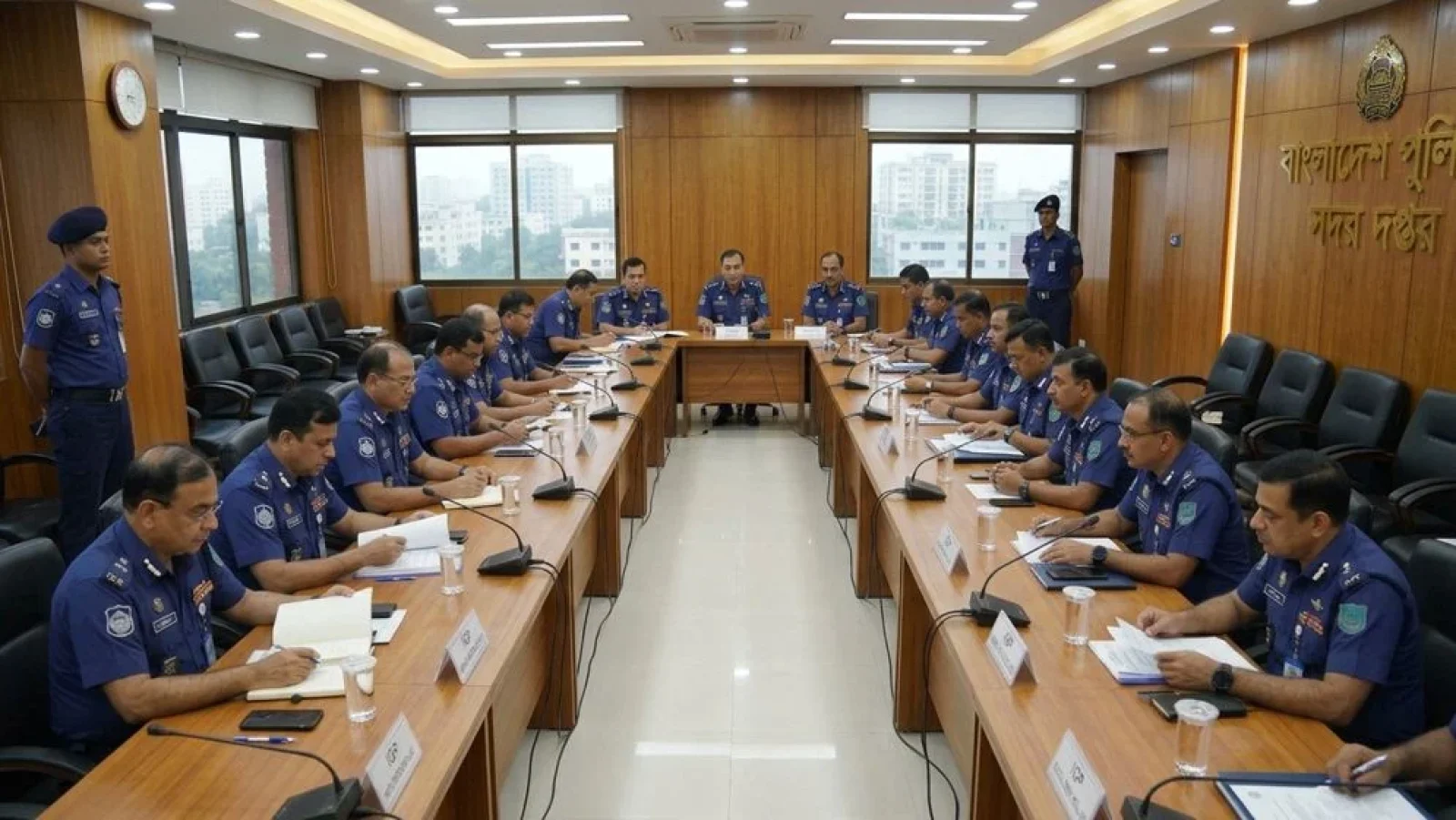
Senior officers expressed these views at a morning meeting at police headquarters on Tuesday, according to sources. Considering the current situation, they proposed tackling crime with a firm hand, including detaining criminals under the Special Powers Act of 1974 if needed. They said it was urgent to end confusion within the force and streamline it, and complained that people accused of extortion and other criminal offences are getting bail because of legal requirements. They also suggested appointing an additional IGP as director general of the Department of Narcotics Control to curb drugs, and stressed strengthening field policing and restoring public trust in the police.
The meeting, organised by the police’s confidential branch, was chaired by Inspector General of Police (IGP) Ali Hossain Fakir and attended by all additional IGPs, unit chiefs, the DIG (crime), the DIG (administration) and other senior officers. At a separate meeting, the IGP ordered that extortionists and criminals be brought to justice by any means.
At the morning meeting, some expressed anger that suspects arrested by police were getting bail within a short time, while an additional IGP said legal requirements and weak investigations were the reasons. Another additional IGP said that since crossfire has stopped, criminals should be detained.
A senior officer at the meeting told Jugantor it was held to improve law and order quickly, close legal loopholes that let criminals get bail and improve internal coordination. The meeting heard that the foundation of policing is building trust with the public, which cannot be restored with statistics alone, such as how many muggings, robberies or murders occurred or how many people were caught. The officer said direct public outreach must increase to clear up misunderstandings, and that better relations and transparency would restore public confidence.
An additional IGP said there is confusion on various issues within the force of about 230,000 members, and that rumours, audio and video campaigns and psychological pressure are affecting morale, so it is urgent to clear up the confusion and streamline the whole force. No miraculous change will come overnight, he said; a sustained, long-term effort is needed, with short- and long-term steps and policy-level reform.
The meeting also discussed several recent high-profile incidents and the police’s role and legal limits in them, including an attack on the Radda Maternal and Child Health-Family Planning Centre, an armed mob attack to grab land in Mohammadpur, an armed attack on New Guinea Properties in South Manikdi near the ECB Chattar, vandalism of content creator Salman Muqtadir’s studio, an attempt to seize an eight-storey building in Adabar, the escape of top drug dealer “Pichchi Raja”, accused in 25 cases, from a prison van, a series of clashes involving teen gangs in Chattogram, the brutal killing of a 13-year-old schoolboy in a remote forest in Lalmai hills, Cumilla, an arson attack on a moving passenger bus in Mirpur, and major clashes over land in Mymensingh and Natore.
Citing railway police chief Barrister Zillur Rahman, sources said suspects easily get bail because of certain legal requirements in the trial process. Under the Code of Criminal Procedure, a suspect becomes entitled to bail if the investigation report is not submitted within 120 days, and trials are supposed to finish within 180 days in magistrates’ courts and 360 days in sessions courts, which often does not happen.
With crossfire no longer in use, Additional IGP (HRM) Khondaker Rafiqul Islam proposed detaining criminals under the Special Powers Act. Zillur Rahman said that rather than mass arrests, a specific database of criminals’ involvement in anti-state activities or crimes should be built and detention orders issued through legal process. He also proposed bringing the Department of Narcotics Control under direct police command, saying drugs are at the root of all crime, and that an additional IGP could be appointed its director general after consulting the home ministry.
DMP Commissioner Mosleh Uddin Ahmed said drug dealing has risen alarmingly and is behind most crime, so drugs must be controlled at any cost. Highway police chief Faruk Ahmed urged using modern technology alongside established methods to control crime. The head of the river police expressed anger that criminals get bail so quickly after being arrested and sent to court, and CID chief Barrister Mohammad Mosharraf Hossain agreed that detention could be an effective method.
After the meeting with unit chiefs, the IGP joined the monthly crime conference at police headquarters, where he said drug dealers, criminals and extortionists must be brought to justice firmly, with no room for considering party identity: a criminal’s only identity is that he is a criminal. He also directed field officers to take proper legal action against juvenile offenders and to act against rumours and propaganda. The conference was chaired by Additional IGP Saidur Rahman, who told officers to gather information on teen gangs, find out whether influential people are behind them and take action, and ordered police to use body-worn cameras properly on duty.
বাংলায় মূল প্রতিবেদন পড়ুন · Read the original Bengali report