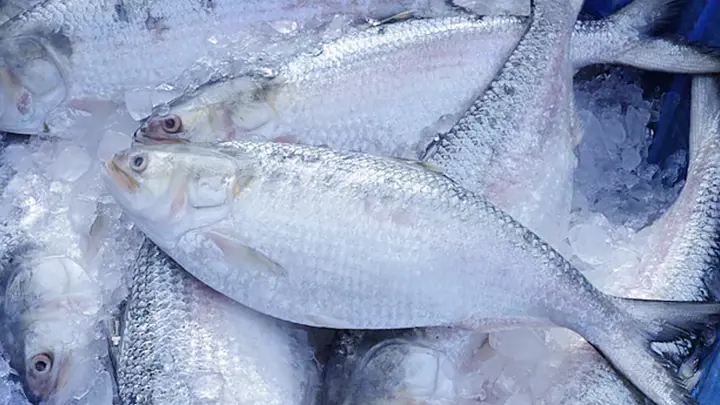
Bangladesh has long been the world’s top hilsa-producing country. The fish was once even exported abroad from Bangladesh. Yet today, traders are importing tonnes of hilsa from India just to meet domestic market demand. Over the past two months, 19 companies imported 352,484 kilograms of hilsa worth nearly 70 million taka through the Benapole land port. A large share of that fish came from Gujarat, India.
Speaking with importers, customs clearing and forwarding (C&F) agents and relevant government officials, it emerged that more hilsa is continuing to enter Bangladesh from India, arriving via West Bengal through the Petrapole-Benapole border crossing.
Syed Anwar Maksud, secretary of the West Bengal Chilled Fish Exporters Association, said around 500 tonnes of hilsa have been exported to Bangladesh via West Bengal over roughly the past two months. Almost all of it, he claimed, came from Gujarat.
The question being asked is why so much fish needs to be imported from India during the country’s own hilsa season.
Hilsa shortage in the market
Speaking with those involved, the main reason appears to be the price gap. Hilsa imported from India costs several times less than the price at which hilsa sells in Bangladesh, making import profitable for traders.
Jashore district fisheries officer Md Monirul Mamun said several companies are importing hilsa with permission from the Department of Fisheries, though officials have no specific insight into why this import is happening.
Department of Fisheries director general Dr Md Khaled Kanak said limited-scale hilsa import permits were granted based on traders’ applications.
Md Kamruzzaman, head of a C&F firm working on behalf of hilsa importers, said supply is falling short of market demand, which is why traders are importing. In his words, traders wouldn’t import if there were no profit in it.
This isn’t the first time hilsa has been imported from India, however — this kind of import first began in July last year.
Production declining in Bangladesh
After nearly two decades of steady growth, hilsa production in the country has been declining for the past three years. The fish’s average weight has also started falling. Researchers have been raising concerns over this trend.
According to fisheries department figures, Bangladesh produced 571,000 tonnes of hilsa in the 2022-23 fiscal year. That fell to 529,000 tonnes in 2023-24, and further to 504,000 tonnes in 2024-25. Official figures for 2025-26 aren’t yet available, but officials believe production has fallen below 500,000 tonnes.
Hilsa researcher Dr Anisur Rahman said river pollution, juvenile hilsa (jatka) being caught with current nets, sand extraction and various other factors have reduced hilsa availability in Bangladesh’s waters. Damage to hilsa’s migratory route from the sea into rivers could also be a contributing factor.
He said harmful fishing methods and pesticide use have also threatened hilsa’s breeding and growth habitats. Identifying the causes behind the current situation and taking swift, effective action is now necessary.
Big profit in imported hilsa
According to several officials and importers, hilsa from India costs at most around two dollars, or roughly 246 taka, per kilogram at purchase, sometimes even less. Even after adding customs duties and other costs, the price remains lower than hilsa of the same weight in Bangladesh’s market.
One official said this margin is giving traders a good profit on imports. With market supply low over the past two months, imported fish has also been selling well in the Jashore region.
Recent conditions in Dhaka’s markets also show high hilsa prices. Buyers said hilsa weighing more than 500 grams is being priced at around 1,600 taka. Fish weighing more than a kilogram costs around 2,800 taka. Hilsa weighing 800 to 900 grams sells for 2,200 to 2,400 taka, and 700-gram fish for around 1,800 taka.
According to the Fisheries Research Institute, hilsa accounts for around 12 percent of the country’s total fish production. Bangladesh produces around 60 percent of the world’s total hilsa. The fisheries and livestock ministry, however, claims Bangladesh currently produces around 70 to 80 percent of the world’s hilsa.
Production-boosting project, questions over effectiveness
A six-year project was launched in 2020 to boost hilsa production, with planned spending of around 4 billion taka. But with production continuing to decline, questions have now emerged over the project’s effectiveness.
Department of Fisheries director general Dr Md Khaled Kanak said it needs to be examined how well the project was utilised under the previous government, and whether there was any negligence. The causes behind falling hilsa production also need to be identified.
On hilsa imports from India, he said hilsa import is not banned; small amounts have entered at various times before as well. With market supply low this time, limited import permits were granted based on traders’ applications.
In his view, hilsa is a sea fish that comes into rivers to breed. Indian fishermen may be catching more of the fish while still at sea, while Bangladesh’s stock is declining. These factors together led to the limited import permits.
Gujarat has a larger hilsa supply
A large share of the hilsa entering Bangladesh comes from Gujarat. West Bengal fish exporter Syed Anwar Maksud said Gujarat’s hilsa supply has been much higher this year, creating a surplus there and pushing prices down.
He said Bangladesh has strong demand not just for hilsa itself but for hilsa roe too. Gujarat’s hilsa tends to be larger and full of roe. In Bangladesh, hilsa roe is processed and packaged for export to markets including the United States and United Kingdom.
According to Maksud, this commercial hilsa route runs from Bharuch in Gujarat, through the wholesale market in Howrah, West Bengal, all the way to the Petrapole-Benapole border.
Chiman Tandel, president of a fish traders’ organisation near Bharuch’s Bhadbhut area, said hilsa production there has been good for the past five years. These fish are generally sent to West Bengal, from where they are also exported to Bangladesh.
According to him, hilsa is also sent directly to Bangladesh from Bhadbhut in refrigerated trucks. Train containers are used when quantities are smaller, but larger shipments generally go by truck.
By Chiman Tandel’s estimate, three trucks leave Bharuch daily, each carrying an average of 250 boxes, with each box holding 60 kilograms of hilsa.
Fisherman Deepakbhai Machhi said Gujarat’s hilsa season runs from mid-June through Navratri. Hilsa currently sells there for 600 to 700 Indian rupees per kilogram. He claimed some small-scale fishermen earn up to around 500,000 taka over the three-month season.
Gujarat’s largest hilsa catches come from near Bhadbhut, where the Narmada river meets the sea. Hilsa is also found near Jambusar and Hansot.
Bangladeshi buyers in West Bengal’s markets too
Rathikanta Bar, president of the Kalibabur Bazar Fish Traders Association in Howrah, claimed that this year, Bangladeshi traders have also been travelling to West Bengal’s markets to buy hilsa in retail quantities. Their purchases total around 1.5 to 3 metric tonnes. They too, however, prefer the larger hilsa arriving from Gujarat and Maharashtra.
Jaykrishna Halder, a leader of several fishermen’s organisations in West Bengal, blamed water pollution and industrial-scale fishing for this shift in hilsa supply.
He said repeated calls to stop the use of banned pesticides and dumping urban wastewater have gone unheeded. Alongside this, large motorised vessels engaged in industrial-scale fishing for nearly the whole year are also having a negative impact on the catch of ordinary fishermen.
Meanwhile, Bangladesh also failed to meet its hilsa export target last fiscal year. According to officials’ figures, against a target of exporting 1,200 tonnes, less than 110 tonnes of hilsa were actually exported that year.
As a result, while hilsa production and supply are declining in Bangladesh, imports from India are rising to meet market demand. The need to identify the causes of falling production and take swift, effective action has now become even clearer if the country is to maintain its long-standing leadership in hilsa production.