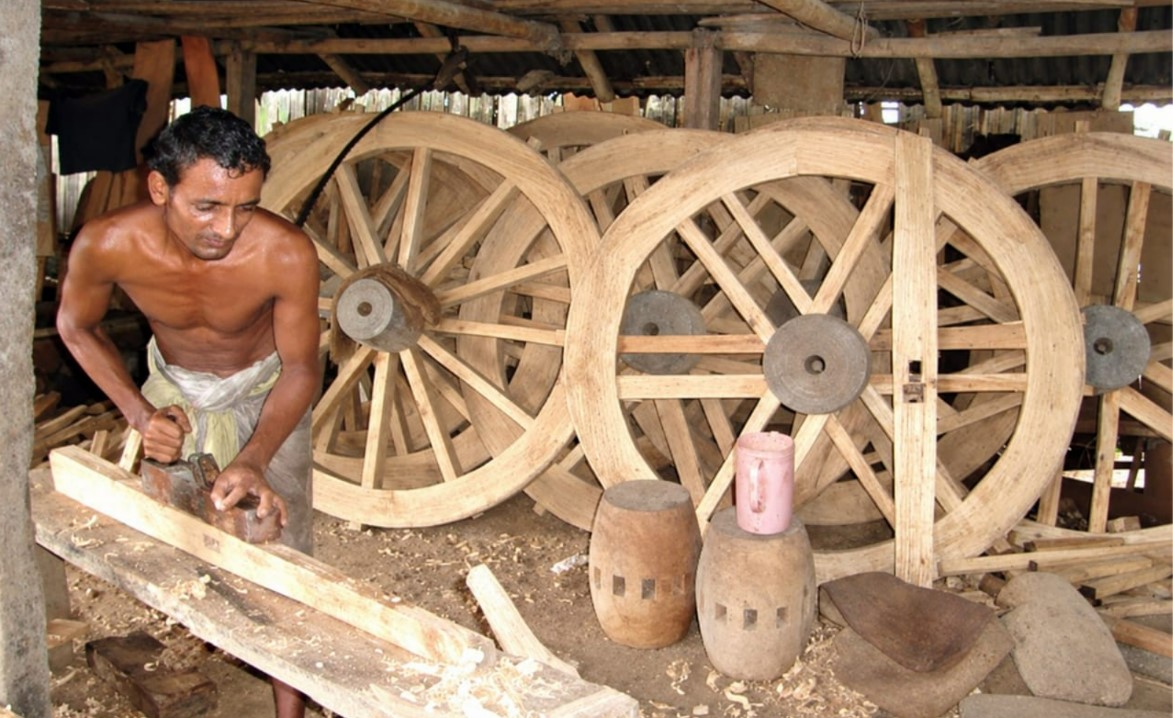
Bullock carts, and the wheels that go into building them, have inspired popular songs, plays and more at various points in history. Wheeled carts pulled by bullocks or horses were once one of the main modes of transport for people across Bengal’s 68,000 villages. With the passage of time and the arrival of the machine age, such carts are now rarely seen. Yet the wheelwrights, craftsmen and cottage-industry workers who make the wheels for these carts have depended on the wheel since British times, and still do. As the wheel turns, so turns the wheel of their fortune.
Kushtia’s six upazilas are home to hundreds of wheel-making craftsmen. Working artisans say this area is famous across Bangladesh for making and selling wheels. They have clung to this trade, generation after generation, since British times. Wheel-making merchants and craftsmen at the market say many families here are highly skilled at making bullock-cart wheels.
They say wheel-making was their father’s and grandfather’s trade, and they too have been unable to leave it. One craftsman can make about one wheel a day, or 25 pairs a month. A pair of wheels costs at least 15,000 taka to make and sells in the market for around 20,000 taka. Babla wood is the sole raw material for these wheels. No machinery is used — the visually striking wheels are shaped entirely by hand, using hammer, chisel and saw.
Babla trees grow strong and straight even while young. A pair of wheels can be made from a small tree costing 2,000 to 2,500 taka. A larger babla tree costing 5,000 to 5,500 taka can yield two pairs of wheels.
Intaz Ali, a wheel-making craftsman in Poradaha, said babla wood is sawn at the sawmill and then left to dry in the sun for a month. After that, the work begins by cutting it on their own custom-built frame or machine with a saw. The wheel’s round central hub (belon), the long spokes inside (pak), and the outer wooden rim (koitha) are fitted together, and the wheel is set within a single day. It is then finished and made ready for sale. A craftsman is paid 700 taka a day. A pair of wheels lasts seven to 10 years on a cart. Wholesale traders come from various districts to Mirpur to collect wheels, and farmers from rural areas across different districts also come here for them.
Craftsmen and merchants say babla trees for wheel-making were once easy to find. Now, however, they are no longer seen growing in rows along dirt roads, canal banks or nearby areas. Wheel-making work continues year-round. While these wheels are used for bullock, buffalo and horse carts, horse carts have nearly disappeared. Bullock and buffalo carts are still used in rural areas to carry crops from fields over muddy dirt roads.
Craftsmen busy making wheels also say that a lack of capital sometimes forces them to buy timber on credit at higher prices. Those involved say that with government and private support, bank loans and similar facilities, this wheel-making trade — directly tied to farming, through bullock and buffalo carts — could survive, and the wheel of fortune could turn again for the hundreds of craftsmen and others connected to this trade.