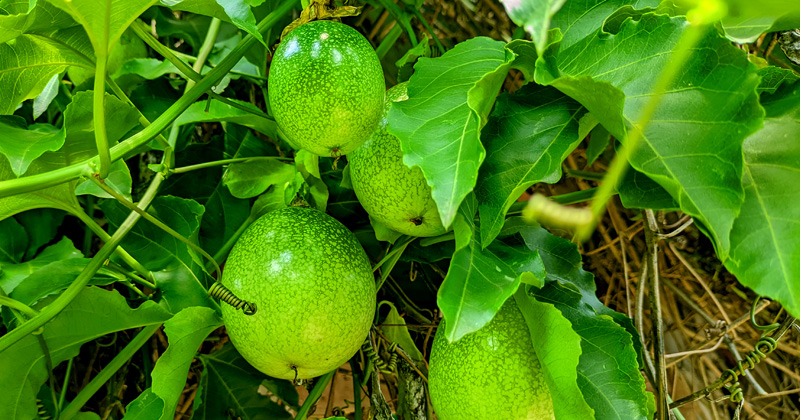
The foreign fruit passion fruit is known in Bangladesh as “Anarkali,” or “Tang fruit.” Saleh Ahmad, a farmer of Kamalganj in Moulvibazar, has found remarkable success growing it. The fruit began to be grown in the district’s hilly areas a few years ago, but he is the first to start commercial cultivation on the plains. The agricultural entrepreneur lives in the West Baghmara village of ward 6 in the Kamalganj union of Kamalganj upazila.
The mildly sweet-and-sour Anarkali is growing in popularity by the day. Each piece sells wholesale for 10 to 15 taka. Anarkali can be grown entirely organically, without chemical fertiliser or pesticide, which keeps production costs low and leaves no health risk. The cultivation of this fruit, unique in taste and aroma, has opened up new possibilities for fruit production in the district.
Saleh Ahmad said that, alongside paddy, he had long kept a small orchard of lemon, latkan and various other local and foreign fruits on his land. In 2022 he began growing Anarkali experimentally, planting three saplings on four decimals of land. In 2024, after meeting his family’s needs, he sold the fruit from those three trees for 10,000 taka. Encouraged, he planted more saplings that year and achieved commercial success. With the fruit now on his trees, he expects to sell more than a lakh (100,000) taka worth this season.
On a visit to his orchard, the trellises and the larger trees were seen covered with the flowers and fruit of the climbing Anarkali, or passion fruit. “I have been involved in farming since childhood — my father and grandfather were farmers too, and farming is my family’s only source of income,” Saleh Ahmad said. “In 2022 I first saw Anarkali fruit at the house of the headman of a Khasia betel-leaf hamlet. When I asked him for saplings, he said that if the cuttings were planted in the soil they would grow into trees.”
“I brought back three good cuttings and, purely as a hobby, planted them on an abandoned plot of mine. Within a few days new leaves sprouted and the plants grew quickly, like bottle-gourd vines. I then built a trellis, and within a year they produced beautiful flowers and then fruit. In the very first year we ate plenty of the fruit at home, and people in the area asked for it too — there is hardly a house nearby that did not eagerly take some from me. But I never imagined I would be able to sell it,” he said.
“In 2024 a young man named Sayed Ali, who has a seasonal fruit stall at Lawachhara National Park, offered to buy the fruit. I agreed and sold the ripe fruits hanging on the trees to him at 25 taka a piece. Even after distributing some locally and meeting my family’s needs, the fruit sold at the end of the season came to more than 10,000 taka,” Saleh Ahmad said. Encouraged, he raised more saplings from cuttings and seeds; his trellises and nearby mango and jackfruit trees now carry many Anarkali plants. He hopes to sell at least a lakh taka worth this year, though bee attacks after flowering caused heavy damage — otherwise the yield and income would have been higher. People are now coming from various areas to buy the fruit and saplings.
Sadrul Hossain of Baghmara village said people come from far away to see Saleh Ahmad’s Anarkali orchard, where hundreds of fruit grow on a plot of just four decimals. Plenty of fruit forms at the tip of every branch; the crop needs no chemical fertiliser and can be grown organically with no health risk, and the fruit is rich in vitamin C, iron, zinc and vitamin A.
Saleh Ahmad said that cultivating Anarkali on a bigha of land could yield several lakh taka worth of fruit, that it is sold by the piece and that production costs are very low. Alongside growing the fruit, he has now also begun producing saplings on a large scale, he said, adding that Anarkali is also delicious to eat.
বাংলায় মূল প্রতিবেদন পড়ুন · Read the original Bengali report