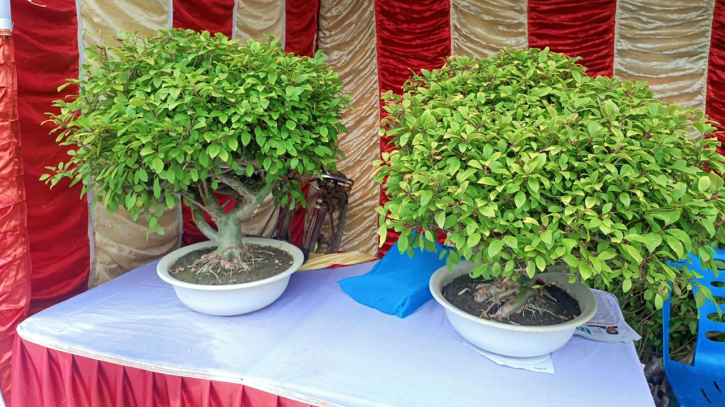
At Bismillah Garage in Jashore’s Bagmara Para, three rooftops of one joint family’s home are a striking sweep of green amid the busy town. Rows of rare plants stand in pots large and small in special soil. Visitors’ eyes catch on one particular plant — not an ordinary bonsai but white sandalwood, one of the world’s most valuable and medicinal plants.
About 350 rare white sandalwood plants are being raised on a single rooftop garden — a quiet herbal revolution that, beyond Jashore, is opening a door of new possibility for the whole country’s economy.
The man behind it is Sajjad Hossen, 45, who was drawn to bonsai from his school days. He found inspiration in 2007 while living in Malaysia, seeing bonsai arranged at a Chinese businessman’s firm. He returned home in 2010 and took up farming but did not succeed at first. With dogged determination, he began making bonsai in 2013 from banyan, pakur and ashwattha saplings, then collected just 10 white sandalwood saplings from the Jashore forest department’s Jhumjhumpur nursery. Without any formal training, he prepared the special soil the plants needed by studying books and magazines at the public library.
To treat plant disease, instead of chemical pesticides he uses an environment-friendly mix of water steeped in rotted mahogany leaves and lemon juice. From those 10 saplings, his rooftop garden now holds about 350 white sandalwood bonsai of various ages, with about 4,000 saplings aged 2-3 years in the nursery.
Sandalwood is thought to have originated on Indonesia’s Timor island, but its tradition in the Indian subcontinent is ancient, with mentions in the Ramayana, the Mahabharata and Kautilya’s Arthashastra (200 BCE). On the world market, white sandalwood is called “green gold.” A mature 20-year-old tree yields about 300 to 350 kilograms of wood, currently worth about 15,000 taka a kilogram. According to the Jashore social forestry department, sandalwood grown on one acre at a cost of about 100,000 taka (1 lakh) can earn 6 million to 10 million taka (60 lakh to 1 crore) after 15-20 years.
Long before penicillin was discovered, sandalwood oil was used in the East and West to treat gonorrhoea, and it has long been used for high blood pressure, bronchitis, skin disease, prickly heat, smallpox and digestive problems, as well as in beauty care. In Hindu tradition, sandalwood is essential for worship and last rites, and in Muslim tradition its oil is a prized ingredient in attar perfume.
Sajjad Hossen recently brought white sandalwood for the first time to a tree fair organised by the Jashore district forest department, where visitors showed keen interest in buying it, and he won the fair’s award for best young entrepreneur. Sabuj Bairagi, a student of Jashore Cantonment College, said he had bought a 44-day-old sapling for just 50 taka as a long-term investment, while a visitor named Arnima said she hoped to use a sapling she had bought, out of memory and religious feeling, in her own worship in 20 years.
Sajjad Hossen is now producing saplings through tissue culture and has kept 2,000 saplings ready, including two special 14-year-old ones to gift to the prime minister; he has also expressed a wish to take on planting and caring for sandalwood in unused space at government buildings. Although Bangladesh is suitable for sandalwood cultivation, the tree is somewhat endangered in the country for lack of long-term care and protection.
Professor S M Ayub Hossen of the botany department at Jashore Government Michael Madhusudan (MM) College and assistant forest conservator Amita Mondal raised several points about the sector. A sandalwood tree brings no income for the first 5-7 years, so easy-term bank loans and government incentives are needed to help young entrepreneurs survive; as a valuable tree it faces theft risk, so proper legal and social protection is needed; and higher research on sandalwood and expanded tissue culture at the country’s universities are needed to conserve genetic resources. A small sapling worth just 50 taka today, with proper care and 20 years’ patience, could become a national asset worth lakhs of taka.
বাংলায় মূল প্রতিবেদন পড়ুন · Read the original Bengali report