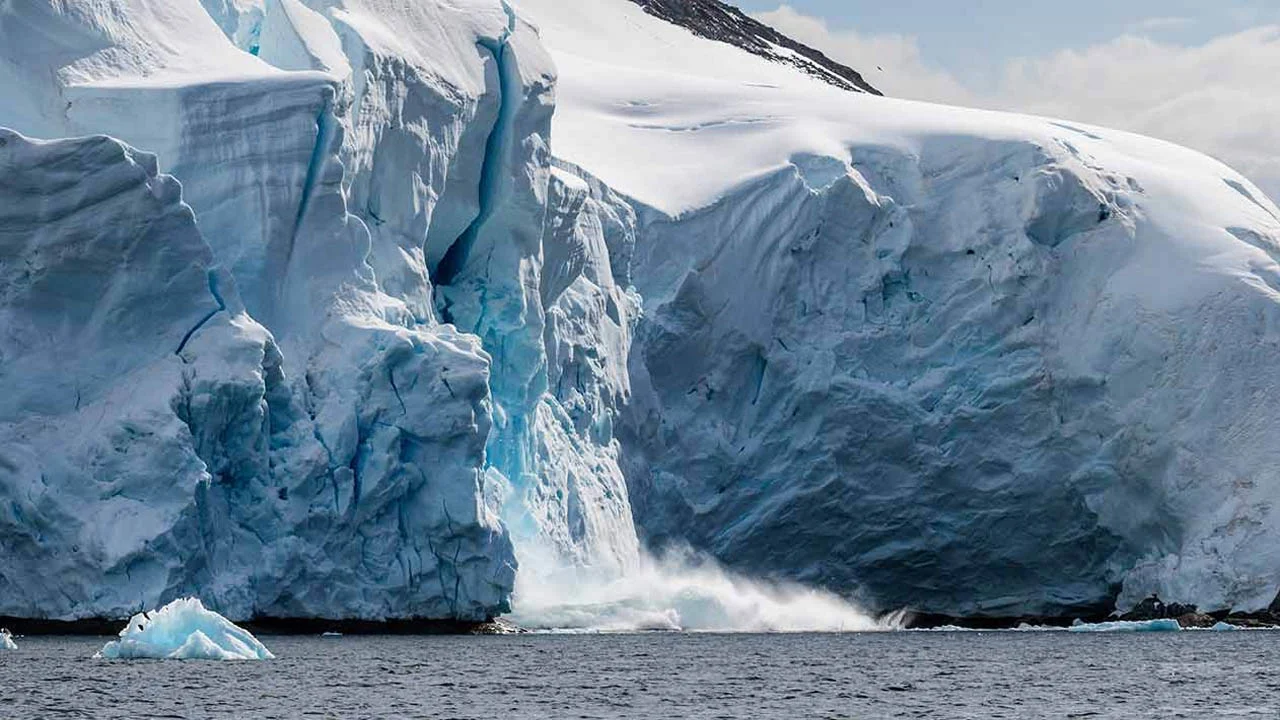
As human civilisation has advanced, the ice-covered continent of Antarctica has come under growing threat. Global warming is melting Antarctic ice at speed, a long-standing concern among scientists. Now the southernmost continent has become the source of a different worry: researchers have found that toxic metal is steadily entering the ocean from Antarctica, with possible consequences for human health before long.
Mercury is among the first 10 chemicals the World Health Organization lists as of major public health concern. It is toxic even in small quantities. As Antarctic ice melts, that mercury is entering the sea.
Mercury ordinarily enters the environment through natural processes, from volcanoes and certain geological activity, in quantities that are not especially worrying. Scientists say the burning of fossil fuels for industry and mining have raised environmental mercury to abnormal levels, and with it the danger. Antarctica has until now acted as a safeguard: for years its ice has functioned as a mercury sink, absorbing the metal from the environment and trapping large quantities of mercury pollution.
The difficulty lies elsewhere. The same heavy industries that release mercury also produce greenhouse gases, raising their concentration in the atmosphere, and those gases are melting the Antarctic ice. The ice that has been holding industrial mercury and limiting pollution is itself melting because of that industry and air pollution, so the ice’s role as a mercury sink is now working in reverse. Scientists have recently observed this pattern in Antarctica.
Researchers at Peking University in China recently studied Antarctic ice and mercury pollution, led by the university’s environmental scientist Chengzhen Zhou. They set out their findings, and described conditions in Antarctica, in the Proceedings of the National Academy of Sciences. The part of Antarctica whose ice is melting fastest because of environmental pollution is identified by scientists as the Antarctic Peninsula, and analysis of sediment samples from there revealed the cause for concern.
Ice on the Antarctic Peninsula holds twice as much mercury as is stored anywhere else in the world. Scientists say the rate of mercury accumulation in this area rose by 160 percent after the Industrial Revolution in 18th-century Europe.
Two mercury cycles are active in the environment. In the first, mercury can be absorbed from the atmosphere into seawater and released back into the air. In the second, in ice-rich areas such as Antarctica, mercury is absorbed from the atmosphere into glaciers, and from there passes through land into the sea. Zhou wrote in the paper: “The coupling of these two cycles has increased mercury emissions to land from melting ice by 550 percent, and atmosphere-to-ocean mercury exchange by 350 percent.” In this way Antarctica’s vast mercury store has gradually become a source of pollution.
Earlier research found bacteria in Antarctic ice capable of converting mercury into methylmercury, a powerful neurotoxin. The compound also accumulates in marine animals, and from there can reach humans. “The present state of mercury pollution in Antarctica may increase the risk to the ecosystem there,” Zhou said.
Scientists have found mercury levels rising in animals in the Southern Ocean, in most cases exceeding previous records. Mercury discharge from the Antarctic Peninsula into the open ocean through currents has risen by 400 percent. Scientists believe the pollution could spread to more distant seas in the years ahead.
বাংলায় মূল প্রতিবেদন পড়ুন · Read the original Bengali report