Hundreds of thousands of people have taken to the streets in several European countries in protest at the rising cost of living, low wages, a housing crisis and budget shortfalls in schools and universities. The protests have spread across France, Belgium, Italy and Portugal, with clashes, looting and arson in some places.
France is now at the centre of the unrest. According to its interior ministry, more than 550,000 people protested across the country last Saturday, continuing a student movement over education and the cost of living.
The unrest has brought the financial troubles of European governments to the fore, and governments are struggling to cope. After years of heavy borrowing, many European countries are now deep in debt, and the cost of that debt is rising.
France’s borrowing costs have reached their highest level since 2002. Protesters say that because the government is spending more on interest, allocations for essential public services such as schools, hospitals and pensions are being cut.
A report by the international news outlet Al Jazeera shows how governments borrow, where France stands among the most indebted countries, and how many trillions of dollars governments are spending on interest.
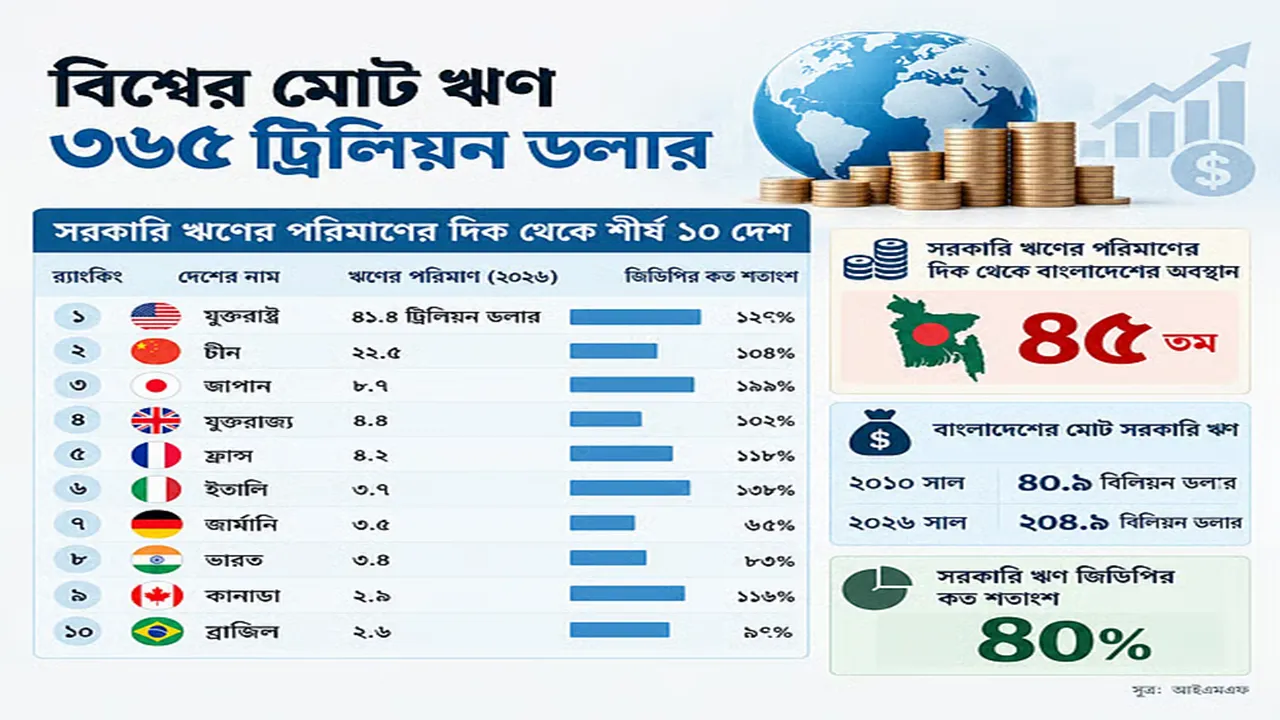
US most indebted, Bangladesh 45th
According to the International Monetary Fund (IMF), the United States has the most government debt in the world.
Its debt stands at $41.4 trillion, equal to 127 per cent of its gross domestic product (GDP).
The United States has the advantage of borrowing in the US dollar, the world’s main reserve currency. Because demand for dollars is high worldwide, investors are also keen on US debt. But the United States cannot borrow without limit.
China has the second-largest government debt, at $22.5 trillion, or 104 per cent of GDP. Japan, in third place, has government debt of $8.7 trillion. Among major economies, Japan has the highest debt-to-GDP ratio, at 199 per cent.
The United Kingdom has the fourth-largest government debt, at $4.4 trillion, or 102 per cent of GDP. France, in fifth place, owes $4.2 trillion, equal to 118 per cent of its GDP.
Italy’s government debt is $3.7 trillion. Its debt burden is heavy relative to the size of its economy, at 138 per cent of GDP. Germany’s government debt is $3.5 trillion, or 65 per cent of GDP. India is seventh, with debt of $3.4 trillion, or 83 per cent of GDP.
Bangladesh ranks 45th on the global list. Its total debt now stands at $204.9 billion, equal to 40 per cent of GDP. In 2010, Bangladesh’s debt was $40.9 billion, which means it has grown about fivefold in the past decade and a half. Even so, Bangladesh’s debt-to-GDP ratio remains relatively low compared with the developed world.
The IMF forecasts that France’s government debt could reach 121.8 per cent of GDP by 2030, making efforts to put the country’s public finances back on a sustainable footing even harder.
How governments borrow
Governments borrow much as ordinary people do. But instead of taking loans from banks, they sell bonds. In return, the government pays the buyers interest and promises to repay the full amount on a set date.
A 10-year bond, for example, is a loan that the government must repay after 10 years. The bond’s yield, or interest rate, is the return investors get for lending. It is one of the most important measures of the financial markets’ confidence in how well a country can manage its debt.
What happens when borrowing costs rise
When bond prices fall, their yield rises, which makes new borrowing more expensive for the government. Just as a household budget is squeezed when the interest on a home loan goes up, the same happens to a government. When interest costs rise, health, education and infrastructure feel the pinch.
In the eurozone, France now pays about 5 per cent interest on 10-year debt, against 3.41 per cent for Germany. France is now paying more than even Italy and Greece. Outside the eurozone, only the United Kingdom is currently borrowing at a higher rate than France.
During the eurozone debt crisis of 2010 to 2012, only countries in trouble, such as Greece, Italy and Spain, had to pay 5 per cent or more. Ireland and Portugal had to seek international bailouts when their rates went above 7 per cent.
$3.3 trillion on interest alone
Total global debt, counting governments, households and private companies, rose by $10 trillion in the first six months of 2026.
According to the Institute of International Finance (IIF), global debt passed $365 trillion at the end of June, or about $44,000 for every person in the world. Much of the increase came from emerging economies.
Interest costs are rising along with this huge debt burden. Over the past year, advanced economies spent more than $3.3 trillion on interest on government bonds. That is more than the world spent on the military ($3.1 trillion), artificial intelligence ($2.6 trillion) or clean energy ($2.3 trillion).
When governments spend more on interest, there is less money for public services. To meet higher interest costs, governments may have to raise taxes or cut spending elsewhere. The effect is felt not only in government budgets but by ordinary people too: when government borrowing costs rise, interest rates on mortgages, car loans and credit cards can also go up. Source: Al Jazeera
বাংলায় মূল প্রতিবেদন পড়ুন · Read the original Bengali report