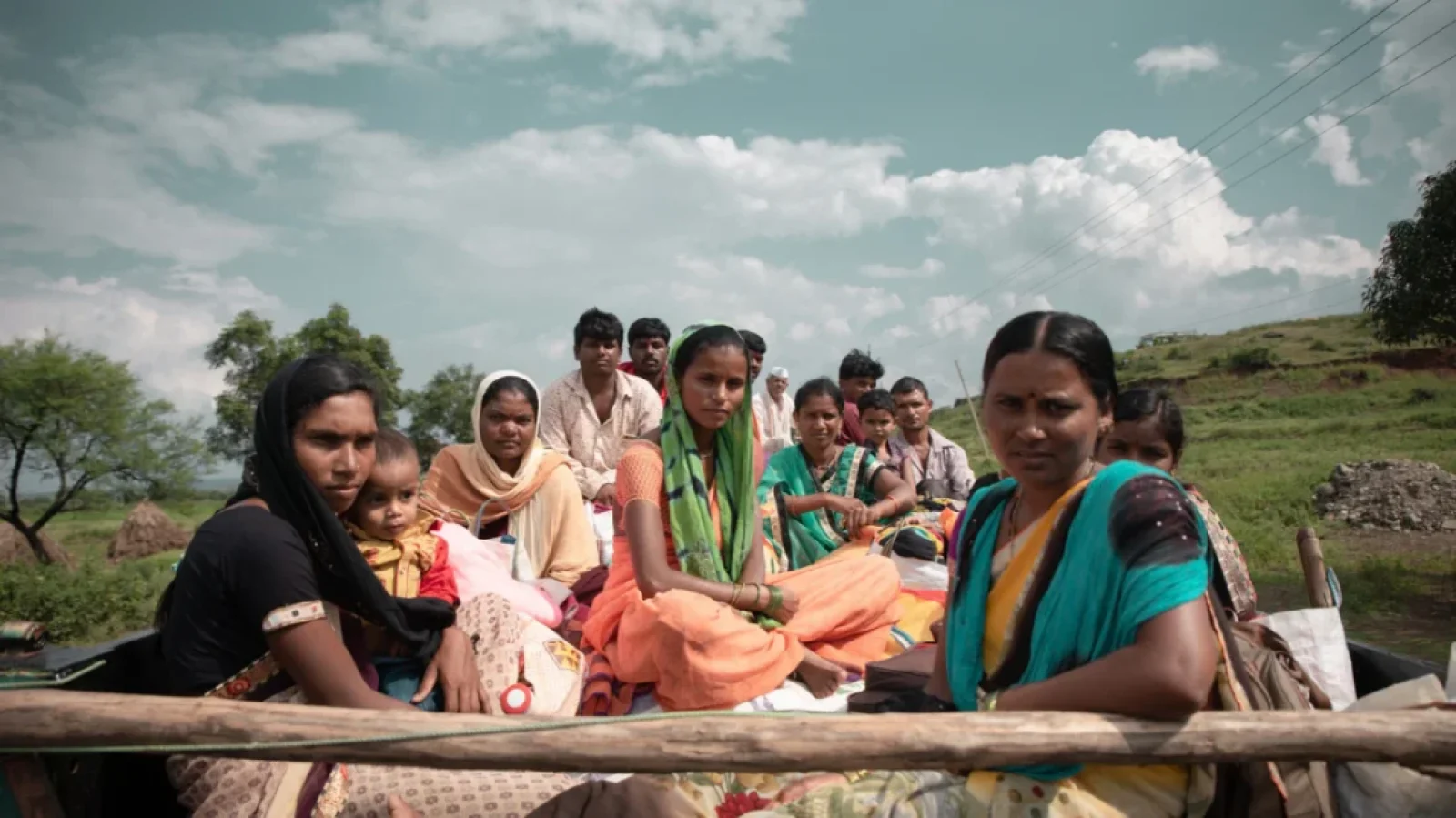
Purnima’s working day begins before dawn. At 4am in Ramnal, a remote rural area of Karnataka in southern India, she steps out of her tent to get ready for the day’s work. The other women in the tents also wash and prepare for work before the men wake up. To pay off debts and make a living, they have come more than 500 kilometres from their own villages.
An estimated 1.5 million people cut sugarcane across India. They often do back-breaking work for up to 14 hours a day for a wage of about 400 rupees. They usually work in husband-and-wife pairs from dawn until night, and their only break comes while the cane is being loaded onto trucks.
According to a report by the British outlet The Independent, 16 percent of the world’s sugarcane is grown in India, the second-largest producer after Brazil. Cane from this region is regularly supplied to global soft drink giants such as Coca-Cola and PepsiCo.
Most of the cane cutters working in these fields come from Beed district in central Maharashtra. With no work in their own area, they are forced to take up this gruelling job to feed their families.
A bitter reality
For many women, the physical labour is only one part of the struggle. More worrying still, for fear of losing work, women are enduring pressure so extreme that it puts their bodies and reproductive health at risk.
Women workers living in makeshift camps without toilets or clean drinking water face a harsh reality. In such conditions, managing menstruation brings not only physical hardship but a serious financial blow as well.
Missing a single day of work means losing a large share of their wages, so they have no chance to take time off during their periods.
These women are left with only two options: stay away from work for the sake of their health and pay a heavy penalty, or keep working at the cost of their bodies.
According to women workers and activists who work on their rights, many workers are forced into extreme and risky decisions to avoid severe period pain and breaks during pregnancy altogether, simply to stay in the fields and keep earning.
“If someone could free me from this pain, it would be a great help,” said a worker named Purnima. She is considering having her womb removed, a hysterectomy, as the solution.
“My pain is not going away. If I keep doing this work, the pain will only get worse,” she said. “If I could stop lifting heavy things, maybe things would be a little better. But we have no choice other than this work.”
Workers trapped in debt
Cane cutting is essentially seasonal work on which many families in the Beed region depend. Every year a contractor gathers these migrant workers. The contractors deal with the sugar mills, arrange the workers’ travel and pay them an advance at the start of the work.
Couples who do this work are known locally as “koyta”. They have to work to repay the advance, and each couple is expected to cut an average of at least three tonnes of cane a day.
Because the group’s earnings are shared, anyone who slows down puts pressure on the rest, so everyone has to keep the same pace. If a woman cannot work because of illness or any other reason, the other couples demand money from her for the extra work they do to make up the shortfall.
A worker named Savita decided to have her womb removed in March 2025 after severe suffering.
“In the field there is nobody to help you. Nobody will give you even a moment’s rest,” she recalled. “I was very ill, and still nobody helped me at all. I had terrible stomach pain and could not climb the ladder to load cane onto the truck. Last year I fell three times doing this work, and still there was no way to complain.”
Purnima tells of the same hardship. “We have no days off,” she said. “From the time we arrive here, we have to work every day without a break for the next four to five months.”
After three years of constant, unbearable pain, Purnima said she too is now thinking of having her womb removed. But if she does decide to have the operation, she will have to take out a new loan to pay for it.
“I will have to borrow even to have my own womb removed,” she said bitterly. “It feels as if my body too has become a slave to this system.”
‘I trusted the doctors, but months later the pain has not eased’
Women’s rights activist Sangeeta Chauhan and politician Dr Neelam Gorhe have long worked for women’s welfare. A report by Dr Gorhe published in 2019 revealed the high rate of unnecessary hysterectomies, and it was mainly after that report that the issue drew wide attention.
Sangeeta said that instead of being referred to government hospitals for low-cost treatment and regular care, many women are forced or pressured into going to private clinics, where these operations are carried out without proper medical reason.
To tackle the problem, the Indian government has appointed ASHA (Accredited Social Health Activist) workers as community health workers in rural areas. They help women working in the fields get government treatment, maternity care and the health education they need.
While many ASHA workers genuinely work to help these women, Sangeeta said she has spoken to some who admitted they are paid in return for recommending women for hysterectomies.
But when The Independent asked ASHA workers in Maharashtra about this, they denied it.
“I have also heard of young women having their wombs removed, but I am not sure whether it is being done in government or private hospitals,” said Ganga Shevante, an ASHA worker from Wadwani.
Denying that she receives any financial benefit for sending patients for surgery, Ganga said she has never taken money for such work herself. She said she does not advise going to private hospitals, and that those who can afford it choose to see doctors at private clinics of their own accord rather than go to government hospitals.
The Independent’s investigation found that everyone is trying to shift the blame onto someone else, and that amid this blame game the women who are the real victims have been left helpless.
Months after her operation, Savita said she is still bleeding and her stomach pain is worse than before. Working has become even harder for her.
“I trusted the doctors,” Savita said. “I thought that if my womb was removed, all the pain would end at once, so I agreed.”
When Savita later sought treatment in the city of Pune, doctors there told her an infection had spread in her body. When she then asked to see all the medical reports from her earlier operation, they were not given to her.
“I am still living with unbearable pain, and yet nobody warned me about any of this before the operation,” Savita said.
Government steps have changed nothing on the ground
Contractors who work with the cane cutters say they do not force anyone to have surgery. But they do not give workers any paid leave either, because that would mean less cane loaded onto the trucks, and the sugar mills would not hire them again.
“Our pay depends entirely on how much cane by weight we can deliver to the factory,” said local contractor Ashruba Datta.
“When we have more workers, we earn well,” the contractor said. “When we are short of workers, we cannot make up the shortfall by piling extra work on the others.”
According to those involved, changing the brutal working conditions of these women requires a fundamental change in the structure and regulation of India’s farm labour system.
In 2019 the Maharashtra government surveyed 82,309 women in Beed district involved in cane cutting. It found that 13,861 of them had had their wombs removed, and more than 45 percent of those women reported various physical or mental problems and suffering afterwards.
In response, the government later announced several measures to monitor hysterectomies and improve the working conditions of migrant workers.
In March 2025 the Bombay High Court issued several directions to the state government to ensure proper registration of workers, welfare benefits and better health care. A report with updated figures was due in November 2025 but has still not been published.
Yet according to workers on the ground, almost nothing has changed in practice.
Purnima and Savita both said they have received no help or support of any kind from the government.
The price of survival
“My pain has gone beyond what I can bear,” Purnima said. She said she has spent about 50,000 rupees on her pain in a single year. “As soon as I go back to the village I will have to have the operation, but for that too I will have to take out a new loan.”
“It feels as if I have to give up my womb just to keep working in this system,” she said.
The Independent repeatedly tried to contact Beed District Collector Vivek Johnson, who is responsible for the district’s administration, public welfare and law and order, but he declined to comment.
Coca-Cola, for its part, said it is working with the international development organisation Solidaridad to give workers access to clean drinking water, toilets, shaded rest areas, ergonomic tools and women’s health products. It said 100,000 people have already benefited from the joint initiative.
The Independent contacted PepsiCo, but it did not respond.
Purnima’s physical and mental suffering continues. “Should I put off the operation or have it done?” she said. “I only hope that without the pain I will be able to keep working in the fields and put food on my family’s table.”
বাংলায় মূল প্রতিবেদন পড়ুন · Read the original Bengali report