The government has drawn up a large plan to deal with the pressure on the economy, strengthen foreign exchange reserves and carry out long-term structural reforms. As part of it, Bangladesh has asked the World Bank for a total of $13.77 billion in foreign loans and support to get through the current economic crisis.
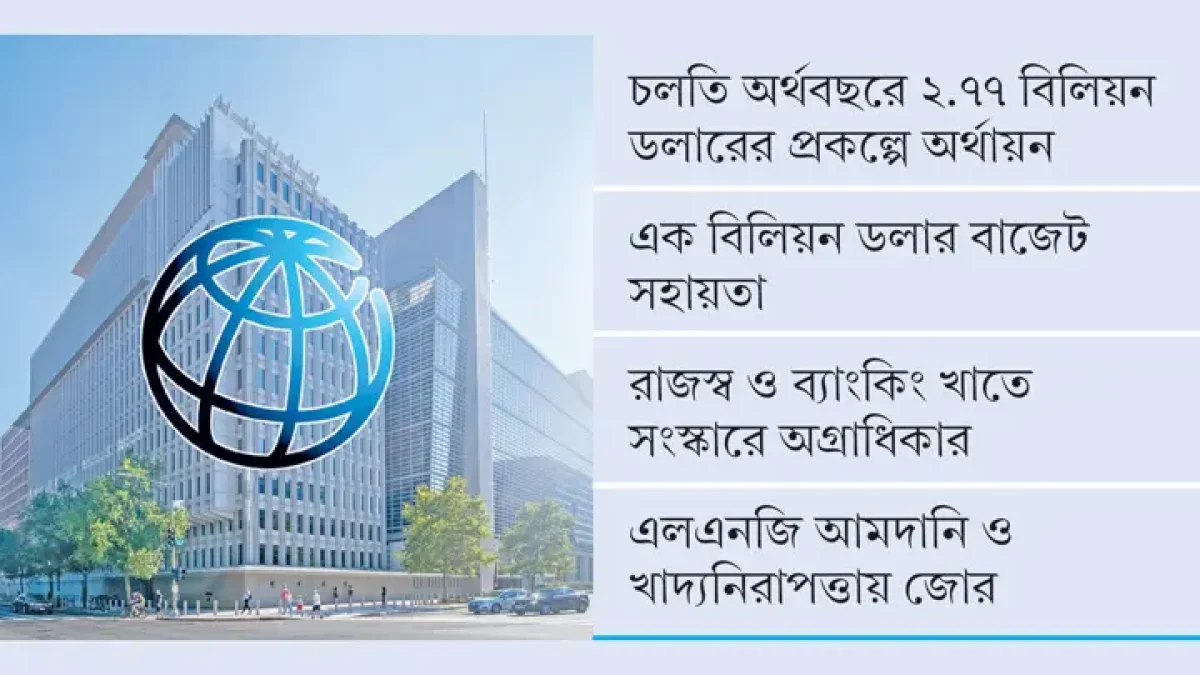
Of that, Bangladesh has formally sought $2.77 billion in project financing and an additional $1 billion in budget support from the World Bank for the current 2026-27 fiscal year. It has also proposed an additional $10 billion in loans over the next three years under a proposed framework called the Resilience, Reform and Investment Partnership (RRIP).
The main aims of the request are to import LNG at affordable prices, revive the fragile banking sector, speed up revenue collection and push ahead with several major infrastructure projects, according to sources familiar with the matter.
Bangladesh first proposed the $10 billion RRIP framework at a bilateral meeting between Prime Minister Tarique Rahman and the World Bank president in New York on 22 September, during the UN General Assembly. The possible agreement, with outlines of various projects, was then discussed in detail at the IMF-World Bank annual meetings in Bangkok from 12 to 18 October.
A report on the Bangladeshi delegation’s participation in the 2026 World Bank and IMF annual meetings confirms that the two sides decided to form a technical team within the next 60 days, made up of the Economic Relations Division (ERD), the World Bank and other stakeholders, to finalise the strategic partnership. The government aims to finalise the agreement by June next year.
Finance Minister Amir Khasru Mahmud Chowdhury led the 12-member Bangladesh delegation to the annual meetings in Bangkok.
During the meetings, the delegation held separate bilateral talks with Anna Bjerde, the World Bank’s managing director of operations, and Joel Barley, vice-president for the South Asia region. These meetings held positive discussions on 10 pipeline projects worth $2.77 billion to be financed by the World Bank in the 2026-27 fiscal year.
Among them, the government has sought $350 million as a guarantee from the International Development Association (IDA), a World Bank affiliate, to import LNG over the long term at relatively low cost. It has also asked for $450 million under the Financial Sector Support Programme-2 for institutional reform of the banking and wider financial sector, and another $300 million for an emergency project to ensure food security.
Bangladesh has also sought World Bank support for three of the government’s priority projects: the Dhaka-Chattogram chord line railway, the Dhaka-Chattogram expressway and the Dhaka Inner Circular Ring Road. In addition, the finance ministry’s report says initial talks have been held with the World Bank on financing an umbrella investment project (UIP) on restoring rivers and canals around Dhaka and tackling pollution.
Under the proposed RRIP framework, the government plans to allocate the additional $10 billion sought over three years, on top of the World Bank’s regular support, to four main areas.
The government plans to spend $4 billion on financing essential imports, including fuel oil and fertiliser. Some $1.5 billion will go to supporting entrepreneurs’ trade and keeping jobs going, particularly in micro, small and medium enterprises (MSMEs). A further $3 billion will be spent on banking reform and the recovery of the financial sector, and the remaining $1.5 billion has been set aside for contingency and co-financing.
The report says the World Bank and Bangladesh have agreed in principle to include the RRIP framework in Bangladesh’s next Country Partnership Framework (CPF). While in Bangkok, the delegation also held detailed talks with International Monetary Fund (IMF) officials on a new $4.5 billion loan package. The IMF urged immediate structural reforms, placing the greatest stress on raising the country’s tax-to-GDP ratio and closing the banking sector’s severe capital shortfall.
The finance minister acknowledged that several strict conditions, or performance criteria, would remain on the IMF loan. He said some problems would be resolved through discussion and mutual understanding, and that an IMF technical team would visit Dhaka within the next two weeks for further talks.
On the sidelines of the annual meetings, the Bangladeshi delegation also met officials of the International Finance Corporation (IFC), the World Bank Group’s private-sector arm. The finance ministry’s report says the talks covered reform and recapitalisation of the banking and financial sector, trade finance and increasing private investment. Separate meetings with various global banks and other institutions discussed banking reform, exchange rate flexibility and monetary policy.
বাংলায় মূল প্রতিবেদন পড়ুন · Read the original Bengali report