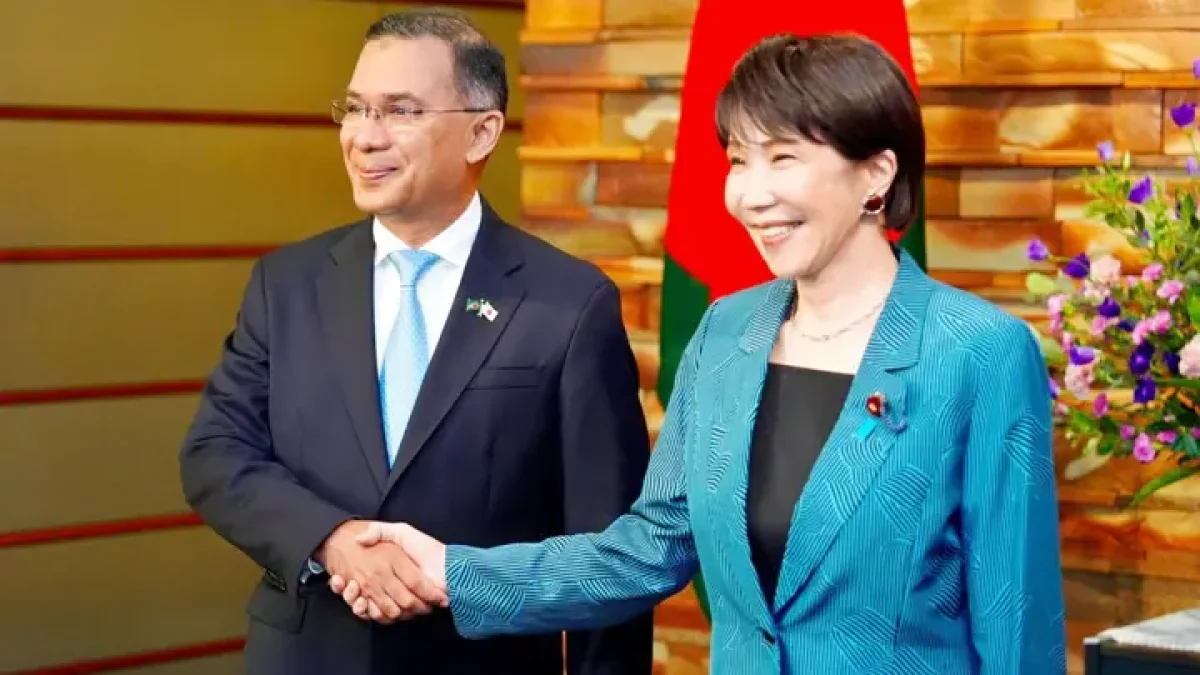
A bilateral summit between Prime Minister Tarique Rahman and Japanese Prime Minister Sanae Takaichi has stressed strengthening the two countries’ long friendship and widening cooperation on trade and investment, energy security, technology and space research, infrastructure, and regional and international issues.
The summit was held at 11:30am local time on Tuesday at the Kantei, the Japanese prime minister’s office.
The prime minister’s deputy press secretary, Shahadat Swadhin, gave the information.
At the meeting, Tarique Rahman also called on the Japanese government and private sector to engage more actively in Bangladesh’s goals of economic development, technological progress and industrialisation.
Noting that the government is working on plans to make Bangladesh an economic, technology and manufacturing hub, the prime minister said: “Bangladesh could become the world’s ninth-largest consumer economy by 2030, and its gross domestic product (GDP) could pass one trillion US dollars by 2034.”
He added: “Japan has a special place in the hearts of the people of Bangladesh. Japan was among the first countries to recognise Bangladesh after independence in 1971, and has since been one of its most important development partners. Our relationship is built on mutual respect, trust and a shared aspiration for peace, prosperity and stability.”
The prime minister recalled the two visits to Japan by his father, the late President Ziaur Rahman, and the contribution of his mother, former Prime Minister Begum Khaleda Zia, to strengthening Bangladesh-Japan relations. Following in their footsteps, he pledged to take relations to new heights.
Placing special emphasis on Bangladesh’s energy security, he said: “Ensuring reliable and affordable energy supply is essential to sustaining the country’s economic growth.”
He thanked Japan for its long-standing support in this area.
Referring to the recent ¥50 billion emergency support loan under the Partnership for Power Asia initiative to strengthen energy security in Asia, he called for more Japanese investment and participation in liquefied natural gas (LNG) infrastructure, efficient power generation and renewable energy in Bangladesh.
Tarique Rahman proposed a Bangladesh-Japan Tech Park to build a research- and technology-based economy. He stressed connecting Japanese companies, universities and investors with Bangladesh’s talented young people, entrepreneurs and skilled tech workforce, and said the proposed park should prioritise artificial intelligence (AI), cloud computing, robotics and electronics manufacturing.
He also expressed interest in expanding cooperation with Japan’s advanced capabilities in space science, satellite engineering and related technologies.
The prime minister set out plans for modern, integrated transport infrastructure to speed up economic growth.
He spoke of plans for a high-speed rail network linking six major divisional cities and for elevated expressways across the country, and sought Japan’s cooperation in planning, technical support, investment and financing for such large projects.
He said Japan’s long experience in infrastructure development and modern transport could play an important part in fulfilling Bangladesh’s development ambitions.
The meeting also discussed ¥1 trillion ($6.3 billion) of private investment in energy, infrastructure and ICT, and the prompt dispatch of a Japanese team to Bangladesh to carry the plan forward.
Welcoming new investment by Japanese businesses in Bangladesh, the prime minister said his government is committed to improving transparency, predictability and efficiency in regulation, tax policy, customs clearance and fund transfers to make the investment climate friendlier.
Hoping for the early entry into force of the Bangladesh-Japan Economic Partnership Agreement, he said both sides must work together to bring its benefits to the people of the two countries.
In discussions on regional and international issues, including the UN, the Indo-Pacific and the Rohingya crisis, Tarique Rahman highlighted the two countries’ shared commitment to multilateralism, international peace and international law.
He thanked Japan for supporting the election of Bangladesh’s foreign minister, Dr Khalilur Rahman, as president of the 81st session of the UN General Assembly.
He said he looked forward to working closely with Japan under that presidency to strengthen multilateral cooperation and tackle global challenges.
Reaffirming a shared vision of a free, open, peaceful and inclusive Indo-Pacific, Tarique Rahman stressed closer cooperation for regional connectivity, the free flow of trade and economic growth.
Expressing deep concern over the worsening situation in Myanmar and the resulting Rohingya displacement crisis, he called for an end to all violence, unhindered humanitarian access and dialogue among all parties.
He praised Japan’s support for Bangladesh’s humanitarian efforts for the Rohingya forcibly displaced from Myanmar’s Rakhine State and sheltering in Bangladesh.
Urging Japan to stay actively engaged with all sides to bring peace and stability to Rakhine, the prime minister said: “The lasting solution to this crisis lies in Myanmar. The voluntary, safe and dignified return of the Rohingya to their homeland must be ensured quickly.”
In his closing remarks, proposing a joint commission and pledging to take relations to new heights, Tarique Rahman said: “While maintaining the historic continuity of Bangladesh-Japan relations, this summit will open a new chapter in our ties, built on deeper trust, broader economic cooperation, stronger investment links and a shared commitment to peace, stability and prosperity.”
He proposed a ministerial-level joint commission to identify the two countries’ priority sectors, speed up implementation and turn opportunities for cooperation into concrete initiatives, and stressed closer contact and cooperation between the two business communities.
The prime minister said the constructive talks had strengthened the shared aspiration for inclusive economic growth and sustainable development. He invited Prime Minister Sanae Takaichi to visit Bangladesh at a mutually convenient time.
Tarique Rahman expressed hope that the friendship between Bangladesh and Japan would grow deeper and wider in future on the basis of mutual trust, cooperation and shared prosperity.
বাংলায় মূল প্রতিবেদন পড়ুন · Read the original Bengali report