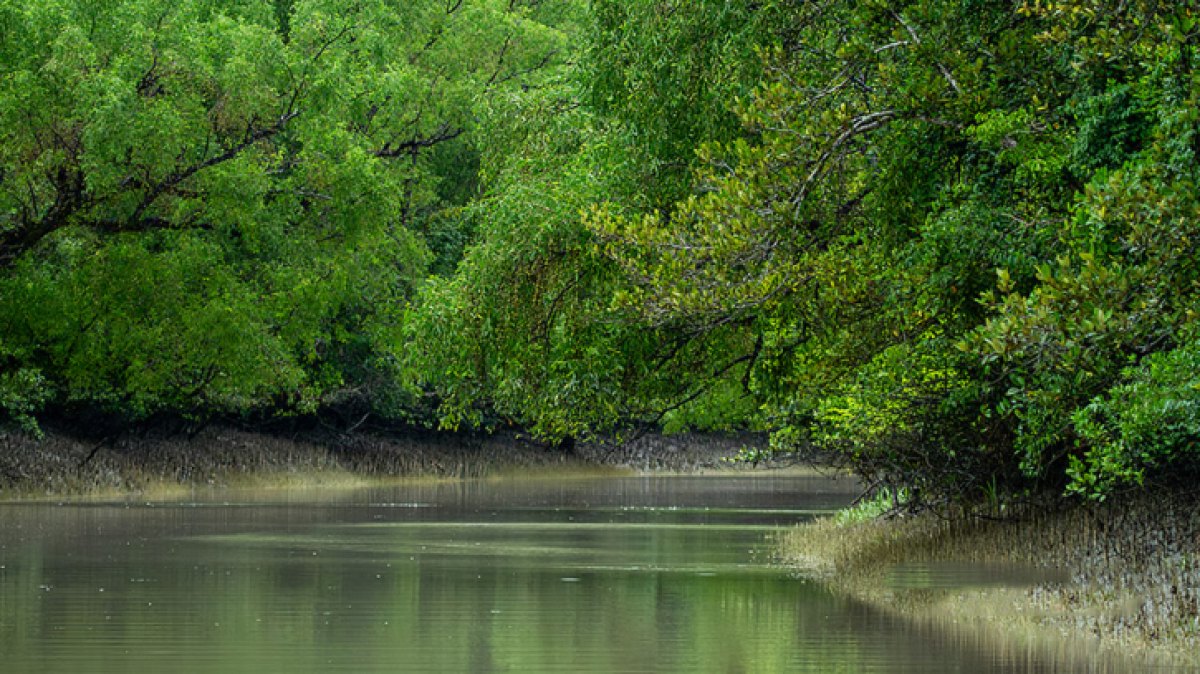
The make-up of the Sundarbans’ vegetation is changing. As freshwater flow falls and salinity rises, the spread of the once-dominant sundari tree is shrinking, while salt-tolerant gewa and goran are becoming more common. A study carried out from 2010 to 2020 found that 52.89 per cent of seedlings in the Sundarbans died over that period, although the seedlings that survived grew considerably. The findings raise new concerns about the forest’s natural regeneration and ecological balance.
The findings come from a study titled “Ecological Influences on Regeneration Dynamics in the Sundarbans, Bangladesh: Exploring Biotic and Abiotic Factors Across Time and Space”. Researchers from the mangrove silviculture division of the Bangladesh Forest Research Institute examined seedlings, saplings and mature trees in zones of different salinity across the Sundarbans. The study found that seedling deaths rose as salinity rose.
Seedling deaths above 82 per cent in saline areas
The study identifies salinity as one of the most important factors in whether seedlings survive. In low-salinity areas, 3.33 per cent of seedlings died. In moderately saline areas the figure rose to 35.65 per cent, and in highly saline areas it reached 82.84 per cent.
Goran seedlings had the highest death rate, at 22.63 per cent, followed by sundari at 19.39 per cent. Kankra and gewa seedlings died at rates of 4.12 and 1.9 per cent respectively. In other words, not all species are coping with salinity in the same way.
The growth of the surviving seedlings, however, is encouraging. Between 2010 and 2020 they grew by 230.31 per cent. Saplings grew by 301.1 per cent in low-salinity areas, 96.39 per cent in moderately saline areas and 232 per cent in highly saline areas. The researchers say the real state of the forest’s regeneration can only be understood by analysing seedling deaths and the growth of surviving trees together.
Sundari and gewa shrink in Chandpai
Another study shows how tree species in the Sundarbans are changing. Titled “Detection of Kankra Tree Expansion in the Northern Sundarbans”, it used satellite images to track changes in tree cover in the Chandpai area of the Khulna range from 1988 to 2022.
According to the study, the area dominated by sundari and gewa in the Chandpai range was 17,032 hectares in 1988. By 2022 it had fallen to 12,022 hectares. Over the same period, the area of dense kankra trees grew from 121 hectares to 2,016 hectares.
Analysis by density also showed kankra spreading. In high-density areas, kankra’s share rose from 0.44 per cent in 1988 to 7.38 per cent in 2022. In medium-density areas it rose from 1.97 per cent to 12.5 per cent, and the kankra-dominated area in this class grew from 539 hectares to 3,418 hectares.
The researchers caution, however, that this change does not represent the whole Sundarbans. The study, led by Mahmudur Rahman of the Bangladesh Space Research and Remote Sensing Organization (SPARRSO), mainly shows changes in a specific area of the Chandpai range. The Chandpai range covers 272 square kilometres of a forest of about 6,000 square kilometres, so data from one area cannot determine how species are changing across the whole forest.
Falling freshwater flow raises the risk
Mominul Islam Nahid, a senior research officer in the mangrove silviculture division of the Bangladesh Forest Research Institute, said gewa has increased somewhat in almost every part of the Sundarbans. Although goran and gewa are more common in saline areas, sundari remains the dominant species in low-salinity areas. The Sundarbans’ natural ecosystem changes over time, he said, but climate change, sea-level rise and falling freshwater flow are changing the conditions different tree species need to survive. When freshwater from upstream cannot reach the forest, salt water moves further in. That favours salt-tolerant trees and puts species that depend on less saline water under stress.
Professor Kamruzzaman of the forestry and wood technology discipline at Khulna University said satellite data also show kankra spreading and a long-term decline in sundari. Top-dying disease, in which the tops of sundari trees dry out, is another cause of the species’ losses. In his view, reduced freshwater flow since the Farakka Barrage, fungal attack and an environment that has become unsuitable for the tree may all be contributing to the sundari’s decline.
He said an effort to cut sundari trees affected by top-dying disease was made around 1998-99, and healthy trees were felled along with diseased ones at that time. Although felling is now banned under conservation policy, more research is needed on the potential of replanting and habitat restoration to bring back the sundari.
Human pressure on top of natural change
Professor AKM Saiful Islam of the Institute of Water and Flood Management at the Bangladesh University of Engineering and Technology (BUET) said salinity in the Sundarbans is rising through both natural and man-made processes. Freshwater flow is falling because of sea-level rise, melting glaciers and ice, withdrawal of water upstream through dams and barrages, and obstruction of rivers’ natural flow. Silting of riverbeds is making the situation more complex.
In his view, tree species that depend on fresh water could gradually disappear. Accidents such as the sinking of oil tankers and coal-carrying vessels have added further human pressure on the Sundarbans.
Protecting the Sundarbans needs the natural flow of water
The research and the experts make clear that the change in the Sundarbans is not only about tree species being replaced; it is tied to water flow, salinity, climate change and human activity. The spread of gewa and goran as sundari declines is one aspect of the forest adapting, but it cannot be taken as proof of overall ecological health.
SPARRSO researcher Mahmudur Rahman said it is essential to let the Sundarbans’ natural ecosystem run its own course and to maintain the flow of water as before. Rather than trying to manage the forest artificially, there should be regular monitoring of whether freshwater is arriving from upstream, what changes are occurring in river flow and what other factors are shifting the balance of tree species.
The Bangladesh part of the Sundarbans extends across Khulna, Bagerhat and Satkhira districts and covers about 6,017 square kilometres. Sundari, gewa, goran, passur, dhundul, baen, kankra, keora and many other species make up the forest’s biodiversity. Their survival depends on how far the conditions they need are maintained.
বাংলায় মূল প্রতিবেদন পড়ুন · Read the original Bengali report