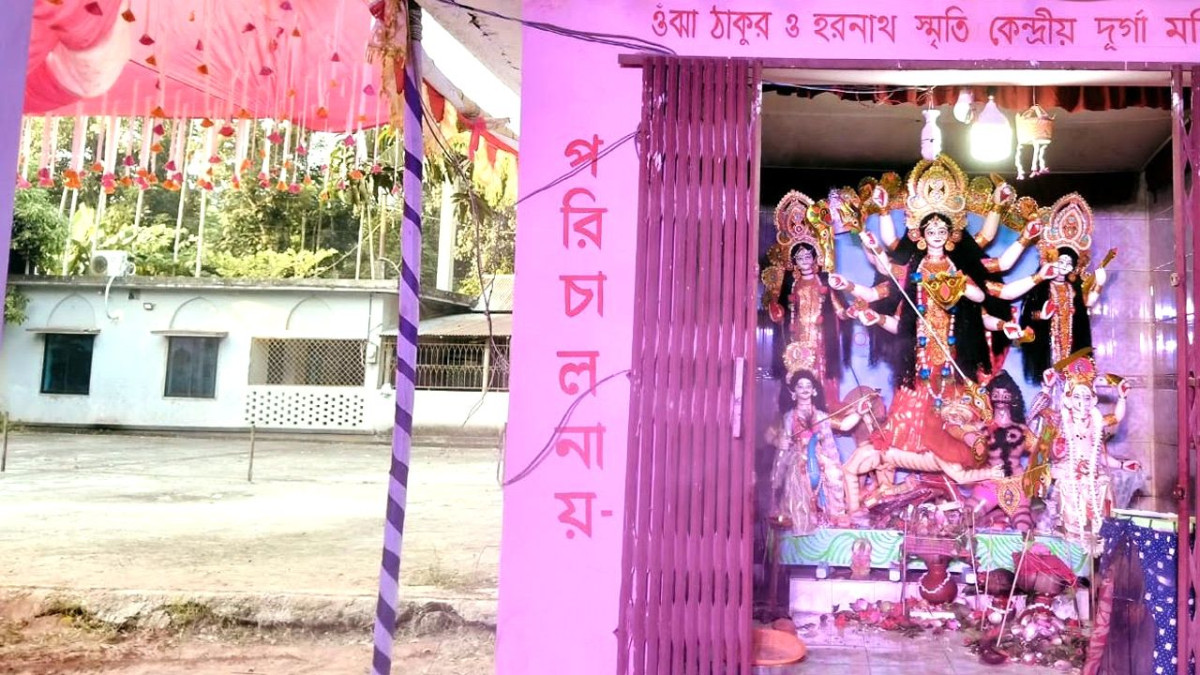
In the Chowdhury Bari area of Nagarpur upazila in Tangail, local Muslims and Hindus have practised their faiths for 64 years at a mosque and a temple that share the same courtyard.
For many years, followers of the two religions have practised their own faiths bound by harmony and brotherhood, without any communal riot or violence. By helping each other worship, they have set a rare example for the whole country.
The Ojha Thakur and Haranath Smriti Central Durga Temple was founded at Chowdhury Bari in the Bengali year 1339 (1932/1933) by Sri Paresh Chandra and Shailesh Chandra Das. Since then, the area’s Hindus have celebrated Durga Puja there with festivity every year.
After the temple was founded, the Nagarpur Chowdhury Bari Central Jame Mosque was built in 1962 on the other side of its courtyard, to the west. With the mosque on the western part of the same ground and the temple on the eastern part, there has never been any religious dispute or communal violence among local people.
On a visit to the puja pavilion at the temple, worship was under way, with ululation and the beating of dhak drums, and visitors crowded in to see the idol. Before the call to prayer, it was announced that the puja would resume after the azan and prayers.
As soon as the azan began at the set time, the drums, cymbals, microphones and loudspeakers fell silent. After the azan, worshippers came to the mosque to pray. Some time after prayers ended, the temple’s drums, cymbals and music started again.
In this way the sound of conch shells and drums stops at the start of each call to prayer and stays silent until prayers are over. In the same way, when Hindus are at worship, the Muslims refrain entirely from any religious activity other than prayer.
Visitors who come to see the idol mostly gather in the mosque courtyard. Fasting, prayer and puja are all observed by followers of the two faiths in the same courtyard. For generations, the area’s Hindus and Muslims have stood shoulder to shoulder to protect each other’s mosque and temple.
Far from any violence, there has never even been an argument here. Followers of both faiths are determined to keep this harmony and brotherhood alive for centuries to come.
Worshippers at the mosque said people in the area are very peaceable, and there has never been any conflict between the two communities over religious practice. Muslims give them every help, and they in turn pause the puja during the azan and prayers. Nobody has to be told to do it, they said.
Devotees visiting the temple pavilion said the temple is named the Nagarpur Chowdhury Bari Ojha Thakur Central Durga Temple. After it was founded, devout local Muslims built the Nagarpur Chowdhury Bari Central Jame Mosque right beside it, and since then the mosque and temple have functioned side by side without any trouble over worship. They hope the harmony will last for generations.
Shib Shankar Sutradhar, president of the puja celebration committee, said Durga Puja was being celebrated at 139 pavilions in 12 unions of Nagarpur upazila this year. “Hindus and Muslims in this area have worked shoulder to shoulder for generations to protect each other’s mosque and temple,” he said.
Mufti Humayun Kabir, the mosque’s imam and khatib, said the drums and puja stop before the azan is given at the mosque. “Then you could not tell that puja was going on here a moment ago,” he said. A temple beside a mosque in the same courtyard has set an example in Bangladesh, he said, and there has been no communal violence here to date.
বাংলায় মূল প্রতিবেদন পড়ুন · Read the original Bengali report