From the vast heavens and earth, the moon and sun, rivers and seas to the tiniest insects, the creation and life cycle of everything holds the great design of a supremely skilled Creator. In the Holy Quran, Allah, Lord of the worlds, declares: “We did not create the heaven and the earth and all that is between them in vain; that is the assumption of those who disbelieve. So woe to the disbelievers from the Fire” (Sad 38:27). He has also made known that He made all creation on earth subservient (taskhir) chiefly for the service and good of humankind.
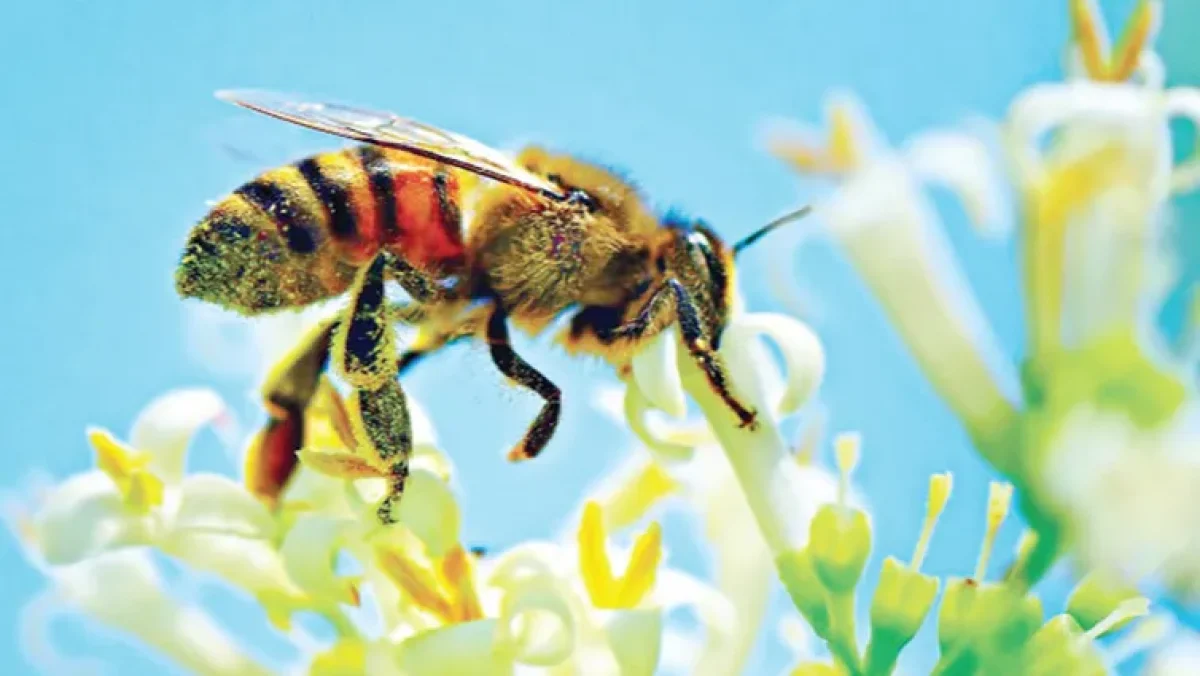
The most living and astonishing sign of this eternal truth of nature, and of this divine subjection, is a tiny insect: the honeybee. The bee’s flawless way of life, its social order and the way it makes honey carry an important message for people. The 16th surah of the Holy Quran is named An-Nahl, which literally means “the bee”. In its verses 68 and 69, Allah sets out the mystery of the bee’s creation: “And your Lord inspired the bee: take for yourself dwellings in the mountains, in the trees and in what people build. Then eat from all the fruits and follow the ways of your Lord made easy…”
The word used here, ilham, inspiration or prompting, means innate instinct. Allah has placed in the bee an automatic knowledge of geometry and engineering that lets it build combs of perfect six-sided wax cells with no schooling. Bees fly miles away and still find their way back to their own comb, because Allah has made their paths easy and smooth for them.
Verse 69 of Surah An-Nahl says that from the bee’s belly comes a drink (honey) of varying colours, in which there is healing (shifa) for people. Honey differs in colour because nectar and pollen differ. Modern medicine and chemical research have shown that honey contains natural antioxidants, antibacterial substances and energy-giving glucose and fructose, which play a unique part in strengthening people’s immunity. The Quran does not call honey a healing for the bee; it says “in it is healing for people” (fihi shifa’un linnas), which shows the whole process is chiefly in the service of humankind.
Watching the bee’s way of life fills one with wonder. By the rules of biology, every creature spends only as much energy and labour as it needs to survive and reproduce. The bee is a great exception. A worker bee makes only a twelfth of a teaspoon of honey in its whole life. To make just one pound of honey, bees must visit about 2 million flowers and fly about 55,000 miles. Most of the honey made by this gruelling toil is not used by the bees themselves; people collect it from the comb. Though bees store this food for winter, Allah has given their instinct such abundance and foresight that they make many times more honey than they need, and leave it for people rather than consuming it all. This trait, the writer argues, shows that their programming is not self-made: Allah has set in them, in the background, a software or instinct (ilham) that unconsciously serves humankind.
Some may think bees make honey only for people. But the scientific truth is that bees store this food mainly for winter or bad weather, when there are no flowers in nature.
Allah has given the bee a foresight and an instinct to store that many animals lack. Bees know how to build perfect geometric wax cells and keep honey in them for years. Remarkably, they make so much more honey than they need that even after people cut honey from the comb, enough is left for the colony to survive. Such a perfect balance in nature, the writer says, is impossible without the Creator’s prior plan.
There is no disorder in a beehive. The queen, the drones and the workers each have a fixed role.
Worker bees toil without rest until they die in flight, their wings worn out or exhausted. They do not think of their own comfort or pleasure but give their lives for the good of the whole hive and of future generations.
This perfect discipline is called eusociality in scientific terms. Who gave such complex social intelligence to the head of this tiny insect? The Holy Quran answers that their Lord inspired them with it.
Their “robotic” discipline and self-sacrifice, the writer argues, show that they are not the product of blind evolution but run under the flawless plan of a great Creator: divine engineering.
The bee’s way of life is a great slap in the face to human pride and selfishness. Allah made humankind ashraf al-makhluqat, the best of creation. Yet a tiny bee rises above its own interest to keep the plant world alive (through pollination) and humankind (through honey).
Through this, Allah teaches people two things:
1. A truly successful life is one that serves others.
2. The intelligence and ability Allah has given should not lie idle but be used tirelessly, like the bee.
Without knowing it, the bee works as a great host of Allah. It makes honey, stores it, leaves it for people and departs this world. This cannot be blind evolution or coincidence, the writer says; it is the flawless engineering of the all-skilled, all-knowing Allah, which constantly calls people to bow before Him.
The root reason why this vast arrangement of the universe, the bee’s honey and livestock have been put to the service of humankind is that Allah has given humans a unique dignity and honour (takrim) as the best of creation. In verse 70 of Surah Al-Isra, Allah declares: “We have certainly honoured the children of Adam…”
Humans were sent to earth with the finest form, free will, and as khalifa, Allah’s representative. Because of this dignity, the world has been arranged for them like a perfect heavenly garden, with the moon, sun, wind and fruits.
One of the main purposes of the intellectual excellence and talent Allah has given humans is to reflect on and study His creation, which the Quran calls tafakkur. Verses 190 and 191 of Surah Al Imran call on people of understanding to reflect on the alternation of night and day and the creation of the heavens and the earth.
When people study the bee’s small life, its discipline and the scientific mystery of how pollination keeps the world’s food chain going, their faith becomes firm, unshakeable and grounded in science. The Quran declares that those who do not use their minds to seek the truth are worse than animals.
Learning from the bee’s selfless service, people should put their talent and intellect to work for the good of humankind. Two main forces drive a believer’s service to society:
The pleasure of Allah (rida-e-Ilahi): serving people for the Creator’s pleasure alone, with no hope of name, fame or renown. According to a hadith qudsi, serving a sick or hungry person is serving Allah Himself.
Sadaqa jariya (lasting charity): when a person dies their record of deeds closes, but the reward of lasting charity continues. When someone uses their talent and scientific thinking to leave behind a new discovery, such as a life-saving medicine or a beneficial technology that helps generation after generation, its reward keeps reaching them in the grave after death.
Conclusion
Looking at the inevitable law of old age and death in Surah An-Nahl (verse 70), it is clear that this worldly life is very short. In this brief life, humans have taken on their shoulders the “great trust” of God-given free will and talent that the heavens and earth refused in fear. So if a tiny bee can rise above its own interest to keep the world’s plants and humankind alive with its honey, the responsibility of humans, as the best of creation, is far greater. People should give up pride and selfishness, use their talent and intellect to study Allah’s creation, and devote themselves to the good of humankind purely for Allah’s pleasure, to achieve final success in this world and the hereafter.
বাংলায় মূল প্রতিবেদন পড়ুন · Read the original Bengali report