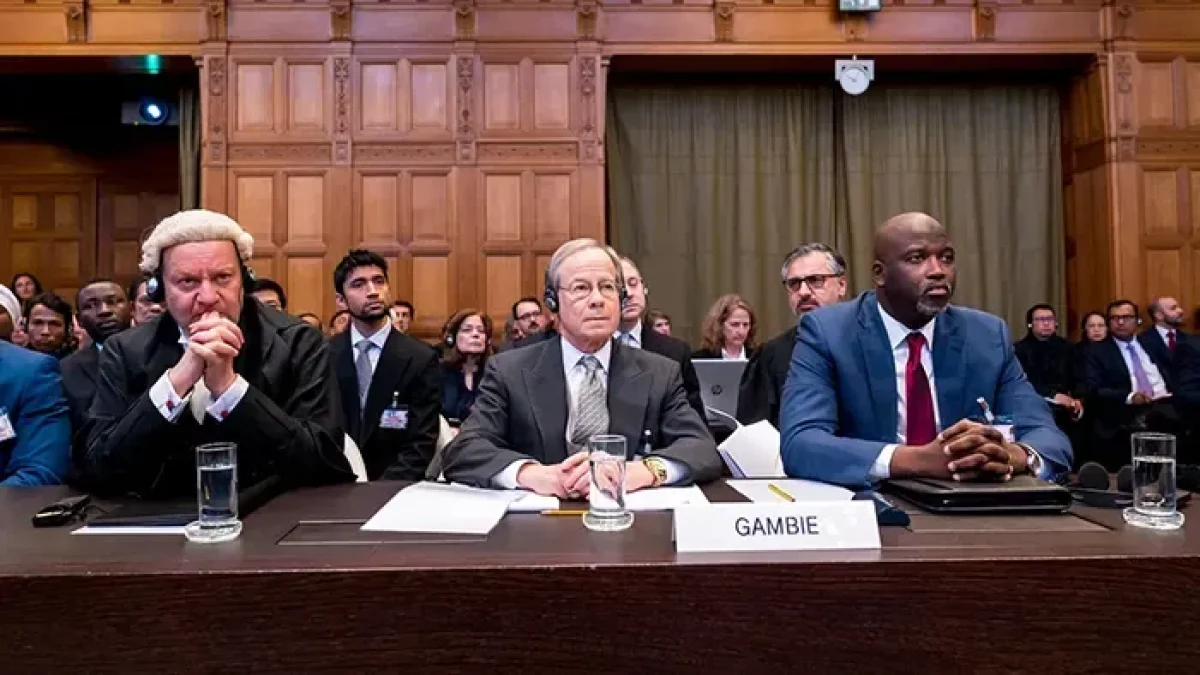
The Gambia has brought a case against Myanmar at the International Court of Justice (ICJ) over the Rohingya genocide, and a ruling is near. The court in The Hague, in the Netherlands, may deliver its verdict within the next few weeks. The ruling could change how genocide is defined around the world.
In an analysis, Middle East Eye said the ruling would not only give judicial recognition to the long persecution of the Rohingya but would also have far-reaching effects on how “genocide” is defined in international law and on South Africa’s ongoing case against Israel over Gaza. In 2017, more than 700,000 Rohingya fled to Bangladesh in the face of a brutal military campaign in Myanmar’s Rakhine state.
About 1.2 million Rohingya refugees now live in camps in Cox’s Bazar. The Gambia, a West African country, filed the case against Myanmar at the ICJ in November 2019 with the support of the Organisation of Islamic Cooperation (OIC). If the court finds Myanmar guilty, it will be the first ruling in the ICJ’s history that a state directly committed genocide.
Antonia Mulvey, executive director of Legal Action Worldwide, which represents Rohingya witnesses, said the World Court’s ruling was very important for the refugees in Cox’s Bazar. A survey by the organisation found that 86 per cent of Rohingya believe that real justice for them means regaining full citizenship in Myanmar and securing the right to be identified as Rohingya.
They want more than financial compensation or punishment of those responsible; they want the root of the problem removed. They are demanding repeal of the disputed 1982 citizenship law, the return of their homes and land, and a guarantee of safe repatriation with full citizenship rights.
During hearings in January this year, three Rohingya eyewitnesses appeared before the court in The Hague and testified. They gave harrowing accounts of relatives being killed, of mass rape and of homes being burned. The hearings heard that soldiers singled out Rohingya women of childbearing age and gang-raped them.
Lawyers for The Gambia argued that the indiscriminate persecution of at least 800,000 people, the killing of children and the shooting of people in the back as they fled could not have been an ordinary operation. It was, they said, clearly a planned intent to destroy an entire people.
Myanmar’s main defence was that it had only carried out a “counter-terrorism operation” against the separatist Arakan Rohingya Salvation Army (ARSA). In reply, the lawyers told the court that burning women and children to death or razing homes could not be lawful on the pretext of a counter-terrorism operation.
At one point Myanmar even claimed it had not sought to destroy the Rohingya but to drive them out of the country. Experts say, however, that expelling people through indiscriminate killing is also part of genocide. Western countries including Britain, Canada, France and Germany have also set out positions at the ICJ supporting The Gambia’s arguments.
Michael Becker, a professor of international law at Trinity College Dublin, said the coming ICJ ruling could reshape international genocide law. In particular, it would set a precedent on how genocide can be proved when it takes place under cover of a counter-terrorism operation.
In the war in Gaza, Israel has made a similar argument: that it is fighting Hamas, not destroying civilians. So if the ICJ rejects Myanmar’s “counter-terrorism” defence and gives a final ruling of genocide, it would put Tel Aviv under heavy legal pressure in the case South Africa has brought against Israel at the ICJ.
Although ICJ rulings are final and binding, the court has no power or police force of its own to enforce them directly. If a country refuses to comply, the matter goes to the UN Security Council, where Russia and China could use their veto in Myanmar’s favour.
Analysts believe, however, that even outside the Security Council the ruling would greatly increase global economic and diplomatic pressure on Myanmar’s junta. To avoid isolation on the world stage, any future Burmese government would have to take responsibility for complying with the court’s ruling.
বাংলায় মূল প্রতিবেদন পড়ুন · Read the original Bengali report